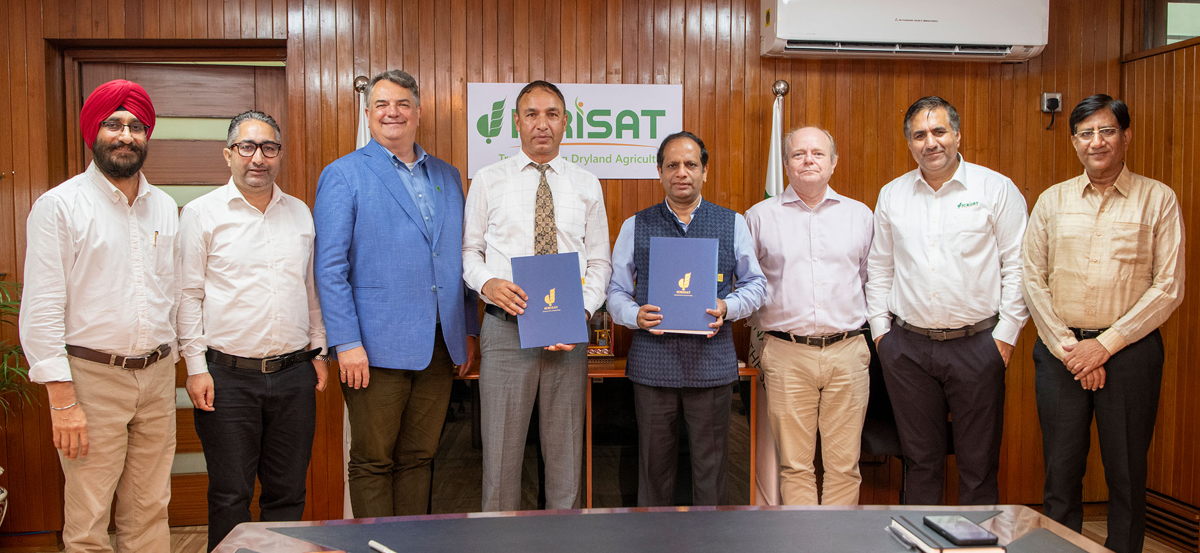
The Sher-e-Kashmir University of Agricultural Sciences and Technology of Kashmir (SKUAST-K) and the International Crops Research Institute for the Semi-Arid Tropics (ICRISAT), Hyderabad, have entered into a formal partnership to strengthen climate resilient agriculture in the Himalayan region. A Memorandum of Understanding (MoU) was signed between the two institutions, aiming to address growing agricultural challenges in Jammu and Kashmir posed by climate variability and ecological fragility.
The MoU was signed at ICRISAT’s headquarters in Hyderabad by Dr Himanshu Pathak, Director General of ICRISAT, and Prof Nazir Ahmad Ganai, Vice Chancellor of SKUAST-K. The agreement lays the groundwork for a long term institutional collaboration focused on research, academic exchange, and grassroots impact in climate smart agriculture.
Strategic Alignment with Regional Realities
This collaboration brings together ICRISAT’s global scientific capabilities and SKUAST-K’s deep regional expertise in the unique agro-climatic conditions of Jammu and Kashmir. The partnership is designed to address the specific needs of the Himalayan agricultural landscape, which is increasingly exposed to erratic weather patterns, soil degradation, and the vulnerability of traditional farming systems.
Dr Himanshu Pathak highlighted the rationale behind the partnership, describing it as a step towards aligning scientific research with region specific needs.
“This partnership with SKUAST-K, an institution deeply rooted in the unique agro climatic realities of Jammu and Kashmir, reflects our shared commitment to creating sustainable agricultural solutions. Our collaboration will empower farmers through innovative, science backed interventions that enhance resilience, productivity, and food security in the region.”
Academic Exchange and Joint Research Initiatives
A major component of the agreement is the facilitation of academic exchange programs between the two institutions. These include mutual visits and collaborative engagements involving faculty, students and researchers. By opening channels for academic interaction, the institutions aim to build technical knowledge and research capacity that aligns with both local challenges and global agricultural science standards.
Prof Nazir Ahmad Ganai emphasized the importance of this academic integration. “Collaborating with ICRISAT will open exciting avenues for our faculty and students to engage in advanced research, particularly in climate resilient practices that are vital for the sustainability of farming in J&K,” he stated. He noted that this MoU represents an important step in enhancing SKUAST-K’s access to advanced agricultural science and extending that knowledge to the region’s farming communities.
Development of Climate Resilient Crops and Technologies
The agreement outlines a research agenda focused on developing and deploying climate-resilient crop varieties and sustainable farming technologies. The collaboration will give special attention to water management, soil health, and innovative farming practices suited to the diverse agro-ecological zones within Jammu and Kashmir.
Both institutions will jointly undertake research to identify crop varieties that can withstand the climatic stresses prevalent in the region. The co-development of technologies will be informed by both scientific data and field-level insights. These efforts are expected to enhance the adaptive capacity of local agriculture and support more stable and sustainable production systems.
Capacity Building for Farmers, Researchers, and Extension Personnel
Beyond research and development, the MoU places strong emphasis on capacity building through structured knowledge dissemination. The two institutions plan to co-organize workshops, training programs, and seminars targeted at researchers, extension workers, and farmers. These initiatives will serve to translate research findings into practical solutions that can be implemented at the community level.
The training modules will be designed to equip participants with practical tools and skills in climate smart agriculture. These will include best practices in sustainable water use, soil conservation, crop management under changing climatic conditions, and use of appropriate agri technologies.
Shared Infrastructure and Resource Exchange
To support this integrated approach, the agreement includes provisions for shared access to research infrastructure. Both SKUAST-K and ICRISAT will make their laboratories, germplasm banks, and research facilities available to one another for joint projects. This resource sharing model is intended to foster efficiency, reduce redundancy, and accelerate the pace of innovation and implementation.
The pooling of scientific infrastructure will also enable multi location trials and cross-institutional validation of research outputs, ensuring that solutions developed are robust, scalable, and locally relevant.
Also read: INTERVIEW | Vijay Singh on How Shunya Agritech is Rethinking Livestock Nutrition
Addressing Regional Agricultural Challenges
The collaboration is being launched at a critical juncture, as Jammu and Kashmir’s agriculture faces rising threats from climate-induced disruptions. Increasingly unpredictable weather, declining soil productivity, and the limitations of traditional farming models have placed stress on local livelihoods. The ICRISAT-SKUAST-K partnership seeks to provide practical responses to these issues by merging global scientific research with the localized knowledge and outreach capacity of a regional agricultural university.
Officials from both institutions noted that the agreement aligns with broader national and international efforts to mitigate the effects of climate change on agriculture. By developing region-specific solutions and ensuring their adoption at scale, the initiative hopes to contribute to both local food security and environmental sustainability.
Bridging Research and Grassroots Implementation
A key objective of the partnership is to close the gap between research and its real world application. The joint programs will be designed not just to produce academic outputs, but to create tangible improvements in farming outcomes on the ground. This includes reducing the vulnerability of smallholder farmers, improving resource use efficiency, and fostering more sustainable agricultural systems in fragile mountain ecosystems.
By combining international expertise with local knowledge systems, the ICRISAT-SKUAST-K agreement seeks to serve as a model for collaborative agricultural development in regions facing climate adversity. The long term vision is to create an ecosystem where scientific advancements are directly linked to community level improvements in resilience, productivity, and livelihood outcomes.
As climate challenges intensify across agrarian landscapes, particularly in ecologically sensitive zones like Jammu and Kashmir, the collaboration between ICRISAT and SKUAST-K positions both institutions to play a critical role in the evolution of sustainable agriculture in the region. The partnership reflects a strategic move toward integrated, research-led development that acknowledges the complexity of climate adaptation in farming and the need for coordinated, science-based interventions.