
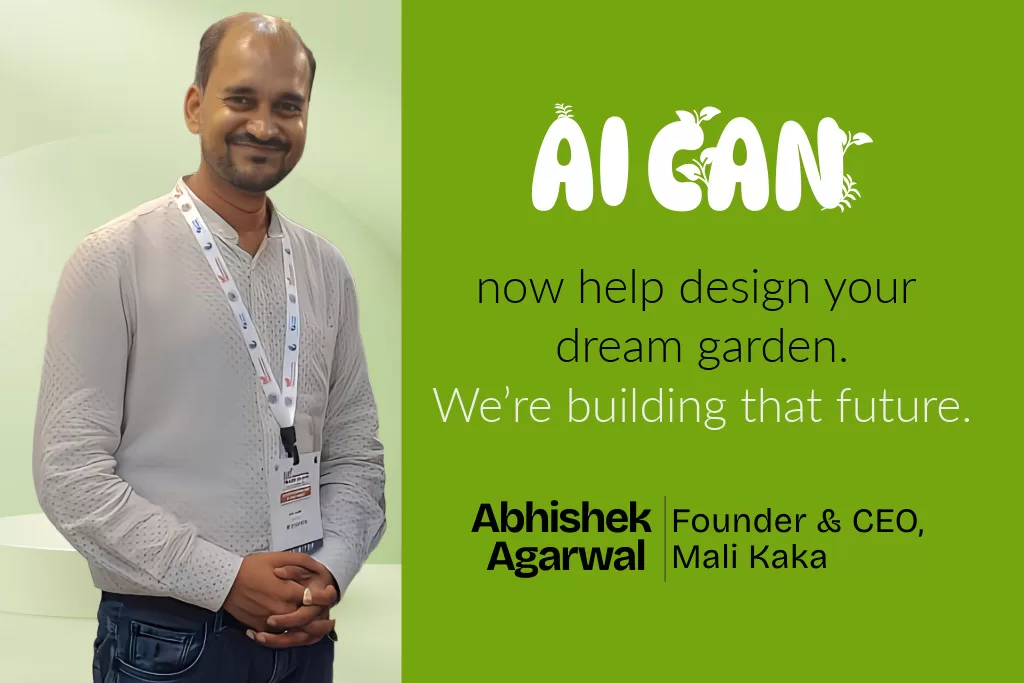
In an era of rapid urbanization and environmental strain, green spaces are no longer a luxury—they’re a necessity. Yet, while agriculture often dominates the sustainability dialogue, the role of horticulture in restoring ecological balance is frequently overlooked. Stepping into this gap is Mali Kaka, a homegrown startup on a mission to “rebuild nature” one garden, terrace, and vertical wall at a time.
In this exclusive conversation, we speak with Abhishek Agarwal, Founder and CEO of Mali Kaka, whose journey blends passion, perseverance, and a deep-rooted connection to nature. From transforming everyday balconies into breathing sanctuaries to introducing tech-enabled horticulture solutions, the excerpted edited interview sheds light on how this startup is shaping the future of urban greening in India:
Agrotech Space: What inspired you to start Mali Kaka, and how did your personal passion evolve into a mission of rebuilding nature?
The name “Mali Kaka” itself draws from a cultural memory — the friendly neighborhood gardener we all knew growing up. The idea was to evoke emotional familiarity while clearly communicating what the brand is about.
The journey began with the realization that while everyone talks about agriculture, very few discuss horticulture. Pollution, rising temperatures, and shrinking green spaces in Delhi-NCR made it clear that solutions lay in restoring nature, not banning cars or industries. So the focus shifted to managing green spaces and promoting horticulture.
The first project was personal — redesigning the home garden. That led to retailing plants and consulting customers based on where they’d place the plants. Eventually, demand grew for home visits, which evolved into the idea of free design consultancy — helping people imagine and create green spaces without costly design services.
Agrotech Space: What challenges did you face in scaling Mali Kaka, and how did you overcome them?
The biggest challenge for Mali Kaka was shifting public perception. People don’t prioritize landscaping — it’s often seen as decorative rather than essential. Unlike plumbing or lighting, greenery isn’t viewed as a necessity, so getting customers to invest in it was a struggle.
On the institutional side, while applying for startup funding, scalability was a key concern. The answer was in the government’s own vision — as they develop Tier 2 and Tier 3 cities, green infrastructure must be part of the plan. Landscaping and horticulture are essential to any infrastructure expansion. This argument helped secure DPIIT and StartInUP recognition and a government grant.
Agrotech Space: How aware are Indian homeowners about the importance of green spaces, and how do you educate them?
Awareness is still limited. Many people invest in artificial decor — grass, climbers, walls — but overlook the benefits of real plants that purify air and enhance wellbeing.
To bridge this gap, Mali Kaka runs educational initiatives in residential societies. These are not sales pitches but awareness camps. Residents are shown how keeping a few puja plants like Tulsi, aloe vera, or banana, and flowering plants in the balcony can serve both spiritual and environmental purposes. It’s about helping them reconnect with nature in practical ways.

4. How is your horticulture maintenance service different from traditional options?
Traditional services often undercharge for labor and overcharge for unnecessary products. In contrast, the approach here is skill-focused. Unskilled laborers from remote areas are trained into semi-skilled horticulture workers. They’re taught to diagnose plant health, understand diseases, and apply targeted solutions — much like prescribing different medicines for different illnesses. This ensures clients receive genuine service, not sales tactics. The team understands each plant’s unique needs and applies the right care.
5. Are you using any smart technologies or developing mobile-based solutions for landscaping?
Yes, an AI-powered mobile app is in development. Currently, free design consultations are done manually, often with sketches or verbal inputs. The upcoming app of Mali Kaka will allow users to upload photos of their space, answer a few questions about style preferences, and receive personalized design suggestions with estimated budgets.
Users will know upfront what the cost of development might be — including items, labor, and installation — before contacting a professional. If the estimate exceeds their budget, they can still consult for a customized, cost-effective plan.
Also Read: India’s Nutraceutical Landscape Grows Stronger with Scientific Rigor, Traditional Wisdom
Agrotech Space: How is Mali Kaka making its services scalable and accessible in Tier 2 and Tier 3 cities?
We have expanded Mali Kaka’s operations into cities like Ranchi and Patna, with a focus on commercial clients. For example, premium restaurant chain Romeo Lane is now opening in Tier 2 cities, and they’ve partnered for landscaping solutions.
Sales representatives have been deployed locally to scout opportunities and build relationships. For now, homeowner services are limited to Delhi-NCR due to staffing constraints, but expansion to individual clients in smaller cities is part of the long-term vision.

Agrotech Space: What are the key business lessons you’ve learned, and what advice would you give to entrepreneurs in niche sectors like landscaping?
The most important lessons are to stay calm and stay focused. There were times post-COVID when there were no clients, no manpower, and no funds. But giving up wasn’t an option.
The belief was that the landscaping industry itself was on an upward trajectory. If the business could just match the pace of the growing industry, success would come. That’s the advice to any entrepreneur: if your sector is growing, hang in there and catch up with its speed.
Agrotech Space: What are your five-year growth plans, and how do you hope Mali Kaka contributes to urban green living?
The goal is to go global. Right now, India imports a lot of horticulture items — for instance, over 120 varieties of lily bulbs come from Germany. India lacks the infrastructure to produce many premium varieties locally.
The long-term vision is to reverse this dependency and turn India into an exporter of horticulture items. That means building climate-controlled infrastructure and reducing reliance on imports — essentially, creating a horticulture ecosystem that can serve both domestic and international markets.
Agrotech Space: How does India’s horticulture sector compare with global standards?
India is still far behind. For example, in a project bid in Dubai, the local vendor won simply because they had a wider variety of aesthetic, unique plants that clients wanted. Local nurseries in India largely stock the same 20–25 common varieties.
Internationally, landscaping is treated as a serious design discipline. Countries like Israel have even turned vertical gardens into agricultural spaces — something India has yet to achieve. Even sourcing Pinterest-like designs is tough in India because the required items are often unavailable locally.
Agrotech Space: How do you maintain uniqueness in your offerings despite the limitations of the Indian horticulture supply chain?
It’s a challenge, but effort goes into sourcing distinctive products that aren’t available in local nurseries. The aim is for every client to feel their space is uniquely designed — not something they could replicate by visiting a standard nursery.
Although it’s difficult and time-consuming, this commitment to uniqueness sets the business apart. Clients who have previously struggled to find such diversity often recognize the added value once they experience it.


