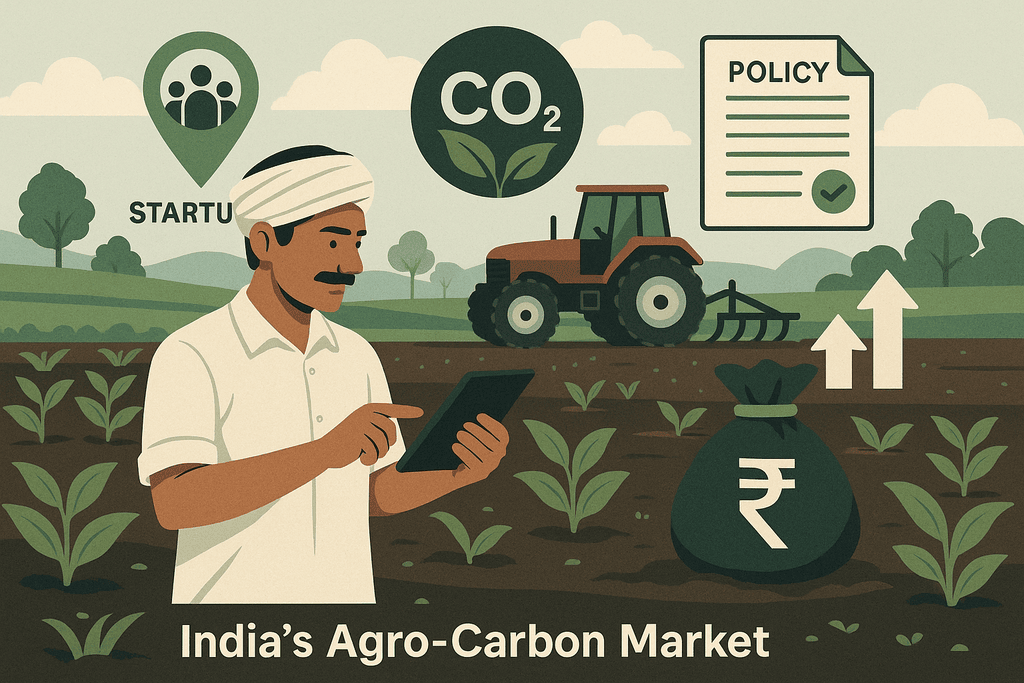
India’s agricultural sector, long central to the country’s economy, is now stepping into a new role — as a key player in the fight against climate change. The emerging agro-carbon market, which rewards practices that store carbon in soils and vegetation, is experiencing rapid growth. This expansion is being driven by increasing corporate climate pledges, a push for sustainable farming, and an evolving policy framework. For India’s farmers and agrotech entrepreneurs, it could mean new revenue streams alongside environmental benefits.
Growing Demand for Carbon Credits
A major factor behind this growth is the surge in demand for carbon credits. Many companies, both Indian and global, are committing to net-zero emissions targets, creating a market for credits to offset unavoidable emissions. Voluntary Carbon Markets (VCM), where companies purchase credits without a regulatory mandate, are expanding and providing an avenue for Indian farmers and startups to monetise sustainable practices.
At the same time, India is preparing to launch its own regulated carbon trading market by 2026. The Carbon Credit Trading Scheme (CCTS), adopted in July 2024, is a rate-based Emissions Trading System (ETS) that initially covers nine energy-intensive industrial sectors. Rather than capping total emissions, it sets benchmark emissions intensity targets, awarding credit certificates to facilities that outperform these benchmarks. While its compliance mechanism focuses on industrial sectors, a parallel voluntary carbon crediting mechanism — covering areas like agriculture, afforestation, and clean cooking — is being developed to channel private investment into climate-positive projects.
This dual approach — regulatory compliance and voluntary participation — is expected to generate strong demand for carbon credits from agriculture and allied sectors.
Startups at the Forefront: From MRV Tools to Agro-Carbon Exchanges
Agrotech startups are at the forefront of making this market accessible and trustworthy. Many are building AI-driven digital MRV (Measurement, Reporting, and Verification) platforms that measure carbon reductions in real time. This technology ensures that carbon credits are backed by transparent, verifiable data.
Others are creating community-based carbon projects, particularly in agroforestry, where farmers integrate trees into farmland to boost biodiversity and store carbon. Startups are also experimenting with carbon credit exchanges — digital marketplaces connecting farmers, project developers, and corporate buyers.
These efforts are being reinforced by national initiatives like Mission LiFE (Lifestyle for Environment), launched to encourage individuals and communities to adopt eco-friendly habits, and the Green Credit Program, which incentivizes activities like tree plantation on degraded forest lands through a market-based system. Together, such programmes help bridge the gap between smallholder farmers and global carbon finance markets.
India’s Natural Advantage: Land, Labour, and Agricultural Diversity
India’s agricultural profile offers several advantages in building a thriving agro-carbon market. Vast tracts of farmland, diverse cropping patterns, and millions of farmers mean significant potential for carbon sequestration. Practices like regenerative agriculture, agroforestry, and biochar application can all store carbon while improving soil health and resilience to climate shocks.
The government’s policy support — from the Energy Conservation (Amendment) Act, 2022, which provides the legal basis for a carbon market, to the National Green Hydrogen Mission — is helping create a cohesive climate action framework. By March 2025, eight crediting methodologies for voluntary carbon credits were approved, including renewable energy, green hydrogen production, industrial energy efficiency, and mangrove afforestation. Such clear standards will make it easier for agricultural projects to be integrated into broader carbon market mechanisms.
The Tools of Transition: Practices That Unlock Carbon Potential
Some of the most promising carbon-sequestering practices in Indian agriculture include:
- Regenerative agriculture: Practices like reduced tillage, crop diversification, and residue management can restore degraded soils and increase their carbon storage capacity.
- Agroforestry: Planting trees alongside crops not only stores carbon but also provides shade, fodder, and additional income streams.
- Biochar: This charcoal-like material, made from agricultural waste, improves soil fertility and locks carbon into the ground for centuries.
- Enhanced rock weathering (ERW): Applying certain minerals to fields accelerates natural carbon capture processes while improving soil quality.
In the voluntary market, agriculture-related carbon projects are expected to gain from India’s broader climate market readiness measures, including the creation of the National Steering Committee for the Indian Carbon Market (NSCICM) and the Bureau of Energy Efficiency’s oversight. These institutions are tasked with setting emissions intensity targets, approving methodologies, and ensuring transparent trading systems — all of which will increase investor confidence in agricultural carbon credits.
Bridging Trust and Access Gaps – Challenges Along the Way
While the market is promising, it faces hurdles. One is the trust deficit — some buyers question the credibility of carbon credits. Digital MRV can help, but wider adoption and third-party verification are essential. Another challenge is the complexity of carbon market rules. With multiple standards and verification systems, navigating the process can be daunting, especially for small-scale farmers. Simplifying procedures and standardising rules will be key.
Inclusivity is another concern. For the agro-carbon market to succeed, it must deliver benefits to smallholder farmers, not just large-scale operations. This requires awareness-building, training, and financial support to help farmers adopt sustainable practices without risking their livelihoods.
Finally, India’s choice of a rate-based ETS rather than an absolute cap-and-trade model reflects a balancing act — reducing emissions intensity while allowing economic growth. This flexibility can help the country remain competitive internationally while transitioning to a low-carbon economy, but it also means agricultural carbon projects must demonstrate clear, measurable climate benefits to attract buyers.

A Climate Ppportunity Rooted in Indian Soil
The convergence of corporate climate commitments, innovative startups, and government policy is setting the stage for India’s agro-carbon market to become a meaningful contributor to both climate mitigation and rural incomes. If implemented well, it could channel climate finance directly to farmers, improve soil and water resilience, and help India meet its net-zero goals.
With domestic and voluntary carbon markets developing in parallel, and initiatives like the Green Credit Program and Mission LiFE embedding sustainability into public consciousness, India is positioning itself not just as a participant but as a shaper of global carbon market norms. For agriculture, this is more than a financial opportunity — it is a chance to align economic and ecological priorities for the decades ahead.