
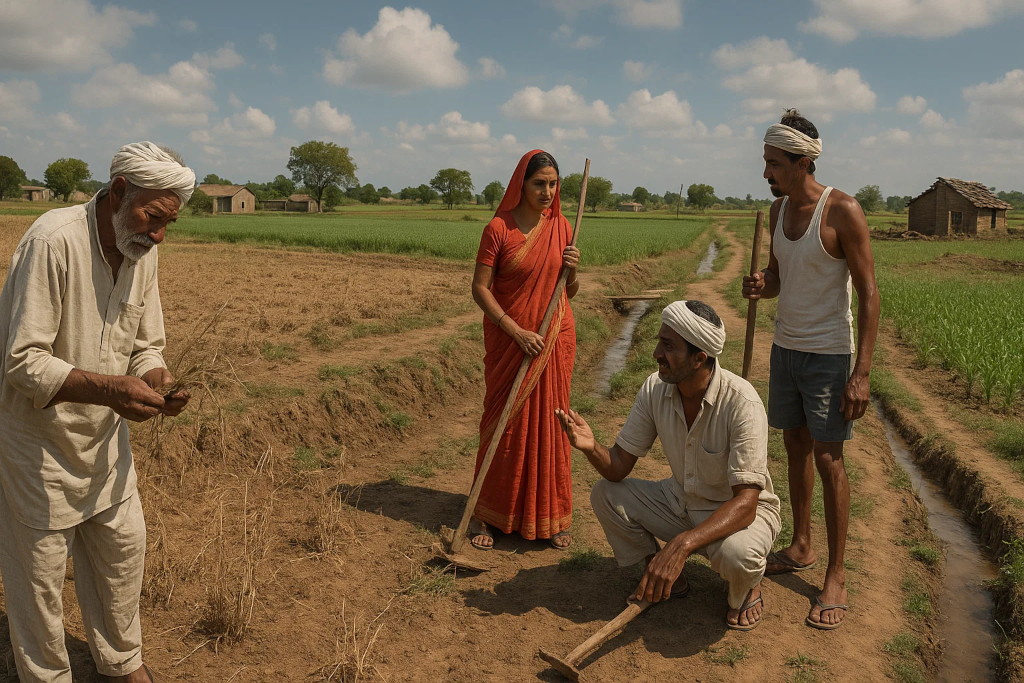
In a recent LinkedIn post, young industrialist Rithik Goyal called to attention top 10 real struggles faced by Indian farmers, discussing urgent need for systematic tech based reforms. The challenges range from small landholdings to mental health problems induced to by stress and debt traps. The post stated that Indian farmers feed 1.4 billion people but the hands that are growing food faced silent battles everyday. The ground reality is rather harsh and limit the ability of Indian farmers to actualize the potential agriculture in India really holds.
Debt, Drought, and Despair for Indian Farmers
The post stated that 85% farmers hold less than two hectares of land, preventing scaling of technology based solutions for a major portion of the farming workforce. Indian farmers remain at the mercy of Monsoon rains with most of irrigation infrastructure remaining broken to enable stability. Extreme weather events compound the distress of Indian farmers, with erratic rainfall patterns, prolonged droughts, and sudden floods increasingly linked to climate change.
At the same time, middlemen continue to capture a large share of profits, while the government’s Minimum Support Price mechanism failing to reach many growers. Rising input costs for fertilizers, quality seeds, and farm labour are further limiting already narrow margins. In absence of affordable institutional credit, reliance on informal moneylenders charging exorbitant interest rates often triggers a cycle of debt, leaving farmers without a safety net in times of crisis.
Post harvest losses continue to remain a big challenge, with inadequate warehousing and underdeveloped cold chain infrastructure causing major portions of produce to rot even before reaching the markets. There is still a big technology gap with mechanization still being a luxury for most, meaning many small land holders continue to receive small productivity gains.
Even with availability of government schemes and subsidies, a lack of outreach and awareness prevents farmers from benefiting. In many cases, stress caused due to challenges like debt and produce loss take a heavy toll on mental health of farmers. These factors have contributed to a high suicide rate among Indian famers and agricultural labourers. In 2022, India recorded 11,290 suicides among people engaged in farming, including 5,207 cultivators and 6,083 agricultural labourers, averaging nearly one death every hour. In the first half of 2025, Maharashtra’s Marathwada region saw 520 farmers suicides, a 20% rise from the previous year.
Also Read: ICRISAT, Odisha Govt Partner to Launch Carbon Farming Initiative
From Community Roots to Market Reform
The post also highlighted the need for immediate measures that need to be taken in order to mitigate challenges faced by the Indian farmers. The post emphasized the need for a bottom-up approach where community involvement and local knowledge in policy development empowers the individual farmers and larger communities. Farmers producer organizations (FPOs) are one such avenue where famers can collaborate to improve their livelihoods. This approach is participatory mechanism for Indian farmers to be involved in decision making and implementation of policies, rather than dictation from central authorities.
Digitization of agriculture is an important pathway for Indian farmers to break out of challenges, that are limiting growth of primary sector in the country. A sustainable solution will require boosting awareness and education among famers while building infrastructure to enable large scale adoption of technology based inputs such as precision agriculture, satellite based weather forecasting, smart irrigation systems, IoT enabled farm sensors, AI-powered pest detection, yield forecasting models, irrigation scheduling tools, and soil moisture sensors.
Ensuring fair prices and timely payments is crucial for safeguarding farmer livelihoods and fostering an environment of trust in the agri-value chain. Indian farmers often face issues like delayed settlements and price deductions due to informal market practices, where middlemen dictate unfair terms. Strengthening mechanisms like institutionalization of transparent e-market platforms, direct procurement, and timely disbursal of Minimum Support Price will reduce payment delays and provide strengthened income security to farmers. Digital payment systems and blockchain-based transaction tracking are also emerging as effective tools to ensure farmers receive the right share for their produce on time, Adoption of large scale mechanisms to ensure fair prices and fast payments will foster financial stability and trust in the marketplace.

