
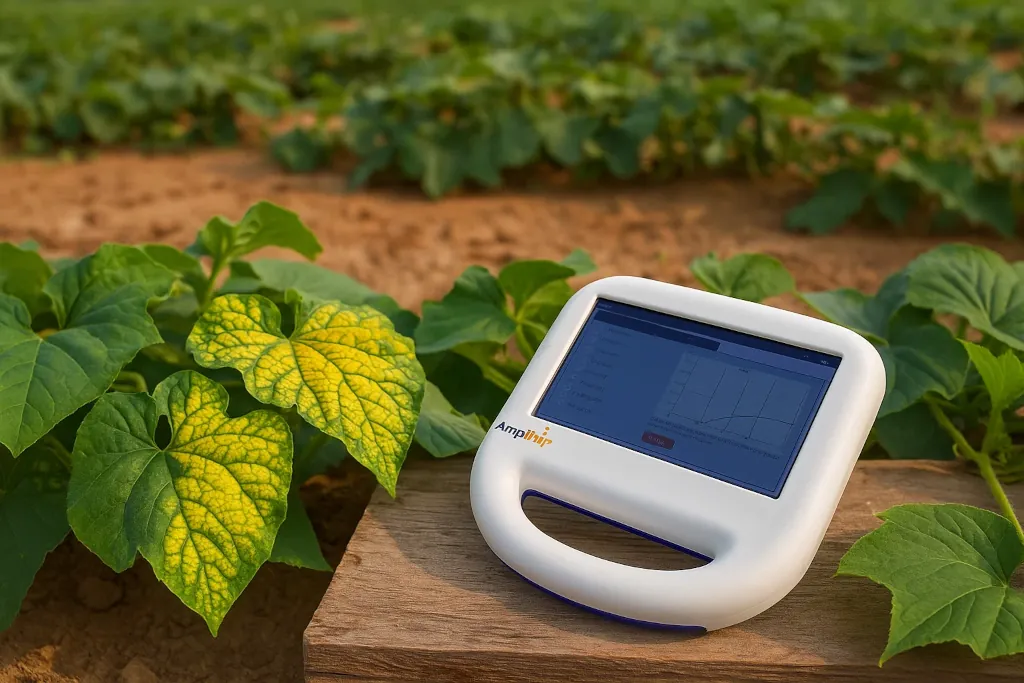
Agdia, a biotech plant diagnostics company, has launched a field-deployable rapid molecular test kit on their AmplifyRP XRT platform for onsite detection of Cucurbit yellow stunting disorder virus (CYSDV).
CYSDV is a plant virus (crinivirus) that affects cucurbit crops such as melons, cucumbers, and squash, causing yellowing, mottling, and stunting. It can result in considerable yield and quality losses.
Agdia is offering this diagnostic solution through its Testing Services laboratory for growers who prefer to submit plant samples. Agdia claims to provide expert guidance on crop screening along with rapid turnaround times for results.
Agdia’s Rapid Molecular Test Validation
According to Agdia, extensive validation studies were conducted to analyze the performance of the new molecular assay developed for CYSDV detection. The company reports a diagnostic specificity of 100%, correctly identifying all 108 true negative samples with no cross-reactivity observed with other pathogens tested.
Also read: Maia Ventures Launches €55M Fund to Back Agrifood Startups
The assay also demonstrated a diagnostic sensitivity of 97.3%, successfully detecting 143 out of 147 positive samples. Additionally, Agdia states that the assay was able to detect all tested CYSDV isolates, including those from the United States, the Middle East, Europe, and Africa, supporting its broad applicability across geographic regions.
The new rapid molecular test for detection of CYSDV in cucurbit crops is based on the AmplifyRP XRT platform, an isothermal RNA amplification and detection system designed for use in field or laboratory settings.The assay (laboratory test) utilizes lyophilized reaction pellets containing all necessary reagents to amplify CYSDV RNA at a constant temperature of 42°C. According to Agdia, unlike conventional PCR (Polymerase Chain Reaction)-based methods, this system does not require nucleic acid extraction, making it a faster and more accessible alternative.
The company states that AmplifyRP XRT enables real-time detection of viral RNA using a fluorometer, such as its battery-operated AmpliFire device. Assay parameters are pre-loaded via barcode, and results are displayed automatically as positive or negative. The total time from sample to result is typically under 30 minutes. The company claims that the platform can offer sensitivity and specificity comparable to established PCR protocols and is easy to use, requiring no prior experience with molecular diagnostics.
CYSDV Spread, Symptoms, and Detection
THE CYSDV also infects common bean, shepherd’s purse, lettuce, alfalfa, wright’s ground cherry, and several other weed species. The virus was first discovered in United Arab Emirates in 1982 on melons. Since then it has been detected across the Mediterranean region, Asia, several African countries, the United States and Mexico.The diseases is transmitted primarily by several species of whiteflies, including silverleaf whitefly and tobacco whitefly. The virus doesn’t spread through handling or seeds, but it can travel long distances in infected plant material.
The virus can cause severe losses in fruit size, yield, and quality (ower sugar content in fruit). Symptoms of the virus often include chlorotic spots, mottling, interveinal chlorosis or yellowing. These symptoms are sometimes nearly indistinguishable from those caused by other viruses such as Cucurbit chlorotic yellows virus (CCYV), Cucurbit aphid-borne yellows virus (CABYV) and certain nutrient deficiencies. Therefore Agdia’s new field-deployable rapid molecular test kit diagnostic confirmation of the causal agent can be a critical component in identifying disease management strategies to combat the CYSDV and vector.
The recent detection of Cucurbit Yellow Stunting Disorder Virus (CYSDV) in multiple crops across India, including cucumber, bitter gourd, and watermelon, highlights the virus’s rapid geographic and host expansion. Confirmed through advanced methods like RT-PCR and whitefly transmission assays, this spread underscores the urgent need for reliable, rapid diagnostic tools.
Devices such as Agdia’s AmplifyRP XRT platform can provide timely and accurate detection of CYSDV in diverse cucurbit hosts, enabling growers and researchers to monitor infections early and implement effective management strategies to limit the virus’s impact.
As per a study, phylogenetic analysis of coat protein gene sequences show that round melon and wild melon isolates from India closely match CYSDV isolates from Mexico, sharing up to 100% amino acid sequence homology with global strains. The virus was also successfully transmitted to healthy cucumber plants via whiteflies in bio-assays.
Such findings emphasize the need for precise and rapid diagnostic tools like Agdia’s AmplifyRP XRT, which can detect CYSDV across different hosts and geographic regions, supporting timely disease management.

