
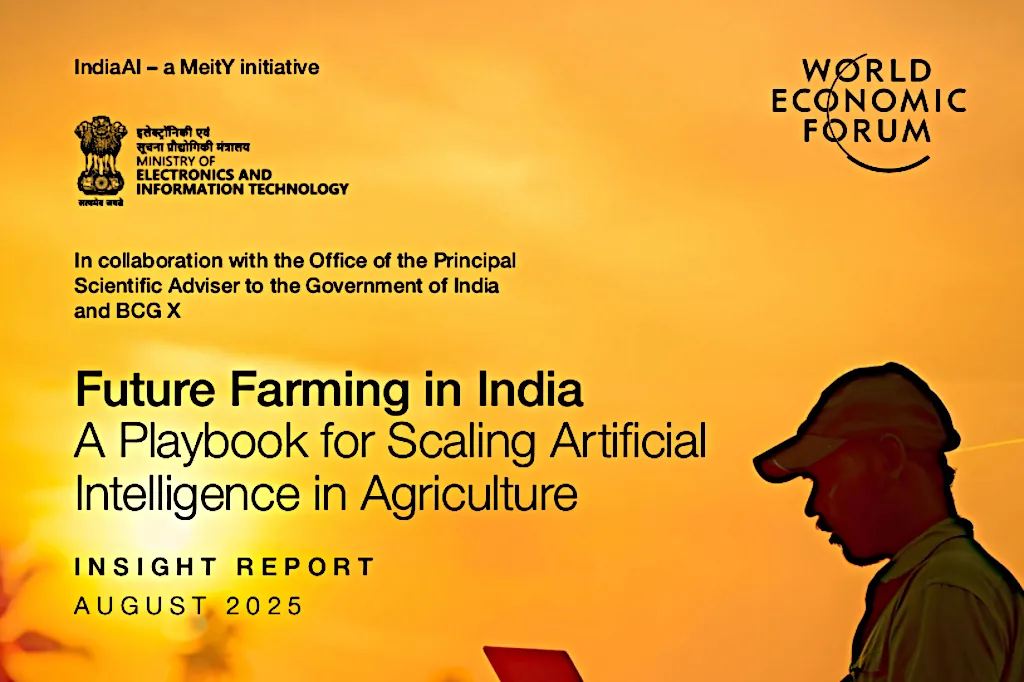
India must take a systems approach to scaling artificial intelligence in agriculture — from soil and seed to market and policy — to unlock higher yields, climate resilience, and equitable prosperity for its millions of smallholder farmers, according to a newly released World Economic Forum (WEF) Playbook.
Titled “Future Farming in India: A Playbook for Scaling Artificial Intelligence in Agriculture,” the report was released in New Delhi by the Office of the Principal Scientific Adviser to the Government of India and the Ministry of Electronics and Information Technology, in collaboration with WEF’s Centre for the Fourth Industrial Revolution (C4IR) India. Developed with support from BCG X, the technology division of Boston Consulting Group, the Playbook outlines a practical strategy to move AI in agriculture from isolated pilots to large-scale adoption through integrated data systems, ecosystem partnerships, and accountable governance.
The document calls for an “inclusive, multi-stakeholder pathway” that enables governments, industry, startups, and farmer networks to work in tandem — ensuring that technological innovation translates into measurable, real-world gains across India’s agri-value chain. It highlights that while agriculture employs more than 42% of India’s workforce, it contributes just 18% to GDP, underlining the urgency for digital transformation backed by AI-driven insights, predictive tools, and localized solutions.
The report addresses the problem of complex agrarian sector of the country. It focuses on how Artificial Intelligence (AI) can be scaled in Indian agriculture, from pilot projects to widespread adoption, especially for small landholders. The report is intended to provide a strategic guidance, including case studies, roadmaps, framework, and steps for large scale integration of AI technology.
It serves as an actionable insight to bridge the gap between AI’s potential and real-world impact for millions of farmers. It aims to introduce a comprehensive strategy for scaling AI to enhance crop yields, mitigate climate and pest risks, and improve market access in the Indian agriculture ecosystem.
The report estimates the average annual income of Indian farming households at around US $1,500, with more than half of farmers burdened by debt. Looking ahead, climate projections suggest that by 2080, crop yields could decline by 10–40%, further compounding stress on already degraded farmland.
Scaling AI-Driven Solutions
According to the report, adoption of AI holds transformative capabilities when it comes to resource allocation, decision making, enabling resilience, and providing yield improvements. The report suggests that pilot use-cases in India have shown improvements, including yields, cost reductions, market access, which remain limited in scale. The report argues adoption of structured approach integrating ecosystem, data, governance, stakeholders, to move from pilots to scaled adoption.
This playbook demonstrates how AI can be seamlessly woven into this transformation – unlocking new efficiencies, better decision-making, and greater prosperity for every farmer.
The report identifies several AI applications across the agri-value chain that can reshape how Indian farming operates. AI-enabled crop planning leverages diverse datasets, covering soil health, weather, markets, and trade flows to guide farmers toward optimal cropping choices, while moving away from the traditional reactive approach based on last season’s prices. Rapid soil-health diagnostics powered by AI and sensor technologies that offer real-time insights, allowing for precise nutrient management and reducing input waste.
Also read: SALIC and Syngenta Partner to Enhance Global AgriFood Security
Similarly, AI-driven pest prediction systems combine satellite imagery and environmental data to detect and mitigate outbreaks early, safeguarding yields and minimising pesticide use. On the market front, AI-enabled digital marketplaces improve price transparency, grading accuracy, and buyer-seller matching, helping farmers access fairer and more efficient trade channels. Collectively, these use cases demonstrate how data-driven intelligence can advance India’s agriculture from intuition-based to insight-led decision-making
Actionable Insights
A white paper on shaping the ‘AI Sandbox’ ecosystem has also been released to facilitate the testing of AI solutions in controlled and monitored environments. It emphasises the need to digitally train the agricultural extension workforce, ensuring that AI solutions effectively reach farmers. The report also highlights the importance of developing practical business models and marketplaces that connect farmers with agritech companies, data providers, input suppliers, and buyers.
I urge all stakeholders to work collectively in implementing these actionable roadmaps for the nation’s growth. The convergence of multiple departments and initiatives reflected in these reports should translate into sustained momentum, and drive the wider adoption of AI across society
Moreover, state and central initiatives such as IndiaAI and AgriStack must be aligned to support AI adoption in agriculture. Precise monitoring of key performance indicators (KPIs), using quantifiable metrics to evaluate outcomes such as advisory reach, input cost reduction, yield improvements, and enhanced price realization, should also be done to ensure accountability, track progress effectively, and guide strategic interventions.
The WEF report encourages the localisation of solutions by adapting them to regional contexts, languages, and cropping systems, as well as to build trust and governance through data privacy, model transparency, rigorous validation, and inclusive design.
WEF”s Three Pillars for Developing the AI Ecosystem
One of the principal recommendations of the WEF report is the establishment of a structured framework termed the Inclusive Multistakeholder Pathway for the Accelerated Convergence of AI Technologies (IMPACT AI) in agriculture. This framework is intended to ensure alignment with public interest, safety, trust, inclusivity, sustainability, and the realization of meaningful impact in the scaling of AI technologies. It underscores that the development of a supportive ecosystem, including data infrastructure, governance mechanisms, multi-stakeholder collaboration, policies, and capacity building is as critical as the adoption of advanced technologies.
Within this model, governments function as ‘enablers’, providing the foundational support through appropriate policies, digital infrastructure, and responsible governance. Industry and startups are tasked with creating ‘scalable’, locally adapted AI solutions through collaboration and rigorous testing. The delivery pillar ensures that these innovations reach farmers through accessible marketplaces and sustained feedback mechanisms, thereby driving practical, measurable impact at the ground level.
Challenges in Ecosystem
Despite the potential of AI in Indian agriculture, the WEF report several systemic barriers that can undermine large-scale adoption. Challenges such as weak data infrastructure, including poor rural connectivity, limited sensor coverage, and fragmented digital platforms, remain a core constraint. The small and scattered nature of landholdings makes deploying AI solutions costlier and less efficient than in regions with consolidated farms.
For many small land holding farmers, affordability of new technologies and subscription based advisory services is another major hurdle. Beyond access there are other issues pertaining to governance, data privacy, and algorithmic transparency that influence farmer trust and willingness to adopt AI-driven recommendations.
Localisation also poses challenges, as models developed in other agro-climatic contexts may not fully reflect India’s diverse soils, cropping systems, and diverse needs. Moreover, ecosystem coordination among government agencies, agribusinesses, startups, and farmer networks is complex, often showcasing slow integration and scaling. Without clear impact metrics, feedback systems, and equitable access, there is also a risk that AI could deepen existing inequalities, only benefiting digitally literate farmers first, while others lag behind.
Scaling AI for Transformative Impact in Indian Agriculture
As Indian agriculture steps into the next era, AI cannot merely be seen as a peripheral tool. Building resilience to climate change, enhancing productivity, and increasing farmer profitability requires the integration of a supportive ecosystem, quality data, robust infrastructure, a clear regulatory framework, and inclusive business models. Connecting farmers to modern market systems also depends on localized solutions, capacity building, trusted services, and measurable outcomes alongside technological advancements.
The three pillar model acts as a call to coordinate and act for stakeholders across government, industry, agriculture extension, agritech startups and farmers. The report provides a roadmap executing transformative actions by highlighting use-cases, building blocks, steps and responsibilities for stakeholders.
As per the WEF report, the potential outcomes of scaling AI in Indian agriculture can deliver higher yields, reduced input costs, greater market access, and more resilient, sustainable livelihoods for millions of farmers. Yet, without inclusive design and strong ecosystem governance, these same technologies could widen existing gaps, remain confined to pilots, or deliver marginal benefits. The true measure of success will lie in ensuring that innovation scales equitably, empowering smallholders as much as large producers while driving systemic gains across the Indian agri-value chain.

