
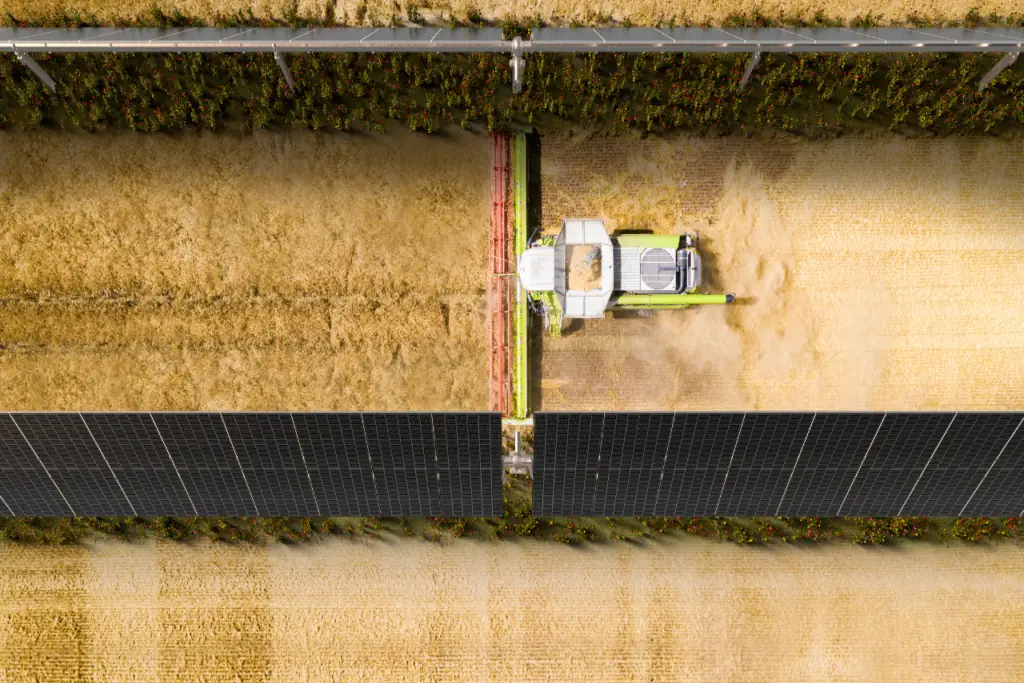
A new report by SolarPower Europe, ‘Leading the Energy Transition: Agrisolar Policy Map,’ aims to provide a comprehensive view of how 18 European Union member states are integrating solar power with agriculture. The report offers more than an overview of solar energy policy, it examines how European Union member states are striving to balance food security, rural livelihoods, and the transition to clean energy.
The Agrisolar Policy Map was officially presented during the Agrivoltaics Industry Forum in Milan, following the European Commission’s acknowledgment of solar PV’s role in its ‘Vision for Agriculture and Food‘ strategy. The European Parliament has also highlighted the importance of Agri-PV in supporting sustainable agriculture and the energy transition.
The report differentiates between Agrisolar and Agri-PV. Agrisolar refers to the broader integration of solar energy into agriculture, including panels on farm buildings, irrigation systems, and power used for cold storage. Agri-PV refers to the use of the same farmland for both solar power generation and agricultural production, creating synergies that improve land-use efficiency and support ecological sustainability.
The report examines the legal definition of Agri-PV, land-use and zoning policies, permitting processes, Environmental Impact Assessment (EIA) requirements, support schemes, and eligibility for Common Agricultural Policy (CAP) direct payments.
Legal Ground for Agri-PV
The assessment examines 18 EU member states, Belgium (Flanders region), Czech Republic, Croatia, Denmark, France, Finland, Germany, Greece, Hungary, Ireland, Italy, Latvia, the Netherlands, Poland, Portugal, Slovenia, Spain, and Sweden.
Of the 18 countries assessed, only five, Czech Republic, Croatia, France, Germany, and Slovenia have established a legal definition for Agri-PV, while Spain is still finalizing one. In countries such as the Netherlands and Hungary, the term appears in pilot project guidelines but lacks formal recognition.
Also read: GAFSP Backs AfDB to Catalyze $200M in Private Agrifood Investment
This legal uncertainty influences project permitting, financing, and classification under agricultural land use rules. Some governments classify elevated Agri-PV structures as non-agricultural, making them ineligible for farm subsidies, while others recognise them as dual-use systems, allowing the land to retain its agricultural status even with solar installations.
In France, EU’s 2024 Acceleration of the Production of Renewable Energies (APER) Law defines Agri-PV based on parameters such as Ground Coverage Ratio (GCR) and allowable land loss, while Germany has adopted a similar description, defining Agri-PV plants as privileged installations under the Federal Building Code, provided they do not harm the land’s agricultural function.
The Agrisolar Policy Map is a vital step in unlocking the full potential of agrisolar. By identifying where Member States are leading or lagging, we can better inform EU-level reforms and empower farmers to harvest the sun twice.”
The study finds that 10 of the 18 countries now permit Agri-PV on farmland, though few have established specific zoning or permitting frameworks. Germany has introduced a simplified process for systems up to 2.5 hectares, allowing construction outside designated zones if agricultural use continues.
France and Italy require stakeholder participation, particularly from farmers, as a condition for project approval, which can extend timelines and cause delays. By contrast, some Eastern European countries do not distinguish between traditional solar farms and dual-use systems, complicating regulatory navigation for developers.
Measures to Protect Farmland
To protect farmland from being quietly converted into energy estates, several European countries are setting technical and agricultural performance standards for Agrisolar projects. The goal is simple, solar panels can share the land, but farming must remain its main purpose.
In France, large scale projects are required to maintain at least 90% of their normal agricultural yield, and any land loss caused by infrastructure, posts, access roads, or shading must stay below 10%. Italy takes a slightly different approach, at least 70% of the site must remain under active cultivation, and solar coverage cannot exceed 40% of total land area. Germany uses a 66% yield retention benchmark, designed to ensure that energy production never overshadows agricultural output.
Monitoring is becoming a key part of this new compliance framework. France’s national energy and environment agency, ADEME, now requires developers to track agricultural yields over time and compare them with nearby control plots, untouched by panels. The data are used to check whether solar installations are genuinely coexisting with crops or quietly displacing them over the years. It’s a practical safeguard against greenwashing, and one that several other member states are beginning to study.
Also read: Farmblox Launches New Security System to Tackle Rising Agricultural Theft
Environmental safeguards, on the other hand, remain patchy and underdeveloped. Only Belgium, Italy, and the Netherlands have formally embedded community participation or farmer ownership models into their Agri-PV frameworks, recognising that social acceptance matters as much as technical performance. In Catalonia, Spain’s most active region on Agrisolar, new projects are even linked to rural job creation targets, making it a rare example of energy policy directly tied to local employment goals.
Only Germany, France, and Czechia have carved out dedicated support schemes, while most countries keep Agri-PV bundled with general solar programmes. In Germany, the new Solarpaket 1 sets aside special auctions for Agri-PV and floating solar, aiming for 800 MW in 2025 and 1,200 MW in 2026. France’s energy regulator, CRE, runs its own dual-track auctions for elevated and interspace systems, capped at 600 MW a year. Czechia is preparing new subsidies under the Modernisation Fund to test pilot projects.
Spain, meanwhile, is tapping into Next Generation EU funds to finance 60 small projects totaling 60 MW, modest in scale but an early signal of intent. Beyond funding, a bigger question about farmers installing solar panels drawing Common Agricultural Policy payments. In Greece, Denmark, and Spain, rules remain undecided, leaving many farmers wary of risking their subsidies for solar gains.
Shaping the Future of Agrisolar
Across the EU, AgriSolar innovation is outpacing policy, creating a fragmented yet dynamic regulatory landscape.
To address policy gaps, SolarPower Europe has recommended defining Agrisolar at the EU level, clarifying CAP eligibility, using Next Generation EU and EIB funds to reduce investment risks, integrating Agrisolar with carbon farming and biodiversity restoration, and creating a CAP eco-scheme to support dual-use and climate-smart practices. The report notes that these measures could accelerate renewable energy deployment, enhance farm resilience, restore degraded soils, and generate new income opportunities for rural communities.
The Policy Heatmap included in the report shows just how heterogenous the policy frameworks are – a patchwork and a work in progress. One aspect I want to stress, is the urgency, with which we have to solve this: Farms and agricultural soils are at the core of Europe’s food and water security.
Taken together, early member states’ regulations defining architecture of EU’s agrisolar governance remain uneven, but increasingly grounded in one shared principle, energy transition cannot come at the cost of agricultural integrity.Each country is approaching that balance differently.
France leans on strict productivity and land-use thresholds, Germany simplifies permits for small dual-use projects, and Italy ties eligibility to how much land remains under cultivation. Others, like Belgium and the Netherlands, are testing farmer-led ownership models, while Catalonia (Spain) links new projects to rural employment.
Agrisolar expansion is a slow and sometimes fragmented process, but one that signals a shift in thinking. Agrisolar is no longer seen only as an energy technology, it is becoming a land use question about how Europe feeds itself, powers itself, and keep its agriculture productive in a changing climate.


