
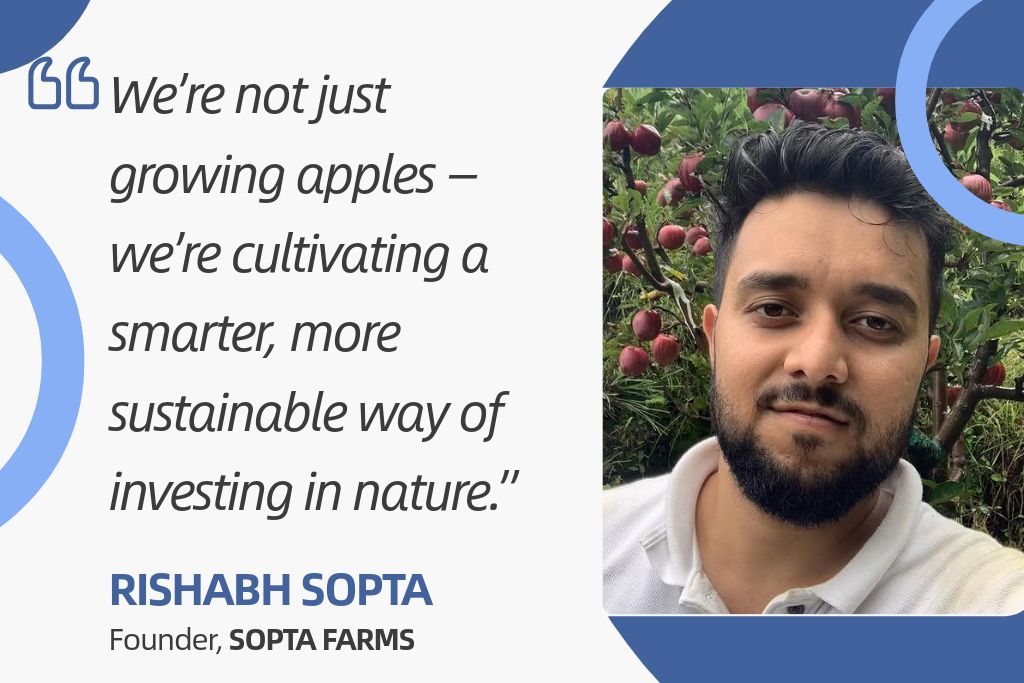
SOPTA Farms is an agribusiness venture that is professionalizing apple cultivation in the Himalayan belt by integrating high-density horticulture, precision agri technology, and investor-grade governance. By converting orchards into structured, income-generating assets under LLP frameworks, the company seeks to align scalable productivity with ecological stewardship and local economic empowerment. Its model pairs scientific plantation methods, rootstock optimisation, precision irrigation, AI-enabled analytics, with experiential investor engagement, including staycations and on-farm visits, to create a transparent and accountable value chain from tree to market.
In this in-depth conversation with Agrotech Space, Rishabh Sopta, founder of SOPTA Farms, reflects on his transition from generational apple grower to architect of a tech-driven, investor-backed horticulture platform, the operational and technological levers behind the company’s 15-18% return thesis, and the sustainability and community frameworks that guide expansion across sensitive mountain ecosystems. Below are edited excerpts from the interview:
Agrotech Space: What inspired you to establish SOPTA Farms, and how did you envision merging high density apple cultivation with an investor backed agribusiness model?
Rishabh Sopta: The inspiration behind SOPTA Farms came from both our family legacy and a deep understanding of how agriculture in India, especially in Himachal, needed to evolve with time. Coming from generations of apple growers, I witnessed firsthand the potential our orchards held, but I also saw the limitations of traditional farming in terms of productivity, technology, and scalability.
I wanted to bridge that gap, to modernize apple cultivation by adopting high-density farming technology, which not only ensures higher yields and better fruit quality but also makes the entire process more structured and commercially viable. At the same time, I realized that agriculture can be a strong investment opportunity, not just a livelihood.
The idea was to create a sustainable agribusiness model where investors could participate in apple farming, owning a part of modern orchards, sharing profits, and experiencing the charm of farming in the mountains.
This is how SOPTA Farms was born, to merge agriculture, investment, and innovation. We’re not just growing apples; we’re building a platform that empowers investors, supports farmers, and promotes sustainable mountain tourism through our luxury staycations, all under one ecosystem.
Agrotech Space: How has your personal connection to the Himalayan region shaped your approach to sustainable orchard development?
Rishabh Sopta: My connection to the Himalayas runs deep, it’s not just where I come from, it’s part of who I am. Growing up among apple orchards taught me to respect the fragile ecosystem of these mountains, and that ethos defines everything we do at SOPTA Farms.
When we began developing high-density orchards, the focus wasn’t only on productivity but on sustainability. We’ve aligned our methods with the rhythm of the Himalayas, using eco-friendly irrigation, minimal chemical inputs, and terrain-sensitive planting practices that protect soil health and biodiversity.
Every decision, from choosing Italian rootstocks to designing orchard layouts, is rooted in preserving the balance of this landscape. We see ourselves as custodians, not just cultivators. For me, true progress in agriculture means nurturing the land so it can sustain generations to come.
Agrotech Space: What inefficiencies in traditional horticulture systems convinced you that technology and structured investment could redefine fruit farming in India?
Rishabh Sopta: Traditional horticulture in India, particularly in regions like Himachal, has long depended on conventional methods that, while rich in heritage, limit productivity and profitability. I observed recurring issues, low yields, inconsistent quality, lack of scientific management, weak post-harvest systems, and minimal financial stability for farmers. Despite their hard work, most growers faced uncertain incomes, and there was no structured bridge connecting agriculture with investment or modern technology.
That realization led to the creation of SOPTA Farms, a model that merges technology with structured investment. Through high-density apple farming, Italian rootstocks, drip irrigation, fertigation, and digital monitoring, we’ve transformed productivity and consistency.
More importantly, by bringing investors into the fold, we’ve introduced capital efficiency, transparency, and scalability to horticulture. SOPTA Farms is redefining fruit farming as a data-driven, profitable, and inclusive ecosystem where technology, growers, and investors thrive together.
Agrotech Space: SOPTA Farms transforms farmland into an investable asset class. Could you break down how this structure works operationally and financially for investors?
Rishabh Sopta: Yes, that’s the essence of our model, SOPTA Farms transforms farmland into a structured, investable asset class that blends agriculture with organized investment. We identify premium land in Himachal ideal for high-density apple cultivation and develop it using Italian rootstocks, drip irrigation, fertigation systems, and protective netting under precision farming techniques. Our in-house team manages everything end-to-end, from soil preparation to harvest, ensuring scientific consistency and predictable results.
Investors participate through ownership or co-ownership of these orchards, funding their development and maintenance. In return, they receive annual returns from apple sales once the trees mature, without having to manage operations. We oversee marketing, logistics, and distribution, turning farming into a passive, income-generating asset, much like real estate or renewable energy, but far more sustainable.
We also integrate luxury staycations and agritourism into select projects, offering investors not just financial returns but a personal connection to the land they own. It’s an asset-backed, experience-led, and impact-driven model designed to make agriculture transparent, profitable, and aspirational for modern investors.
Agrotech Space: Your model promises annual returns of 15-18%. What are the underlying levers, productivity, market linkage, or efficiency, that make such returns sustainable?
Rishabh Sopta: Our projected returns of 15–18% are not aspirational but the result of a structured ecosystem built on productivity, efficiency, and market strength. High-density apple cultivation forms the foundation of this model, delivering up to four times the yield of traditional orchards. By using premium rootstocks, precision irrigation, fertigation systems, and protective infrastructure, we ensure consistent fruit quality and predictable harvests.
Centralized scientific management is equally critical. Every stage, from pruning and pest control to nutrient and harvest planning, is supervised by experts and supported by data analytics. This minimizes inefficiencies, maintains uniformity, and maximizes yield across diverse terrains.
On the market side, we’ve established direct linkages with wholesalers, distributors, and premium retail outlets nationwide. By focusing on graded, export-quality produce and cutting out intermediaries, we achieve better margins and ensure value flows directly to our investors. In essence, our returns are operationally validated, not speculative. Each investment represents a tangible, income-generating orchard managed transparently and sustainably, benefiting both the investor and the local ecosystem.
Agrotech Space: How does the LLP-based ownership structure improve transparency, governance, and investor confidence compared to conventional agribusiness partnerships?
Rishabh Sopta: We adopted the LLP (Limited Liability Partnership) model deliberately as the foundation of transparency, governance, and investor protection at SOPTA Farms. Traditional agribusiness ventures often lack legal clarity, leaving ownership and profit-sharing ambiguous, we wanted to professionalize that system.
Under our LLP framework, each investor becomes a registered partner in a legally recognized entity, with their capital, shareholding, and profit entitlements clearly defined in MCA-registered agreements. This ensures full legal security and financial transparency, every transaction, from land acquisition to profit distribution, is recorded, audited, and accessible.
As Managing Partner, SOPTA Farms oversees operations, compliance, and financial discipline, ensuring that investor capital is managed with professionalism and accountability. Since the LLP structure limits liability to the invested amount, investors’ personal assets remain protected.
In essence, this model gives agriculture a corporate backbone, transforming it into a structured, transparent, and secure asset class where investors don’t just own land, they own a share of a professionally managed, income-generating enterprise.
Agrotech Space: What is the strategic intent behind your “exit plan with guaranteed interest”? Is it primarily risk mitigation or investor lifecycle management?
Rishabh Sopta: The “exit plan with guaranteed interest” at SOPTA Farms is a strategic feature designed to balance agricultural timelines with investor expectations. Farming is inherently a long-term asset, but investors often seek liquidity and predictable returns. Our model allows them to exit after a defined tenure, typically when the orchard reaches full maturity, while still earning a guaranteed interest on their capital.
This structure protects investors who may want flexibility or early liquidity, ensuring their capital remains secure and continues to yield returns even upon exit. In essence, it de-risks agricultural investment participation and builds confidence among first-time agri-investors by combining security with opportunity.
Agrotech Space: What specific technologies, such as precision irrigation, rootstock optimization, or yield analytics, are central to managing high-density apple orchards at SOPTA Farms?
Rishabh Sopta: At SOPTA Farms, technology is at the heart of everything we do. High-density apple farming is inherently a precision-driven model, and our entire operational framework is built around three key technological pillars, rootstock optimization, precision irrigation, and yield analytics.
Rootstock optimization and orchard design form the base of our approach. We use premium Italian and European dwarf rootstocks such as M9 and M26, which are genetically designed for high-density plantations. These rootstocks ensure uniform growth, early fruiting, and greater resistance to disease. Each orchard is scientifically mapped for spacing, slope, and sunlight orientation to achieve optimum root aeration and canopy balance. This data-backed design allows us to maximize yield per acre while maintaining exceptional fruit quality.
Our irrigation and fertigation systems are fully automated and precision-controlled. Water and nutrients are delivered directly to the root zone through drip systems guided by real-time soil moisture data. The fertigation setup enables nutrient scheduling based on the plant’s specific growth stage, eliminating wastage and improving resource efficiency. In hilly terrains like Himachal, this automation has not only reduced manual intervention but also minimized water usage while promoting consistent plant health.
On the analytics front, we rely heavily on data to monitor tree health, nutrient uptake, pest activity, and climatic variations. IoT-based sensors, drone imagery, and yield forecasting tools help us track orchard performance continuously. These insights allow early detection of plant stress, accurate harvest planning, and long-term yield optimization.
Together, these systems allow us to manage orchards as living, data-driven assets, measurable, predictable, and consistently improving. Our model blends traditional horticultural knowledge with advanced precision tools, ensuring that every tree is scientifically nurtured and every investor’s orchard performs to its highest potential. Technology for us isn’t an enhancement, it’s the backbone of efficiency, sustainability, and profitability at SOPTA Farms.
Agrotech Space: How do you use data analytics, IoT systems, or remote monitoring to make real-time decisions on soil health, pest control, or weather adaptation?
Rishabh Sopta: At SOPTA Farms, our orchards operate as data-driven ecosystems where every key decision, from irrigation and nutrition to pest management, is guided by real-time insights rather than assumptions.
We’ve integrated IoT-based monitoring systems, sensor networks, and analytics platforms to manage three critical aspects of apple farming: soil health, pest dynamics, and weather adaptation.
When it comes to soil health and nutrient management, each high-density block is equipped with sensors that measure moisture, EC (electrical conductivity), pH, and temperature. This data flows to our central dashboard, helping us fine-tune fertigation and irrigation cycles. Instead of fixed schedules, we irrigate based on live data, conserving water and improving nutrient absorption.
For pest management, we use predictive climate-linked models supported by sticky traps and pheromone sensors that track insect activity in real time. The data, processed through our analytics software, alerts us to potential outbreaks early, allowing preventive action instead of reactive spraying, reducing chemical dependency and maintaining orchard health.
Each orchard is also connected to micro-weather stations that monitor temperature, rainfall, humidity, and wind. When sudden weather shifts occur, like frost or heat stress, the system triggers automatic responses such as misting, shading, or nutrient sprays.
All this intelligence converges into our AI-powered management system, where every operation becomes measurable, optimized, and data-backed. In essence, we’ve turned traditional horticulture into smart asset management, where every tree is monitored, every drop of water is purposeful, and every action contributes to long-term sustainability and performance.
Agrotech Space: Are you leveraging AI or machine learning for predictive modeling in yield forecasting or disease prevention?
Rishabh Sopta: At SOPTA Farms, artificial intelligence and machine learning have become integral to how we forecast, plan, and protect our orchards. These technologies help us move from reactive to predictive farming, and we primarily use them for yield forecasting and disease prevention.
In yield forecasting, our AI models analyze data from multiple sources, historical yields, soil metrics, weather patterns, and tree growth data collected through IoT sensors and drone imagery. By processing this multi-dimensional data, we can predict harvest volumes and fruit grading months in advance. This enables precise planning for logistics, cold storage, and market timing, ensuring that decisions are driven by accuracy, not assumption.
For disease and pest prediction, our machine learning systems study patterns across climate data, humidity levels, and past outbreaks. By identifying early indicators, such as humidity spikes or temperature changes, the system can predict the likelihood of fungal or pest issues before they appear. This early warning allows us to deploy timely, targeted, and often organic interventions, preventing losses while minimizing chemical use.
As we grow, our datasets evolve, making our AI models sharper with each season. Our long-term vision is to build self-learning orchards that continuously adapt and optimize themselves. At SOPTA Farms, we’re not just cultivating apples, we’re cultivating intelligence, creating an AI-driven horticulture ecosystem that learns, responds, and improves year after year.
Agrotech Space: How do you ensure that your technology stack remains cost-effective and scalable as you expand across new terrains or crops?
Rishabh Sopta: Our technology philosophy has always been centered on “scalable intelligence, not expensive complexity.” We design our technology stack to be modular, adaptive, and cost-efficient, allowing it to evolve seamlessly as we expand into new terrains or diversify into other crops. This ensures that scalability does not come at the expense of efficiency or financial prudence.
Our systems, from IoT devices to analytics platforms, operate on a modular architecture, which means each new orchard or site can be integrated into our central framework without re-engineering the entire infrastructure. Whether it’s in Himachal, Uttarakhand, or another altitude zone, we can deploy location-specific sensors and connect them to our existing analytics cloud at minimal additional cost.
All our monitoring and analytics processes run on a centralized, cloud-based command system that aggregates real-time data from every orchard. This eliminates the need for local IT infrastructure and allows us to oversee multiple farms remotely, scaling up operations efficiently while keeping hardware investments low.
We also use standardized IoT communication protocols such as LoRa, MQTT, and Wi-Fi, ensuring compatibility with cost-effective, locally sourced sensors. At the same time, we calibrate each site’s technology according to its microclimate and terrain, maintaining both adaptability and uniformity. The system learns continuously through AI-based analytics, refining irrigation cycles, nutrient delivery, and pest management each season. As a result, our operational costs per acre decrease even as productivity and efficiency increase.
Through strategic partnerships with agritech startups, data providers, and hardware innovators, we maintain an open, API-driven ecosystem that stays future-ready. This flexibility enables us to integrate emerging technologies without the need to rebuild our infrastructure from scratch.
In essence, our technology is designed much like our orchards, deeply rooted yet capable of intelligent growth. Every expansion, whether geographic or crop-based, taps into the same central intelligence system. This ensures that our growth remains efficient, our data unified, and our costs predictable. At SOPTA Farms, scalability is not just about expansion, it’s about replicating success with precision, sustainability, and financial discipline.
Agrotech Space: SOPTA Farms operates in a fragile Himalayan ecosystem. What sustainability frameworks guide your orchard planning, water use, and carbon management?
Rishabh Sopta: The Himalayan ecosystem is both a blessing and a responsibility, and at SOPTA Farms, sustainability is woven into every decision we make. Our entire approach, from orchard design to water use and carbon management, is built around three core pillars: eco-conscious planning, responsible water management, and carbon-positive operations.
Before planting begins, we conduct detailed soil and environmental assessments to ensure that each site supports high-density cultivation without disrupting local biodiversity. Natural buffer zones, slope-sensitive terracing, and erosion control measures like grass intercropping and mulching protect soil health and stability. Every orchard is designed for sunlight efficiency, soil vitality, and long-term ecological balance.
Water conservation is equally crucial. Our precision drip and fertigation systems reduce water use by up to 70% compared to traditional methods, delivering nutrients directly to the root zone. Rainwater harvesting and micro-reservoirs capture monsoon runoff for reuse during dry months, while soil moisture sensors guide irrigation through real-time data, eliminating waste.
Also read: INTERVIEW | ‘One Drone, One Village’: Dr Preet Sandhu on AVPL’s Vision for Rural India
We are also advancing toward carbon neutrality, and eventually carbon positivity. Organic compost, cover crops, and reduced machinery use help sequester carbon and maintain soil fertility. High-density apple trees themselves act as natural carbon sinks, absorbing more CO₂ due to denser planting and continuous growth. Solar-powered pumps and low-emission logistics further minimize our footprint.
Aligned with the UN Sustainable Development Goals, particularly SDG 2, 12, and 13, our philosophy is simple: sustainability isn’t a component of our business; it is the business. Agriculture, when guided by science and accountability, should restore ecosystems, not exhaust them.
Agrotech Space: How do you involve local farmers or rural entrepreneurs in your operational model, through employment, training, or co-ownership structures?
Rishabh Sopta: Our relationship with the Himalayan community is foundational, not transactional. SOPTA Farms was created not just to modernize agriculture, but to empower the people who have nurtured it for generations. Local farmers and rural youth are central to our operations, and we engage them through employment, skill development, and co-ownership.
Nearly 80% of our workforce comes from nearby villages, ensuring stable rural livelihoods and fostering pride in maintaining the orchards. We also focus on gender inclusion, employing women in nursery management, grading, and packaging, roles where their precision creates measurable value.
We conduct regular training programs with horticulture experts and agritech partners to help traditional farmers adopt modern practices like high-density plantation, fertigation, and scientific pruning. Many go on to become technical staff or supervisors within our teams, building a local knowledge economy that keeps innovation rooted in the community.
Through our co-ownership model, landowners can partner their land into orchard development and share in the profits, shifting from wage earners to agri-entrepreneurs. For me, this is the most rewarding part of SOPTA Farms, seeing farmers evolve into business owners and rural youth become skilled agricultural professionals.
We often say, “Our apples grow on trees, but our roots are in the community.” That’s not a slogan, that’s our truth.
Agrotech Space: From a strategic standpoint, how do you balance commercial expansion with ecological stewardship and community trust?
Rishabh Sopta: That balance, between growth, ecology, and community, is truly the soul of SOPTA Farms. From day one, our philosophy has been clear: we don’t want to grow at the cost of nature or people; we want to grow with them. Commercial expansion is necessary, it creates opportunity, attracts investment, and accelerates technological adoption in Indian horticulture, but the way we expand defines who we are.
We follow what I call our Triple Harmony Framework, aligning profitability, planet, and people in every decision we make.
Profitability with purpose is our first principle. Every orchard project must be economically viable but also environmentally and socially sustainable. We don’t chase scale, we focus on value, building efficient, traceable, and durable orchard assets. Profitability, for us, is a means to reinvest in innovation, conservation, and community growth.
Ecological stewardship is equally central. Before any development, we conduct ecological assessments to protect biodiversity and soil health. Our orchards use slope-sensitive layouts, low-impact machinery, organic pest control, and water recycling systems to safeguard the Himalayan ecosystem. Each orchard adapts to its terrain, designed to grow with nature, not against it.
The third pillar is community inclusion. We employ and train local residents, empower rural youth, and develop land co-ownership models that create shared prosperity. Each orchard becomes a regional asset, a symbol of growth rooted in collective pride.
SOPTA Farms isn’t striving to be the biggest; we aim to be the most responsible and regenerative agribusiness in the Himalayas. When profit, planet, and people move in harmony, growth becomes more than success, it becomes legacy.
Agrotech Space: How do you measure investor satisfaction, through financial performance, experiential engagement, or long-term relationship metrics?
Rishabh Sopta: We believe investor satisfaction can’t be defined by a single number, it’s built at the intersection of financial performance, experiential engagement, and long-term trust. Our goal has always been to create pride and fulfillment alongside profit, ensuring every investor feels genuinely connected to both their returns and the purpose behind them.
Financial performance is the foundation of trust. We monitor how closely our actual returns align with the projected 15–18% annual ROI and maintain full transparency on how those returns are generated. Each report is designed to show that capital is working productively, responsibly, and predictably. Long-term loyalty is the ultimate measure. Renewal rates, reinvestments, and referrals show us how deeply investors trust the model. When someone increases their stake or brings another investor onboard, that’s the highest form of validation.
In the end, we measure success not just by returns but by relationships, when an investor stops calling it “their investment” and starts calling it “their orchard,” that’s when we know we’ve created something meaningful and lasting.
Agrotech Space: Strategically, do you see SOPTA Farms expanding into other high-value crops or regions, or will the focus remain on perfecting the apple ecosystem?
Rishabh Sopta: That’s something we reflect on often because, for us, growth isn’t about expanding fast, it’s about mastering our ecosystem with depth, discipline, and precision. Right now, our focus remains on perfecting the apple value chain through high-density cultivation across the Himalayan belt. Apples are not just our product, they’re our legacy and the foundation of SOPTA Farms. Our goal is to establish the national benchmark for how high-density apple farming can operate as a transparent, investable, and sustainable asset class.
In the near term, we’re focused on strengthening our footprint, expanding orchard capacity, enhancing AI-led forecasting, refining post-harvest logistics, and deepening investor engagement. Over the next few years, we plan to selectively diversify into other high-value temperate crops like cherries, kiwis, and pears that align with our agro-climatic expertise.
In the long run, we envision extending our model to other hill ecosystems such as Uttarakhand and Jammu & Kashmir, adapting it to local environments while maintaining SOPTA’s operational DNA. Our approach to diversification is measured, we don’t chase volume; we pursue perfection. True scale, for us, comes from replicating excellence with precision, sustainability, and purpose.
Our ambition is to build a portfolio of premium, climate-resilient fruit assets under one integrated agribusiness platform.
However, we’re not pursuing diversification for the sake of it. We believe true scale is achieved through perfection, not proliferation. Our strategy is to first make the apple ecosystem the gold standard for modern horticulture, and then expand thoughtfully, crop by crop, region by region. In essence, SOPTA Farms will grow organically, guided by alignment between our values, our technology, and the land we cultivate.
Agrotech Space: Looking ahead, how do you envision investor-led, tech driven agribusiness models like yours influencing the broader trajectory of Indian agriculture?
Rishabh Sopta: I believe investor-led, tech-driven agribusiness models like SOPTA Farms will redefine the future of Indian agriculture. For too long, farming has been seen purely as a livelihood, our goal is to prove it can be a scientific, transparent, and aspirational enterprise.
By combining institutional discipline, data intelligence, and structured investment, agriculture can evolve into a high-performing economic engine. The first transformation will be from unorganized to institutional, bringing governance, compliance, and accountability into a sector long driven by tradition. This structure will attract both domestic and global capital, unlocking scale and efficiency.
The second shift is from manual to intelligent farming. With AI, IoT, and analytics at the core, farming decisions are becoming precision-led, transforming orchards into living, data-driven assets that deliver consistent and measurable returns. The third is from farmer-centric to ecosystem-centric agriculture, where farmers, investors, technologists, and institutions collaborate as one system. Farmers bring generational wisdom, investors provide capital, and technology delivers the intelligence to make every decision smarter.
Finally, the purpose of agriculture itself will expand, from returns to regeneration. We envision a world where every profitable orchard also serves as a carbon sink, a biodiversity hub, and a livelihood generator. This harmony between profit and planet is where the next agricultural revolution will emerge.
I often call it the “Silver Revolution” – the age of agri-investment and smart farming – where technology and capital converge to empower rural India not just to produce more, but to own more, earn more, and sustain more. At SOPTA Farms, our role is to set that example, to prove that agriculture can indeed be the most intelligent, ethical, and rewarding investment of the 21st century.


