
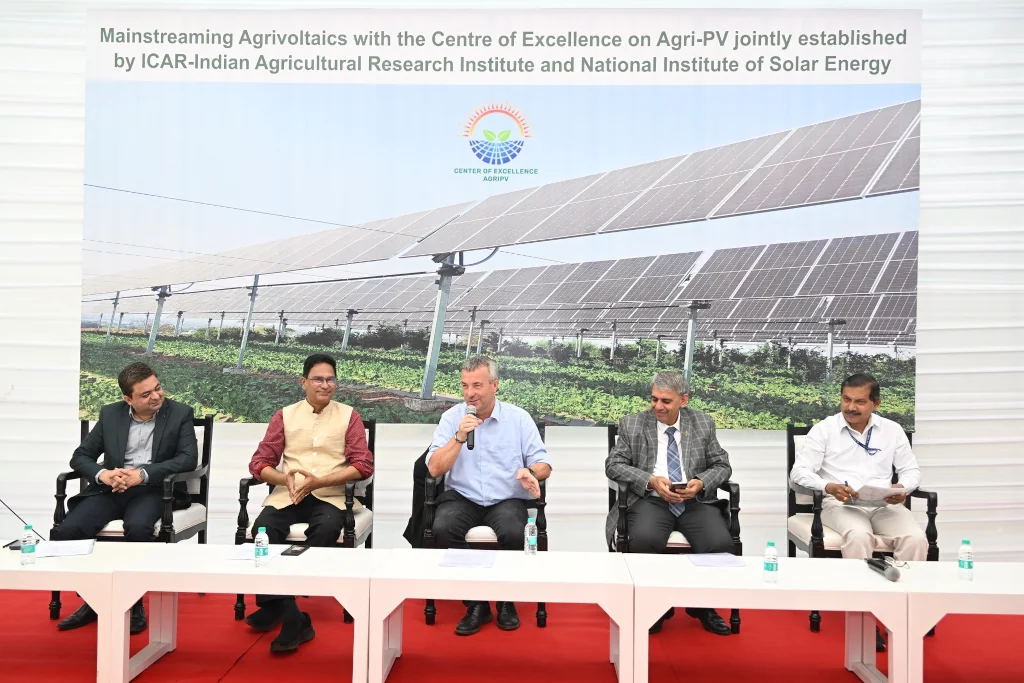
The Ministry of New and Renewable Energy (MNRE) has approved the Centre of Excellence (CoE) on Agri-Photovoltaics (Agri-PV) as a joint initiative between Indian Council of Agricultural Research-Indian Agricultural Research Institute (ICAR-IARI) and the National Institute of Solar Energy (NISE), Gurugram. The 100 kW Agri-PV pilot project at ICAR-IARI is being implemented with support from German Society for International Cooperation (GIZ) India.
A German delegation led by Johann Saathoff, Parliamentary State Secretary at Germany’s Federal Ministry for Economic Cooperation and Development (BMZ), visited the 100 kW (Agri-PV) pilot site at New Delhi.
The visit was organised by Germany’s Federal Ministry for Economic Cooperation and Development (BMZ) in collaboration with the German Consulate General, Chennai, as part of the Green and Sustainable Development Partnership (GSDP) between India and Germany, which aims to foster joint initiatives in renewable energy, sustainable agriculture, and climate action.
Johann Saathoff highlighted that the partnership embodies a unified ‘Team Germany’ approach, bringing together government ministries, development agencies such as GIZ and KfW (Credit Institute for Reconstruction), and the private sector to strengthen global renewable energy value chains.
The visit underscores the deepening Indo-German collaboration aimed at advancing sustainable agriculture through the integration of renewable energy and the development of climate-resilient farming systems.
Optimizing Agri-PV for Productivity
Discussions between the German delegation and senior representatives from ICAR, IARI, and NISE focused on expanding research collaborations, strengthening data infrastructure, and formulating policy and techno-economic frameworks to enhance farmer participation in Agri-PV initiatives. Scientists highlighted progress in areas such as net-zero farming, precision irrigation, and digital decision-support systems designed to optimise Agri-PV performance and sustainability.
Also read: India Unveils AI Based Rice Sorting System at BIRC 2025 to Strengthen Global Export
The CoE–AgriPV focuses on evaluating how solar photovoltaic (SPV) systems can be effectively integrated into cultivated land without compromising agricultural productivity. Scientists are studying power generation performance, shading impacts, and spectral reflectance changes across different crop canopies to understand the balance between energy output and crop health.
The program also examines crop growth and yield under varying light conditions, optimizing Agri-PV design parameters to enhance both energy efficiency and farm output, validate system models for key Indian crops, and conducts cost benefit analyses to identify pathways for scalable and economically viable deployment of Agri-PV systems across India’s diverse agro-climatic regions.
Strengthening Indo-German Clean Energy Collaboration
Saathoff also attended the Indo-German CEO Roundtable on Solar Energy, jointly organised by the Ministry of New and Renewable Energy (MNRE) and the National Solar Energy Federation of India (NSEFI) in New Delhi, where he emphasised the need for deeper collaboration in solar manufacturing, technology exchange, and investment to drive clean energy expansion and sustainable industry growth.
Emphasising that renewable energy serves not only as an economic growth engine but also as a moral responsibility toward future generations, Saathoff noted that both Germany and India as leaders in renewable energy expansion are committed to sharing knowledge and best practices on integrating large-scale solar and wind power into national grids, ensuring equitable market conditions and long-term industry sustainability.
I am joined by a strong delegation from GIZ, KfW, and leading German companies, all dedicated to deepening collaboration with our Indian partners. Together, we are connecting ideas, expertise, and industries, to grow together, to learn from each other, and to build a cleaner, brighter future for our children and grandchildren.
During his visit, Saathoff also attended Windergy India 2025 in Chennai, where he praised India’s growing capabilities and strong commitment within the wind energy sector. At the Renewable Energy India 2025 Expo in New Delhi, he noted the country’s impressive progress and ambition in advancing solar and biogas technologies.
Reflecting on his first official visit to India, he remarked that the experience highlighted the scale of innovation, energy, and optimism driving India’s clean energy transition and its broader commitment to sustainable development.
As India expands its renewable energy capacity alongside transformative changes in its agricultural sector, Indo-German collaboration can emerge as a key enabler of climate-resilient and future-ready farming systems. With early pilot projects now yielding practical insights, both countries can explore pathways for large-scale deployment, joint innovation, and the integration of agrivoltaics into mainstream agricultural practice.

