
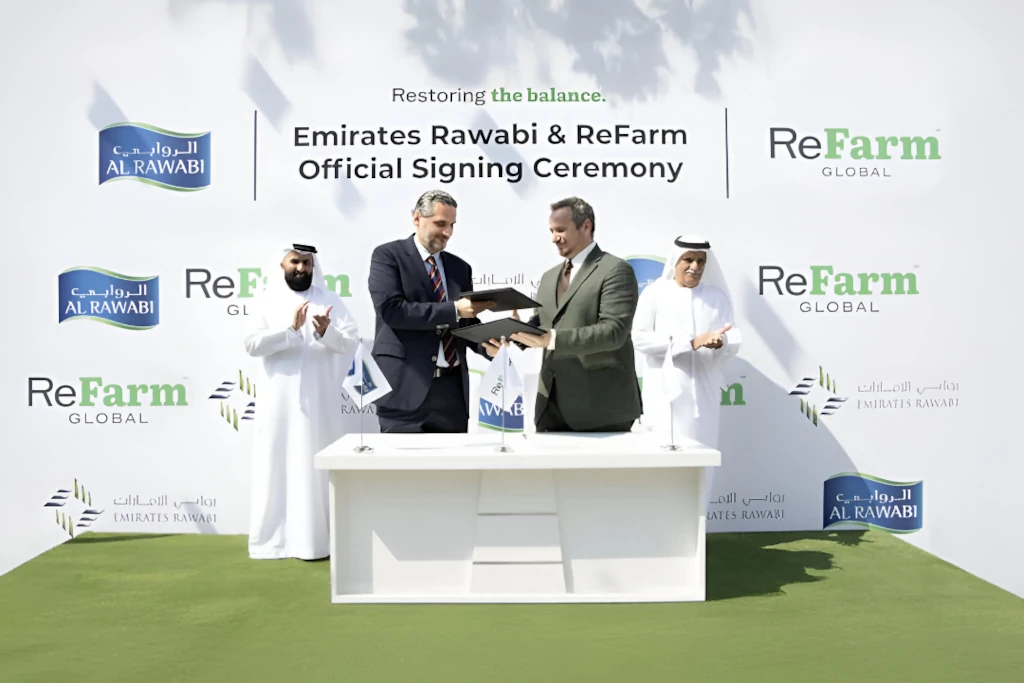
Emirates Rawabi, a UAE-based integrated agribusiness operator, has entered into a strategic partnership with ReFarm Global Investments, a regenerative waste-to-resource technology firm, to advance agricultural and food production practices in the country.
The project will focus on sustainable approaches to food production and landscaping, with potential implications for future urban and agricultural development across the region. The partnership aims to develop a circular agribusiness model built around cost-efficient, carbon-conscious and regenerative practices, combining Emirates Rawabi’s experience in dairy, poultry, feed and food production with ReFarm’s technologies for turning farm waste into usable materials and improving basic soil and water conditions.
Our mission is to restore the balance between nature, technology, and progress. Through this collaboration, we will empower farmers, urban developers, and food producers with innovative and cost-efficient systems that strengthen food security, while preserving our most valuable resources like air, soil and water.
According to the companies, the partnership will focus on developing a more sustainable food system by strengthening soil quality, using resources more efficiently and supporting farming methods that are practical and environmentally responsible. The approach is intended at supporting food security, improving soil health and cutting water use across the UAE’s farming and food production systems.
Rawabi–ReFarm Technology Synergy
Emirates Rawabi and ReFarm Global Investments plan to roll out pilot projects across the UAE to test circular farming practices, including turning agricultural waste into useful materials and improving soil and water management.
According to ReFarm Global, the partnership aligns with a shared aim to advance regenerative and circular agriculture in the UAE. The company says its technologies are intended to help farmers grow crops with less water, improve soil quality and support farming approaches that balance productivity with long-term environmental sustainability.
Together with ReFarm, we are implementing practical, scalable solutions that redefine sustainable farming from soil to plate and raise the standard for sustainable farming, strengthen circularity, and deliver measurable environmental impact.
Emirates Rawabi describes the partnership as an important step in its sustainability agenda, with Group CEO Mazen Al Refae outlining the company’s focus on building more responsible and resilient operations. He points to the work of Emirates Rawabi Sustainable Solutions (ERSS), which runs a circular system that uses biogas, solar power and advanced water treatment to reduce environmental impact and improve efficiency.
These efforts are presented as part of the company’s broader commitment to environmental stewardship and community well-being.The partnership aims to align with UAE efforts on food security, climate goals and sustainable development, and could potentially help assess how these approaches might contribute to lower-carbon, more resource-efficient farming in the country.
Advancing UAE Circular Agriculture
Emirates Rawabi’s role as a major producer in dairy, poultry, feed and food products places it at the centre of the country’s domestic supply chain, giving it operational scale and direct exposure to challenges around resource use, waste management and production efficiency.
ReFarm Global’s ongoing projects, most notably the GigaFarm initiative announced for Dubai Food Tech Valley, which focuses on circular systems, waste-to-value processes and controlled-environment production represent an effort to introduce closed-loop, resource-efficient technologies into the region’s food ecosystem.
Also read: Syngenta Opens AI-Powered Cropwise Platform for Third-Party Developers
Together, the collaboration can offer a platform to examine how circular and regenerative approaches could function within the UAE’s agricultural conditions, particularly where water scarcity, soil constraints and rising climate pressures shape farming decisions. The planned pilot projects are expected to test how converting organic and agricultural waste into usable inputs, improving soil condition and optimising water cycles can be integrated into existing production systems.
These trials may provide practical data on performance, feasibility and environmental outcomes in real-world settings. If successful, the work could potentially contribute to the evidence base for lower-carbon, resource-efficient agricultural models suitable for arid regions, informing future investment, technology scaling and policy discussions within the UAE’s food-system transition.
By linking Rawabi’s existing production base with ReFarm’s circular and waste-recovery model, the collaboration could provide a test case for how such systems could function when integrated across commercial agribusiness settings.


