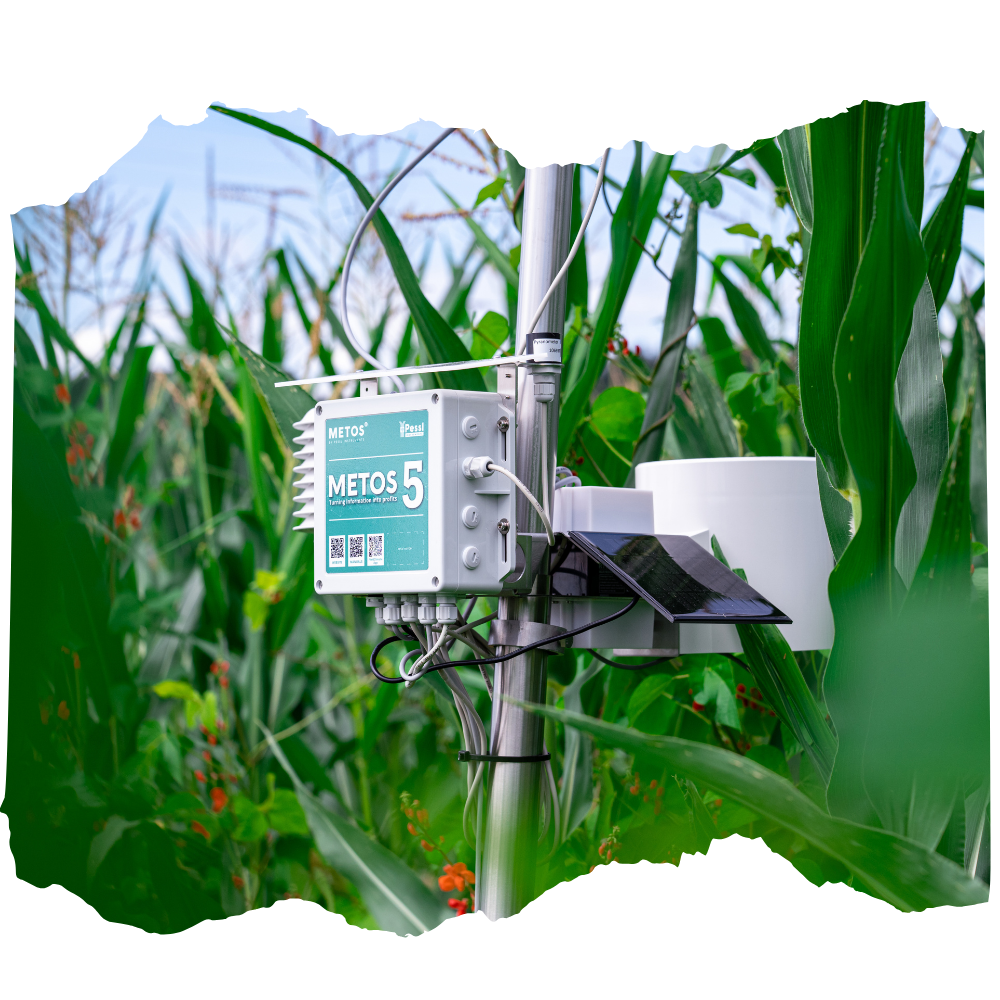
Pessl Instruments, an Austrian company that develops and manufactures Internet of Things (IoT) monitoring systems, has introduced METOS 5, the latest iteration of its precision agriculture weather station line. Unveiled at Agritechnica 2025, the system is presented as a durable upgrade for existing METOS units. It is built for long service life, straightforward field installation, and scalability across different production environments.
METOS 5 includes modular connectivity, compatibility with a wide range of sensors. The platform remains fully compatible with the company’s FieldClimate software, allowing users to continue accessing localized environmental data without changes to their existing workflows. The station provides real time environmental data used for decisions related to irrigation, spraying, pest and disease risk assessments, and frost management.
Over the years, we’ve learned that farmers need tools they can trust: durable, intuitive, and designed to provide meaningful data without demanding constant attention. METOS 5 combines exactly that: ruggedness with smart technology, helping farmers anticipate challenges, respond to them confidently, and make data driven decisions that protect crops while boosting productivity and profitability.
According to Pessl Instruments, the METOS brand has expanded internationally with regional support networks, and its stations are used in a variety of production systems. The company describes the line as a field monitoring platform designed to operate with modest operational and data-management requirements for users.
The system provides real-time environmental information that can inform decisions on resource use and the timing of field operations. It supports assessments related to water stress, pest and disease risk, and conditions that influence spraying and irrigation. According to the company, METOS 5 is intended to help producers apply interventions only when conditions indicate they are needed.
Simplifying Farm Monitoring
According to the company’s leadership, METOS 5 is intended to move beyond a routine product refresh by improving how farmers monitor and interpret field conditions. Company CEO Gottfried Pessl said experience from earlier deployments indicates that farmers place the highest value on tools that are dependable, easy to use, and able to provide meaningful information without demanding constant attention.
Also read: Reinke and CropX Advance Partnership with Unified Platform Integration
METOS 5 uses a rugged, modular architecture that lets farmers choose sensor and connectivity configurations according to their operational needs. In applications ranging from irrigation planning to disease modeling and frost protection, METOS 5 is designed to provide location-specific data that can support timely field decisions.
Too often, technology in agriculture promises to simplify farmers’ lives but ends up adding
complexity. We decided to give farmers something they can install in minutes, yet rely on it for
years.
Benedikt Pircher, VP of Sales and Business Development at Pessl Instruments, said the company views METOS 5 not simply as a weather station but as a platform that can be adapted and expanded as farm operations evolve. He noted that the aim is to provide a system farmers can build on and rely on over time, while continuing to deliver data-driven insights and field-level verification that support practical, sustainable decision-making in a straightforward, user-friendly format.
Pessl Advancing Precision Agriculture
Pessl Instruments develops tools that support data-driven decision-making in field environments. Its METOS line of wireless, solar-powered monitoring systems, together with the FieldClimate platform, is used across a wide range of climates and applications, including agriculture, research, hydrology, meteorology, flood and frost risk, snow management, sports turf, and urban environmental monitoring.
Pessl Instruments’ introduction of METOS 5 reflects a steady shift toward more integrated, field-level monitoring in precision agriculture. Rather than adding new layers of complexity, the system focuses on durability, modular sensor use, and continuity with existing workflows, which aligns with what many farmers seek as weather variability intensifies and operational timing becomes more sensitive.
The emphasis on real-time environmental data suggests growing reliance on localized measurements for decisions tied to irrigation, disease pressure, and frost events. As more farms adopt distributed sensing infrastructure, devices like METOS 5 can play a larger role in calibrating day-to-day management, though long-term value will depend on reliability, ease of use, and data quality across different production systems.