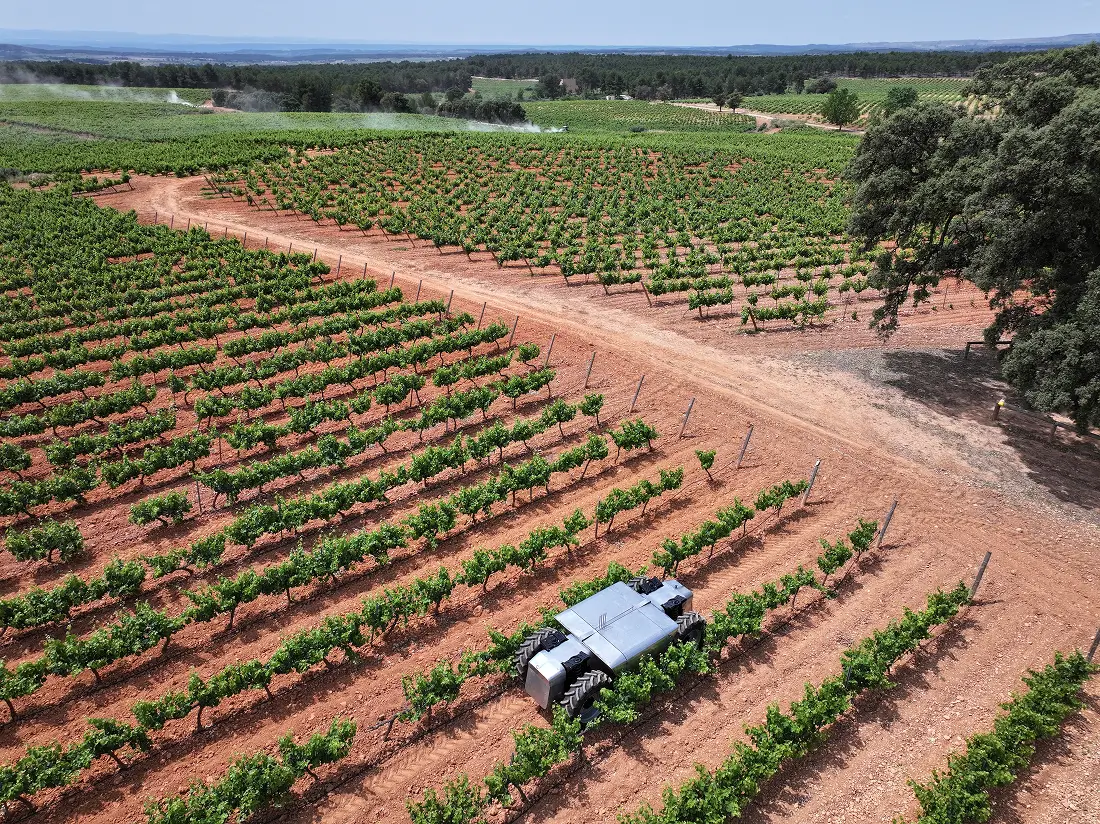
Voltrac, a Spain-based deep tech robotics company, has raised €7 million (US$ 8.11 million) in seed financing round led by Extantia, with FoodLabs, Antler, PUSH, and Prototype Capital also participating. The company plans to use the capital to scale production of its Thor unmanned ground vehicle (UGV), targeting an output of about 100 units a year by 2026, building on its earlier €2 million ($2.31 million) pre seed round.
Founded in 2024 by Thomas Hubregtsen and Francisco Infante Aguirre, Voltrac develops autonomous, electric tractors for use in agriculture and front-line logistics. Its unmanned ground vehicle, Thor, is built to move goods on farms while using onboard camera systems to monitor crop conditions, and can also serve in defense logistics by delivering supplies across difficult terrain.
The company claims that the Thor has undergone field trials in vineyards, olive groves, and citrus farms and is designed to work with standard agricultural implements. Investors point to the platform’s potential to reach cost parity with diesel equipment as a key competitive factor.
Thor’s Overview
According to Voltrac, Thor can be tele-operated and also functions with autonomous modes, allowing a single operator to oversee multiple units at once. The vehicle is compatible with a broad range of standard implements, which can lower upfront equipment costs for farmers.
Also read: AfDB Approves $310M for FirstRand to Scale Agribusinesses in South Africa
Voltrac says the vehicle uses about 70 percent fewer components and relies on a distributed electric propulsion system with individual wheel motors. The company also claims it delivers roughly three times the battery capacity of comparable platforms, with fully swappable batteries intended to limit downtime and cut annual maintenance costs by nearly 30 percent.
My grandfather started a company selling tractor implements in over 25 countries, and my family farmed the land. When there was nobody left to work the fields, we had to sell that land. We built Thor so other families won’t have to make that choice.
Voltrac plans to ramp up production at its Valencia facility to meet growing demand. Beyond agricultural use, the company is adapting Thor for front-line logistics, where it would be able to autonomously move loads of up to 4 tonnes across rough terrain. Voltrac’s team has visited Ukraine to meet with unmanned operations units and is now preparing for on-site trials.
Investor Perspective
Extantia partner Yair Reem said the firm backed Voltrac because it believes the company has addressed one of the main challenges in hardware development, achieving competitive costs. He added that the company is not asking farmers or defense operators to pay a green premium and is already operating at price parity with diesel platforms, with a pathway to undercut them.
Prototype Capital’s Andreas Klinger offered a similar assessment, noting that the firm views Thor as a clear step forward in the category. Prototype Capital considers the platform ahead of products from established manufacturers such as John Deere and on par with advanced systems emerging from China, including the Honghu T70.
Voltrac’s Scaling Outlook
Voltrac’s latest funding round reflects a broader shift in agricultural automation, where electric and autonomous platforms are beginning to move from pilot stages to early commercial deployment. The company’s push toward cost parity with diesel equipment is central to this transition, since many growers remain cautious about switching to electric machinery unless total ownership costs are clear and competitive.
Thor’s design choices, including fewer components, distributed propulsion and swappable batteries, indicate an emphasis on lowering maintenance demands and improving utilisation, two areas that often determine real world viability in farm operations. Field trials in vineyards, orchards and citrus farms suggest an initial focus on high value, structured environments where autonomy can be deployed more consistently.
Voltrac’s push into defense applications highlights how agricultural robotics companies are exploring wider use cases, but the core test remains performance in day to day farm conditions. Adoption will dependent on how well the platform handles varied terrain, crop systems and seasonal workloads. The planned production scale up will provide a clearer picture of reliability in agricultural settings and whether demand can grow as growers gain more exposure to autonomous equipment.