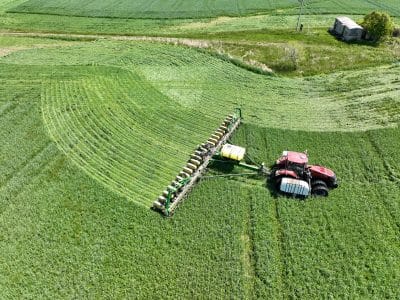
US Secretary of Agriculture Brooke L. Rollins has announced that representatives from Weed Science Society of America (WSSA) will support a $700 million agriculture based Regenerative Pilot Project. The initiative will be administered by the USDA Natural Resource Conservation Service (NRCS) with an aim to help farmers improve soil health, enhance water quality, and boost long-term productivity, all while strengthening America’s food and fiber supply.
The pilot project’s four-pronged focus will help to improve both the nations’s food security and food affordability. The program’s success will largely depend on how well it provides farmers with technical support to achieve its goals while also optimizing weed control.
The WSSA supported pilot will also be supported by partner organisations, including GROW (Getting Rid of Weeds), which will contribute field-tested tools and extension support for regenerative weed management.
Weed control is what will make regenerative agriculture possible, as practices that help to improve soil health and water quality will also minimize reliance on tillage. Without tillage, weed control can become quite challenging, and farmers will need technical help from weed scientists and weed-science research to succeed.
Established in 1956, WSSA is a nonprofit scientific society aimed at encouraging and facilitating the development of knowledge concerning weeds and their impact on the environment. The Society promotes research, education and extension outreach activities related to weeds, provides science-based information to the public and policy makers, fosters awareness of weeds and their impact on managed and natural ecosystems, and strengthens cooperation among weed science organizations across the nation and around the world.
Weed Management Central to Regeneration
The 15-member council will include a weed science representative tasked with advising on incentive structures that promote effective weed management aligned with regenerative agriculture objectives. The programme also aims to establish a clear, science-based definition of agricultural regeneration to guide implementation and evaluation.
Also read: TerraClear Reduces Field Setup Process Through John Deere Integration
There is broad agreement that streamlined administration will be critical to the project’s success, particularly if programme goals are clearly defined, application processes are simple, and the supported practices are economically viable for farmers to adopt.
Stanley Culpepper, past president of WSSA, stated that implementing practices to improve soil health and long-term farm sustainability is a priority for family farms seeking to strengthen their operations for the next generation, and added that including an applied weed scientist in both the development and implementation phases would help address these challenges while ensuring that weed pressures are not overlooked.
WSSA will assist USDA NRCS to implement the new project, with support from other existing organizations, including GROW which has already been doing the exact work required for regenerative ag pilot program. Based on this Weed Management Planner has been descirbed as perfect resource on which to begin by Lee Van Wychen.
The goal is to provide science-based and Extension-vetted tools to farmers and also to help farmers learn from each other when trying out new sustainable, or regenerative weed control practices.
The GROW network’s website covers a range of regenerative and integrated weed management tactics, such as cover crops, harvest weed seed control, weed electrocution, precision sprayers and more introduced by Farmer-led education projects, such as Farmer Forums and Farmer Case Studies.
Scaling Large Regenerative Initiatives
USDA’s $700M Regenerative Agriculture Pilot is a large and necessary federal bet on whole-farm regenerative systems, funding outcomes across EQIP (Environmental Quality Incentives Program)/CSP (Conservation Stewardship Program) and bundling conservation into a single application to scale soil-first practices. Unlike corporate supply-chain programs that target specific commodities or acres, including General Mills’ multi-partner efforts to transition tens of thousands of acres to regenerative practices, the USDA pilot endorsed by WSSA is nationwide, programmatic, and incentive-driven rather than buyer-led.
Major corporate initiatives such as McDonald’s $200M ranch program and CPG (Consumer Packaged Goods) pilots typically pair payments with measurement and supplier engagement, while the USDA model channels public funding and NRCS technical assistance at scale. State and regional cover-crop pilots show similar practice mixes but operate at smaller geographic scope and with varied payment rates. The WSSA endorsement underscores that successful scaling will require robust, field-tested technical support particularly for integrating weed management into reduced-tillage systems.