
Despite steady investment levels and a growing pipeline of agricultural technologies, adoption on the ground remains a persistent challenge for India’s AgFoodTech sector. Across the AgFoodTech ecosystem, this challenge spans farming, post harvest operations, processing, and market linkage.
Funding activity has become more selective, deal volumes have declined, and many technologies continue to struggle to move beyond pilots and early users, particularly among smallholder farmers.
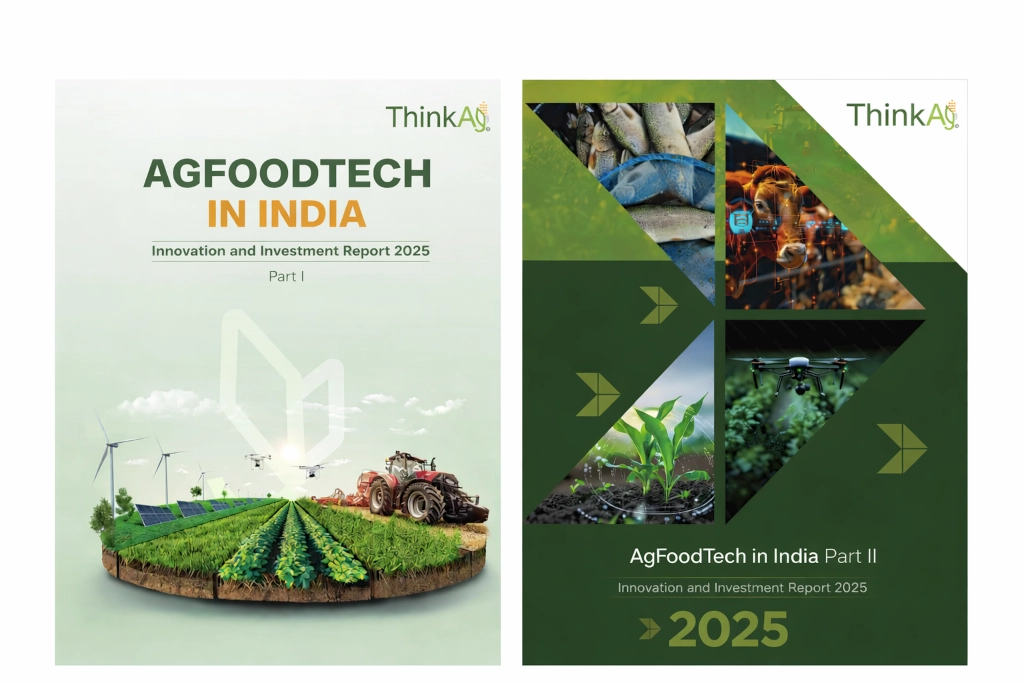
Two research publications by ThinkAg, AgFoodTech in India: Innovation and Investment Report 2025 Part I and Part II, provide insight into this shift. Part I documents investment trends, deal activity, and sectoral rebalancing across AgTech, FoodTech, and allied categories. Part II examines the practical realities of technology adoption among Farmer Producer Organisations and farmer collectives.
This year’s report reflects a sector that is maturing with purpose. While overall investment
volumes have stabilized, the quality of innovation has progressed, particularly in precision
agriculture, platform-led models, and climate-resilient solutions.
Read together, the reports indicate that the sector is not experiencing a slowdown in innovation, but is moving into a phase of greater capital discipline amid unresolved adoption constraints. The reports were developed with support from Rabo Foundation, which contributed to the research process and analytical framework used to examine investment trends and technology adoption across the agri food value chain.
Investment Stability with Reduced Transaction Activity
Aggregate investment in Indian Agritech during 2024 remained broadly stable at $411.74 million, even as the number of funding transactions declined to 61, a drop of 18% year on year. Capital deployment during the year was heavily concentrated in existing portfolio companies, with about 82% of transactions classified as follow on rounds. Large capital infusions were limited, with only a small share of deals exceeding $15 million. These trends point to a phase of capital discipline within the broader AgFoodTech ecosystem.
This pattern points to a shift in capital allocation priorities rather than a contraction of interest. Investors appear increasingly focused on operational continuity, capital efficiency, and demonstrated execution capability, instead of early stage experimentation. The reduction in new deal formation reflects greater scrutiny of business fundamentals in a sector where adoption cycles are long and revenue realisation is closely linked to farmer behaviour and institutional capacity within AgFoodTech models.
Rebalancing Across AgTech Segments
The sectoral distribution of Agritech investment also changed materially during the year. Downstream Agritech, which includes market linkage platforms, agri commerce, and logistics driven models, continued to attract the largest share of funding in absolute terms. However, its relative dominance declined significantly. From accounting for more than three quarters of Agritech investment in 2021, downstream models represented about 42% to 50% of total investment by 2024, reflecting recalibration across the AgFoodTech value chain.
This shift reflects growing investor caution toward logistics intensive and margin sensitive business models that require sustained capital support to scale. While downstream platforms remain central to market access and price discovery, their long term resilience and path to profitability are being reassessed in the context of evolving AgFoodTech economics.
Also read: Bartronics India Acquires 51% Stake in Farm-to-Commerce Player AYOU
In contrast, Precision Agritech recorded a sharp increase in investor interest, with year on year investment growth of about 140%. Capital inflows were concentrated in areas such as agricultural drones, mechanisation, and precision aquaculture. This trend reflects stronger alignment with use cases that address structural constraints, including labour shortages and efficiency losses, within the AgFoodTech ecosystem rather than consumer facing scale narratives.
Post harvest Agritech also saw a marked recovery, with investment increasing by more than 200% compared to the previous year. Storage, processing, and cold chain solutions emerged as key focus areas, highlighting the importance of income stabilisation and value realisation beyond farm level production in AgFoodTech systems.
Persistent Limits to Technology Adoption
While investment patterns suggest consolidation and maturity, adoption data presents a contrasting picture. Primary research across 64 FPOs and CBBOs in seven states, including Maharashtra, Madhya Pradesh, and Uttar Pradesh, shows that technology adoption among member farmers typically ranges between 20% and 40%. This remains true even among relatively well organised collectives, indicating a structural ceiling on the diffusion of Agritech solutions within the AgFoodTech context rather than a short term lag.
The consistency of this pattern across geographies and organisational types suggests that adoption constraints are systemic rather than isolated. These findings challenge the assumption that improved technology or increased funding automatically translates into widespread usage. Instead, they point to deeper institutional, economic, and behavioural constraints that limit absorption capacity at the farm level, shaping AgFoodTech outcomes more than innovation intensity alone.
Technology Adoption as a Lifecycle Rather Than a Single Decision
A central insight from the adoption focused report is that technology uptake follows a multi stage lifecycle rather than a single decision point. The study outlines six stages, beginning with perceived relevance and awareness and extending to institutionalisation and reinforcement. Each stage is shaped by different enablers and friction points, many of which lie outside the technology itself, particularly in AgFoodTech delivery environments.
In practice, many technologies stall during the transition from trial to sustained use. While pilots and demonstrations may establish technical feasibility, operational complexity, recurring costs, service availability, and uncertainty around returns often prevent solutions from becoming embedded in routine farming practices. The absence of consistent handholding and post deployment support further compounds this challenge, limiting the long term effectiveness of AgFoodTech interventions.
Institutional and Systemic Sources of Adoption Friction
At the institutional level, internal factors within farmer collectives, including governance quality, financial transparency, leadership capacity, and trust, play a decisive role in determining adoption outcomes. Organisations with higher turnover and stronger management capability are more likely to adopt multiple technologies and sustain their use over time.
At the ecosystem level, external conditions frequently limit adoption. Although subsidies and grants help reduce entry barriers for capital intensive technologies, gaps in infrastructure, limited availability of skilled personnel, certification requirements, and exposure to market volatility often undermine long term viability. In many cases, policy support addresses procurement costs without adequately accounting for operating conditions and service delivery needs.
At the level of solution design, the reports highlight persistent shortcomings in adoption models. High upfront costs without rental or embedded finance mechanisms, weak after sales support, and limited integration with market linkages reduce the practical utility of many Agritech solutions, even when their technical performance is sound, constraining their role within the AgFoodTech ecosystem.
Capital Allocation Reflecting Adoption Constraints
Investor behaviour increasingly reflects these ground realities. The growing preference for platform oriented business models, spanning input access, post harvest handling, and market linkage, signals an emphasis on integrated solutions capable of supporting adoption at scale. Similarly, AgriFinTech investments declined in aggregate value but recorded higher median cheque sizes, indicating more selective support for models closely aligned with agricultural cash flows and institutional lending frameworks.
Renewed interest in post harvest AgTech further reinforces this trend. Case studies cited in the adoption report show that processing capacity and assured market access contribute more directly to income stability than productivity improvements alone, positioning post harvest infrastructure as a core pillar of AgFoodTech investment strategies.
Implications for the Sector’s Next Phase
Taken together, the findings suggest that reduced deal volumes should not be interpreted as diminished opportunity. Instead, the AgFoodTech sector appears to be transitioning toward fewer, more structured interventions focused on value realisation and institutional capacity.
Opportunities are likely to concentrate in areas that strengthen adoption infrastructure, including service delivery, embedded finance, long term technical support, and market integration. FPOs are positioned as critical intermediaries in this process, provided they are supported with governance, financial management, and market facing capabilities.
Policy, Capital, and Innovation Considerations
For policymakers, the evidence indicates that financial incentives alone are insufficient to drive adoption. While subsidies and grants help lower entry barriers for capital intensive technologies, the reports show that adoption often stalls when these incentives are not accompanied by investment in institutional capacity, service delivery, and market integration essential to AgFoodTech effectiveness.
Case observations from FPOs indicate that technologies are more likely to be sustained where farmers receive ongoing technical support, training, and assistance in linking output to markets. Without these complementary layers, subsidised technologies frequently remain underutilised or confined to a small subset of members, limiting their systemic impact.
Also read: AI Startup Biographica Raises $9.5M to Advance Crop Gene-Editing Technology
For investors, the data reinforces a shift away from transaction volume toward execution quality. The dominance of follow on rounds and the concentration of capital in fewer deals reflect growing emphasis on business models that can demonstrate repeat usage, stable revenue flows, and operational resilience. The reports highlight stronger investor interest in platform oriented models, post harvest infrastructure, and embedded finance solutions, where adoption is supported by services and market access rather than dependent on standalone technology uptake. Capital, in this context, is increasingly aligned to companies that can translate adoption into sustained value creation.
For AgTech companies, the central challenge lies in designing adoption models that address behavioural, institutional, and economic constraints alongside technical performance. The adoption lifecycle outlined in the reports shows that many solutions fail not at the point of awareness or trial, but during the transition to routine use. Examples from the field point to the importance of rental models, after sales support, and risk sharing mechanisms that reduce upfront costs and uncertainty for farmers. AgTech firms that align product design with farmer cash flows, institutional decision making within FPOs, and clear income outcomes are more likely to achieve scale than those focused primarily on technological sophistication.
Conclusion
Taken together, the ThinkAg reports depict an AgFoodTech sector undergoing consolidation rather than contraction. Investment activity is becoming more selective, with capital increasingly directed toward companies that demonstrate operational resilience and sustained adoption capacity across the AgFoodTech landscape.The next phase of India’s AgFoodTech development is therefore likely to be shaped less by the speed of innovation and more by the ability to integrate technology into the operational realities of agriculture and food systems.
At the same time, adoption data highlights persistent structural constraints that capital and innovation by themselves have not resolved. The limited uptake of technology among farmer collectives points to gaps in institutional capacity, service delivery, and market integration. Without addressing these foundations, even technically sound Agritech solutions struggle to become embedded in everyday agricultural practice. Adoption, as the reports show, remains a function of trust, affordability, support systems, and economic relevance rather than technological sophistication.
The next phase of India’s AgFoodTech development is therefore likely to be shaped less by the speed of innovation and more by the ability to align technology with the operational realities of agriculture. This includes strengthening farmer institutions, designing models that account for risk and cash flow, and ensuring that productivity gains translate into income stability. In this context, fewer deals may signal not reduced ambition, but a recalibration toward durability, relevance, and long term impact across the agri food value chain.


