
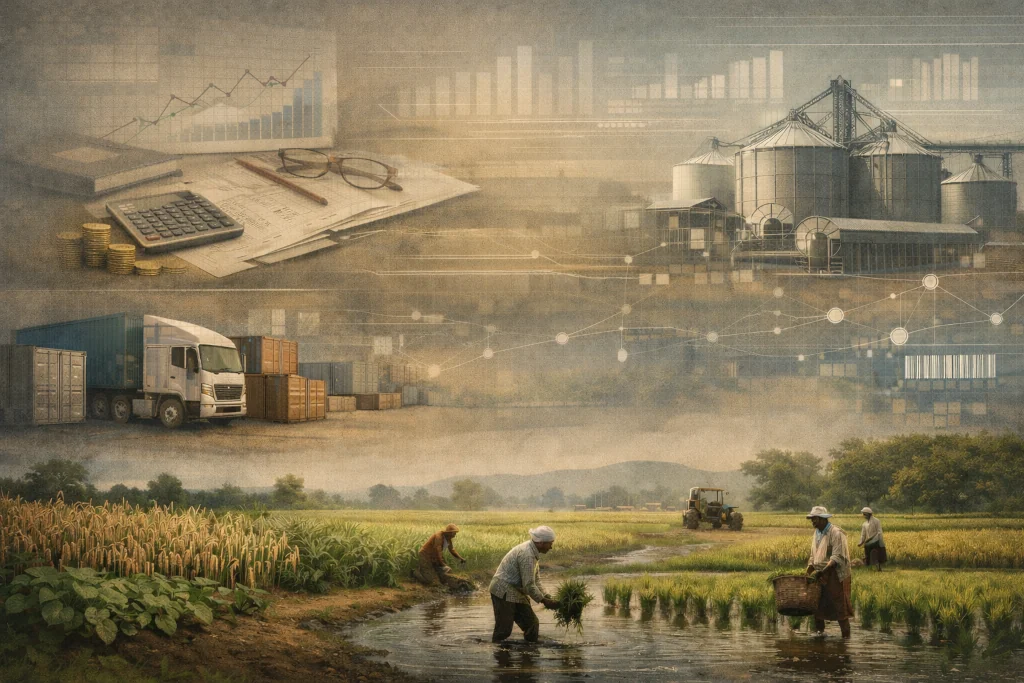
As the Union Budget approaches, Indian agriculture, including its supply chains, is entering a period shaped less by scarcity of ideas and more by competing priorities. Over the past decade, agritech has matured into a functional layer of the farm economy, with tools spanning advisory, inputs, logistics, and finance now deployed across regions. At the same time, adoption remains uneven, influenced by institutional capacity, market structure, and public policy alignment.
Recent analysis from ThinkAg reflects this mixed picture. The ecosystem is no longer defined by experimentation. Instead, the challenge lies in translating technical readiness into broad based uptake, particularly among smallholder farmers, farmer producer organisations, and state led extension systems, a process that remains closely tied to how supply chains are structured, incentivised, and governed.
This transition is unfolding within a budget environment under pressure. Public spending decisions are being shaped by a wider set of national priorities, including strategic preparedness, infrastructure, and macroeconomic stability. While agriculture continues to receive policy attention, the space for new structural initiatives appears narrower than in earlier cycles.
In a recent LinkedIn post, Vishnu Sree Raj, CEO & Founder, Pepperhub, anticipates that the Union Budget may emphasise expanded agri-credit targets. He frames this as an opportunity to revisit how farmer support is measured, suggesting that alongside credit, greater attention to price stability, storage infrastructure, and market linkages could play a stronger role in improving farm incomes.
Prediction for Feb 1st: The Govt will announce a massive “Agri Credit” target. And everyone will clap. 👏 But here is the Reality Check: A loan is not income. A loan is Debt. We keep celebrating that we are giving farmers easier access to loans.
Supply Chains Shaping Agritech Priorities
One visible shift in the sector is the growing influence of supply chains on agritech adoption. Traceability requirements, logistics efficiency, and compliance standards are increasingly driving where and how technology is deployed. Digital tools that support aggregation, quality monitoring, and export readiness have seen stronger uptake, particularly in organised value chains.
For agritech companies, this focus has opened new commercial pathways. At the same time, it has exposed friction in parts of the farm economy that remain informal or fragmented. Adoption tends to accelerate where supply chains are consolidated and capitalised. In regions where market linkages are weaker, the same technologies struggle to move beyond pilots.
Also read: ThinkAg Roundtable Explores How Farmer Collectives Can Drive Tech Adoption
In another LinkedIn post, Vishnu Shree Raj questions agritech’s strong focus on ‘AI for agriculture,’ suggesting that farmer outcomes depend more on reliable supply chains. He highlights timely access to inputs, fair market connections, and efficient logistics as more immediate priorities, noting that technology is most effective when it strengthens these underlying systems.
Over time, a clear pattern begins to emerge. Technology settles first where markets are organised, supply chains are formal, and incentives are easy to align. In these settings, adoption feels natural and commercially justified. Elsewhere, especially in regions facing sharper climate stress or thinner margins, the same tools arrive more slowly or not at all.
This uneven spread is shaped less by innovation capacity and more by the environment into which technology is introduced, including how supply chains are organised and incentives are distributed. Public investment and policy alignment have traditionally helped bridge this gap, extending adoption beyond the most commercially attractive segments. When fiscal headroom narrows, that connective role weakens, and differences in uptake tend to widen rather than close.
Between Efficiency and Food Systems
Alongside growing supply chain pressures, a broader debate is quietly taking shape around the purpose of agricultural growth. As logistics, exports, and processing gain prominence, questions are emerging about whether production systems are being optimised primarily for market efficiency or for food quality, nutrition, and ecological resilience.
Agritech sits at the centre of this tension. The same platforms that enable traceability, standardisation, and compliance across supply chains can also support soil health monitoring, climate advisory, and diversified cropping. Which of these functions gains priority depends less on the technology itself and more on the incentives embedded in policy, procurement, market structures, and supply chain requirements.
Across the system, contrasting patterns are visible. In some contexts, technology adoption is closely tied to supply chain requirements, improving efficiency and predictability but with limited spillover into broader farm practices. In others, digital tools are being applied to manage input use, reduce risk, and support more resilient production, even where formal market access remains constrained. The difference often reflects the level of institutional support surrounding adoption rather than differences in product design.
This structural constraint has been echoed in LinkedIn commentary by Smit Rathod, New Business Development, Atul Ltd., who points to the continued fragmentation of India’s agri supply chains and mandi systems as a limiting factor. His observation reinforces how technology adoption often mirrors existing market structures, improving efficiency where systems are organised, but delivering fewer spillover benefits where institutional linkages remain weak.
On the supply side, several agritech startups, often led by teams with limited agricultural background—learn from farmers, package that knowledge attractively, and attempt to sell it back to them. Yes, there have been good innovations that help improve margins or reduce cultivation costs. But the overall impact has not been as massive as projected
As the budget approaches, this tension is unfolding within a period of fiscal caution. Agriculture is not facing a withdrawal of support. Existing programmes are expected to continue, and the sector remains central to employment and food security. The uncertainty lies in the pace and direction of the next phase of integration.
A related tension emerges around food quality itself. In a recent post on LinkedIn, Prateek Kaushik, Founder, ANAAD – Anhad Naad Foods, reflects on how modern food systems increasingly optimise for shelf appearance and long-distance logistics rather than nutritional value. Observing uniform, blemish-free produce in a premium grocery store, he frames this as a ‘specification error,’ where quality is defined by aesthetics and transport durability instead of human health.
If your food looks like it was made in a factory, it’s because it was treated like a widget, not a biological input.
The result, he argues, is food that is harvested early, treated heavily, and designed to survive supply chains rather than nourish people. His observation adds another layer to the broader debate facing agritech and policy alike, whether efficiency-driven systems are unintentionally reshaping what is grown, how it is grown, and ultimately what ends up on the plate.
Signals Beyond Allocations
For agritech, the concern is less about immediate disruption and more about trajectory. A cautious fiscal environment can slow the transition from readiness to scale, extending adoption timelines and leaving gaps unaddressed. These effects are gradual and rarely visible in budget documents. They surface over seasons, through uneven uptake, persistent exposure to climate and income risk, and differences in how benefits are distributed across regions and farmer groups.
Taken together, the debate over efficiency versus food systems and the reality of an uneven transition point to the same underlying issue. Alignment across policy priorities will influence the direction of Indian agritech beyond the current budget cycle. For industry participants, the Union Budget is read not only for allocations but for signals. Decisions around digital public infrastructure, extension capacity, and risk mitigation frameworks influence how technology providers, investors, and state agencies plan for the coming years.
As noted by Deloitte India on LinkedIn, the Union Budget 2026 presents an opportunity to strengthen agricultural competitiveness and resilience through strategic public investment, underscoring that adoption of new technologies will depend not just on their readiness, but on how fiscal priorities and ecosystem incentives are structured.
The current moment reflects a sector at a crossroads, agritech has developed the capacity to serve multiple objectives, productivity, resilience, supply chain efficiency, and food system outcomes. Whether those capacities are aligned or pulled in different directions will depend on how policy priorities are balanced.
As fiscal pressures rise and competing demands shape public spending, the question for agriculture is not one of relevance, but of alignment. This alignment will play a central role in shaping the trajectory of Indian agritech beyond the current budget cycle.


