
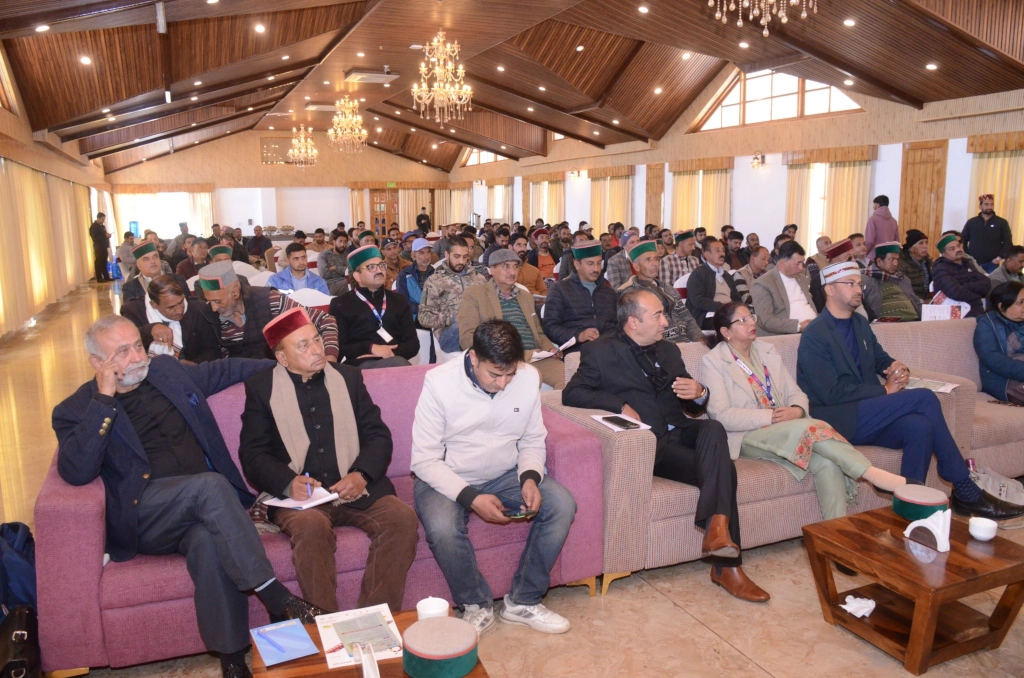
Kisan Manch, a Shimla-based digital agritech platform operated by Agro Farm Ventures, organised a full-day Apple Grower Meet at KC Villas, Fagu, focusing on pre-harvest orchard management to help growers improve fruit quality, productivity, and market realization in the upcoming season.
Sachin Sharma, Director of Agro Farm Ventures stated that the intent of the programme was to build stronger linkages between growers, infrastructure providers, technical experts, and financial institutions. He noted that the region now has access to modern cold storage infrastructure and organized hubs that can support growers beyond harvest.
The programme witnessed participation from around 150-200 apple growers from the Fagu-Cheog belt and nearby areas. It brought together horticulture scientists, subject matter specialists, banking institutions, and industry partners to address critical gaps across orchard management, climate risks, post-harvest readiness, and access to finance.
We have established a state-of-the-art cold storage facility in Narchat and are connected with thousands of apple growers. Through these hubs, we are working with the horticulture department to share knowledge on pre-harvest and post-harvest management and best practices. This interaction between growers, experts, and banks will benefit farmers significantly in the coming time
Sessions during the day covered soil health management, nutrient and irrigation scheduling, canopy regulation, pest and disease management before harvest, and scientific harvest planning aligned with cold storage and market requirements. Speakers underlined that fragmented decision-making at the farm level often leads to quality loss and lower price realization, making coordinated, stage-wise orchard management increasingly essential.
Adapting Apple Farming to Climate Change
According to Dr Kushal Singh Mehta, Horticulture Specialist, Shimla district, declining chilling hours due to changing snowfall patterns are already affecting apple cultivation in the region. He stated that apple varieties earlier required 1,200-1,600 chilling hours, but climate change has led to a steady reduction in snowfall and chilling availability. He noted that low-chilling apple varieties such as Spur, Gala, Fuji, and Crimson Spur were introduced over the years and have shown improved yield performance.
Also read: Digital Agriculture Research at Cornell Poised to Receive a Share of $30M in Federal Funding
Dr Mehta further stated that projected temperature increases in the coming decades may require the introduction of very low-chilling cultivars and alternative crops. He emphasized the need for growers to adjust cropping patterns by adopting multiple fruit crops such as plums, cherries, persimmons, and apples, and to plant forest species like deodar to help maintain microclimate and air quality.
Scientists from the department (Department of Horticulture), Nauni University, Mashobra, and KVK are participating. Around 200 progressive farmers have attended. This area(Fagu-Cheog) is close to Shimla, and the message of organic and climate-resilient farming from here will spread widely.
He also underlined the importance of climate-resilient orchard management practices and environmentally responsible residue management to sustain production under changing climatic conditions. According to him, such measures can support additional livelihood opportunities while improving environmental outcomes. He added that crop residues should not be burned but shredded and used as organic manure to improve soil organic matter and reduce pollution.
Credit Access and Financial Support for Apple Growers
Banking support and access to institutional finance formed a key component of the discussions, with representatives from the State Bank of India engaging directly with growers to address credit-related concerns. According to Anita Hira, Regional Manager, State Bank of India, the objective of participating in the meet was to ensure that farmers are aware of the range of banking facilities available to them and how these can support agricultural and horticultural activities.
She stated that information was shared on Kisan Credit Card (KCC), Kisan Samriddhi Rin, and other banking instruments so that farmers can access credit more easily and benefit from farming, whether related to apple cultivation or other crops.
Under KCC, the government provides interest subvention up to 3%. Under the Agriculture Infrastructure Fund, 3% subvention is available for loans up to ₹2 crore. Under PMFME, farmers setting up grading, packing, or cold storage units can receive a 30% subsidy up to ₹10 lakh.
Further elaborating on scheme-level details, Navdeep Singh, Branch Manager, State Bank of India, Premghat (Theog), stated that the interaction focused on understanding farmers’ needs and clarifying how financial support can help improve incomes, particularly for high-density apple growers with higher investment requirements.
He noted that farmers raised questions regarding processing fees, interest rates, and subsidy eligibility, which were addressed during the session. He added that cold storage loans can generally be sanctioned within 7-14 days, and that documentation requirements had already been clarified during earlier meetings, with no additional paperwork required.
Post-Harvest Infrastructure, Farmer Concerns, and Access to Credit
Industry participation at the meet focused on post-harvest handling and grading infrastructure relevant to apple growers. Jayant Negi, Regional Manager, Zankron Labs (a ZOHO group company), stated that the farmers’ meeting was organized by Kisan Manch, which is Zankron Labs’ partner in Himachal Pradesh.
He said the company has provided the first complete indigenous grading and packing line in the state, including bin dumper, bin filler, washing line, and defect-based grading based on color, size, and weight. According to Negi, all components are manufactured in-house, and the technology is designed to be transparent and accessible, enabling farmers to confidently bring their produce for grading and packing while supporting supply chain efficiency.
During the interaction, farmers also raised concerns related to inspection charges deducted at the field level. A farmer representative stated that growers have requested the Horticulture Department not to levy inspection fees on farmers, noting that these charges are linked to KCC and pass through multiple toll points.
According to the representative, inspection-related deductions amount to nearly ₹1 crore annually from Shimla district alone and are ultimately borne by farmers. The representative requested that this issue be conveyed to higher authorities and that inspection charges should not be deducted from farmers.
Issues related to recurring banking charges were also highlighted by participants during the discussion. One of the speakers noted that Kisan Credit Card (KCC) accounts require annual renewal and that processing fees are charged each year by banks, including private banks. The speaker stated that growers hope the KCC credit limit will be increased to ₹5 lakh in the coming period, as a higher limit could provide greater financial flexibility and support farm-level investments.

