
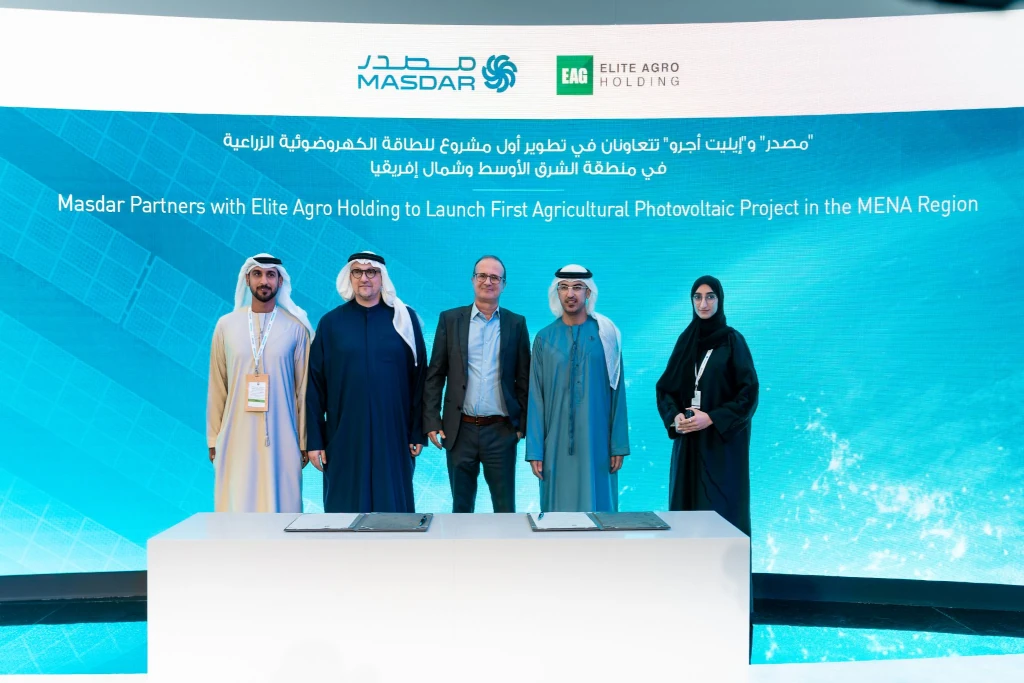
Masdar, a UAE state-owned clean energy company, and Elite Agro, a UAE-based agrifood company, have announced what they describe as the Middle East and North Africa (MENA) region’s first agricultural photovoltaic (AgriPV) project. The pilot is located at Elite Agro’s Al Foah Farm in Al Ain, Abu Dhabi, and was unveiled during Abu Dhabi Sustainability Week.
The initiative integrates solar power generation with greenhouse-based crop production to improve the efficiency of land, water, and energy use. It aligns with the UAE Energy Strategy 2050, the Net Zero 2050 ambition, and the National Food Security Strategy 2051. The main objective is to demonstrate the technical, economic, and agricultural viability of AgriPV under real-world conditions in UAE.
This groundbreaking project will demonstrate how clean energy and agriculture can thrive together, making food systems more resilient and supporting food and energy security. By integrating advanced solar technology with local farming, we will reduce water use, boost crop yields, and generate renewable power.
The design aims to reduce heat and water stress on crops, improve irrigation efficiency, and support agricultural productivity. According to Masdar, the project is expected to serve as a reference model for integrating agriculture with renewable energy in arid climates, with performance data intended to inform future large-scale AgriPV deployments.
Data-Driven AgriPV Pilot
The pilot at Al Foah Farm is designed to generate measurable outcomes, including data on water efficiency, crop performance, land-use optimization, and energy generation. These insights are expected to inform future large-scale AgriPV deployments in the UAE and other regions with similar climatic conditions.
Elite Agro, which operates across the GCC, Europe, and Africa, said the project reflects its broader focus on sustainable farming and agritech. Together, Masdar and Elite Agro aim to develop a practical blueprint for strengthening the energy–food nexus and advancing resilient, resource-efficient agriculture across the region.
Also read: Penn State Extension Introduces AI Tool Tilva for Research-Based Guidance Delivery
Elite Agro’s leadership is of the view that the AgriPV pilot at Al Foah Farm is designed to generate real, measurable outcomes, including improvements in water efficiency, crop performance, land-use optimization, and energy resilience. They see the initiative as a scalable model that supports the UAE’s Net Zero and National Food Security ambitions, while setting a practical benchmark for the wider region.
This partnership with Masdar marks an important step in supporting how agriculture is practiced in arid and semi-arid regions. By integrating agricultural production with clean energy generation, we are demonstrating that food security and energy transition are not parallel ambitions, but interconnected solutions.
The partnership between Masdar and Elite Agro also signals a broader institutional alignment between clean energy developers and commercial agrifood operators. Such collaborations are essential for translating climate and food security strategies into operational models that can be adopted at scale. Importantly, the project’s emphasis on scalability suggests its relevance extends beyond national boundaries, offering lessons for other arid and semi-arid regions facing similar constraints.
AgriPV and Climate Resilience
The AgriPV pilot at Al Foah Farm represents a shift in how arid-region agriculture can respond to mounting climate, resource, and energy constraints. Rather than treating food production and renewable energy as competing land uses, the project positions them as complementary systems, reflecting a more integrated approach to land and resource planning in water-stressed environments such as the UAE.
By generating empirical data on crop performance, water efficiency, land-use optimization, and energy output, the pilot can move beyond concept validation toward evidence-based decision-making. This is particularly relevant for the UAE, where greenhouse cultivation, desalinated water, and energy-intensive farming practices intersect. AgriPV offers a pathway to moderate microclimates, reduce evaporative losses, and improve irrigation efficiency, while simultaneously contributing to on-farm energy resilience.
If the pilot delivers consistent, verifiable outcomes, it could help inform policy frameworks, investment decisions, and farm-level adoption of integrated energy agriculture systems. In doing so, AgriPV may evolve from a niche innovation into a practical tool for strengthening climate-resilient food systems.

