
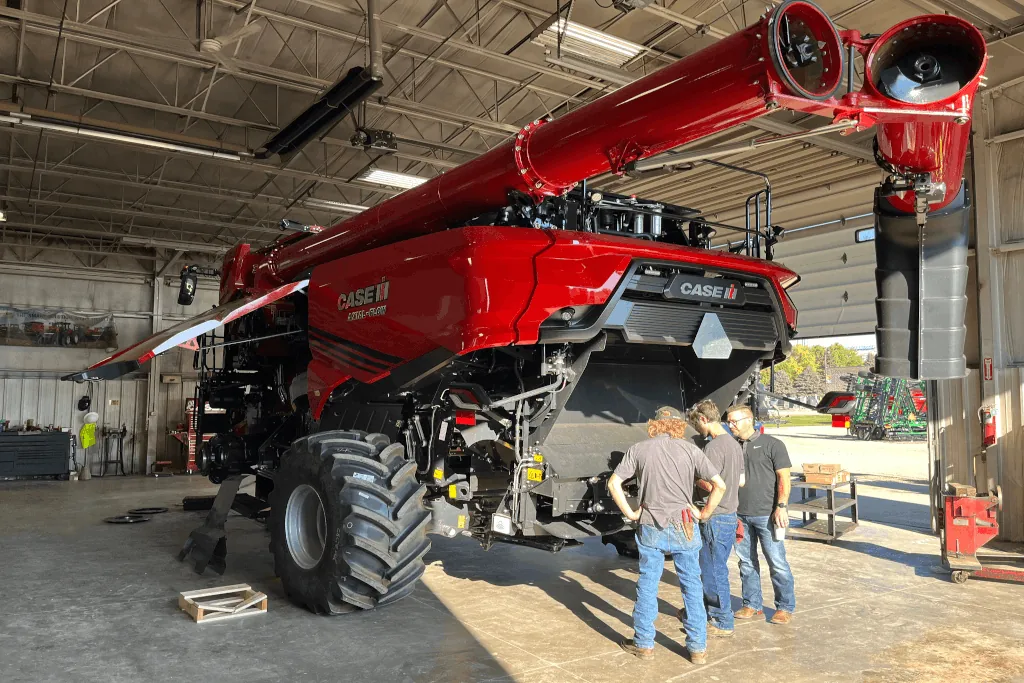
Canadian AI agritech startup Brilliant Harvest, serving the heavy equipment industry, has raised $4M ($5.4M CAD) in seed funding. The round includes new investors FTW Ventures, Alpaca VC, Automotive Ventures, SVG THRIVE, and NYA Ventures, alongside existing backers Builders VC and AltaML.
The funding supports Brilliant Harvest’s continued expansion in the heavy equipment dealer segment. The company said its platform is currently used by dealerships representing more than 50% of CNH Industrial’s large dealer stores. Brilliant Harvest added that capital efficiency remains a focus as adoption increases.
We didn’t build a chatbot; we built an industrial-grade infrastructure layer for dealerships. When the most progressive dealerships from CNH, AGCO and Kubota quickly adopt the solution, it tells us dealerships are ready for tools they can truly trust in high-stakes environments. This capital allows us to deepen our market leadership and roll out high-value products that extend beyond service teams.
Brilliant Harvest is an AI-based customer experience platform focused on the heavy equipment industry. The company’s software is used by dealerships to support service, parts, and aftermarket teams by organizing and surfacing technical information to improve workflow efficiency. The platform is designed for operational environments where equipment uptime and information accuracy are critical.
AI Applied to Service Operations
Brilliant Harvest’s platform aggregates technical manuals, work orders, and conversational data to provide search and response capabilities for technicians, service teams, and aftermarket operations.
Also read: Bartronics India to Launch Multilingual, Voice-Based Agritech Platform
According to Brilliant Harvest, its platform uses a proprietary data ingestion process combined with a human-in-the-loop verification layer to reduce errors associated with generic large language models. The company said this approach is intended to ensure that technical outputs, such as specifications and part information, remain accurate and aligned with OEM documentation.
The company’s presence in the market includes multiyear renewals with Rocky Mountain Equipment (RME) and Titan Machinery. According to Titan Machinery, the platform is being used to bring internal service-related information into a single system, supporting efforts to improve response times for customers.
Brilliant Harvest has cracked the code on ‘support deflection’ in a way we rarely see. Dealers are drowning in low-value phone calls that kill service absorption rates. Brilliant Harvest stops the phone from ringing with trivial questions so high-value technicians can focus on billable hours and customers experience first-contact resolution. It’s a pragmatic, high-ROI application of AI that dealerships are adopting immediately.
The investment syndicate brings together experience across agriculture, automotive, and deep technology. FTW Ventures contributes exposure to food and industrial systems, while Automotive Ventures adds connections within dealership and service networks. Alpaca VC, SVG Ventures, and NYA Ventures bring experience in B2B platforms and agritech scale-up.
Operational AI Faces Scale Test
This funding round suggests that AI adoption in the heavy equipment dealer ecosystem may be moving beyond experimentation toward more embedded operational use. Dealerships manage highly fragmented technical knowledge across OEM manuals, service histories, and informal expertise, and the persistence of this fragmentation has long constrained service productivity. Brilliant Harvest’s traction indicates that dealers may now see structured AI systems as a practical layer for managing this complexity rather than a future-facing add-on.
The involvement of investors spanning agritech, automotive, and enterprise software could signal a broader convergence between industrial operations and customer experience technology. As equipment becomes more software-driven and service expectations tighten, platforms that sit between machinery data and frontline teams may become increasingly central. Multiyear renewals also hint that switching costs and workflow integration could play a larger role in vendor selection going forward.
At the same time, the emphasis on verification and human oversight reflects ongoing caution around AI reliability in mission-critical environments. If this balance between automation and control proves scalable, similar models may emerge across other industrial service-heavy sectors.


