German agricultural equipment manufacturer Claas via its Corporate Venture Capital unit Seed Green Innovations, has made a strategic investment in Pheno-Inspect, a German agritech company specializing in AI-based, image-driven field analysis. Through the investment, Claas is seeking to enable faster and more objective field analysis without relying on additional sensors or specialised measurement equipment. The funding will be used to further develop the underlying AI models and to expand the interdisciplinary team behind the platform, with the aim of extending functionality across a wider range of crops and growing conditions.
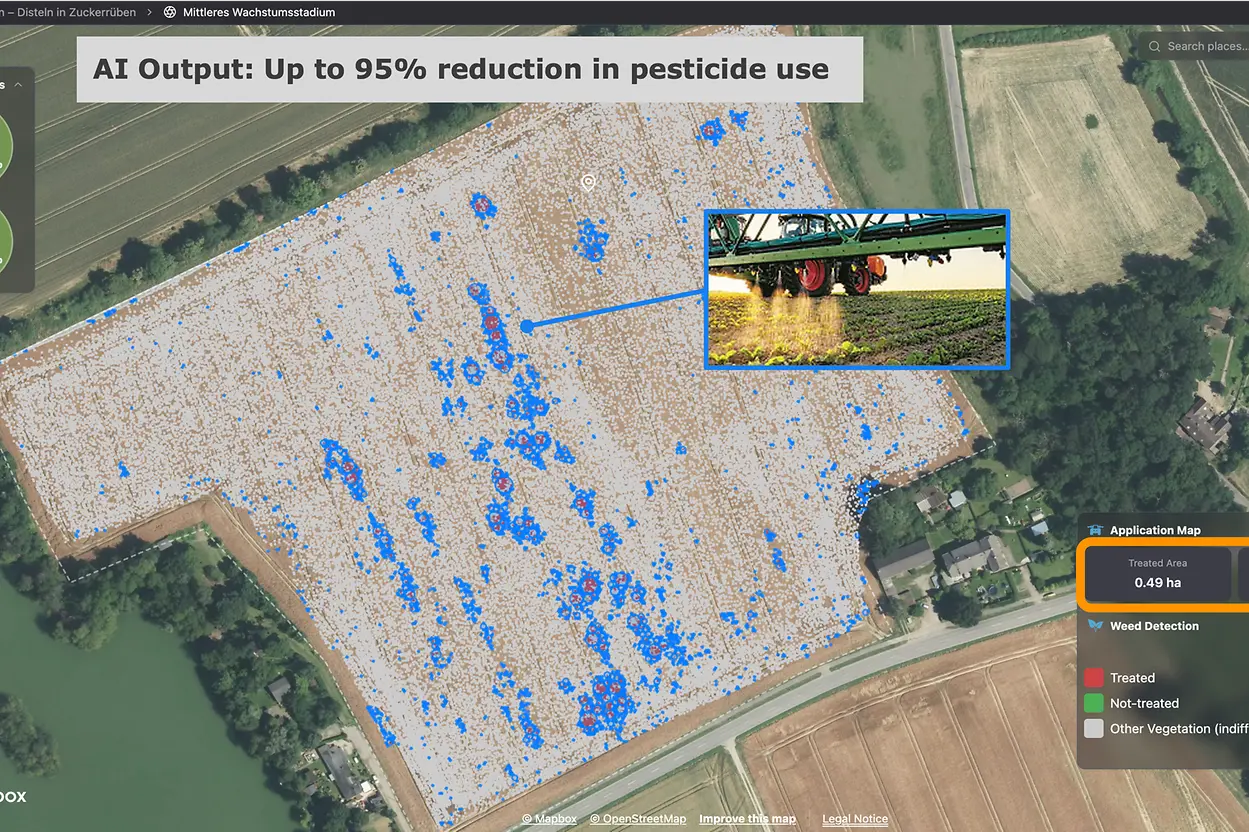
Pheno-Inspect’s cloud-based platform processes high-resolution images captured by standard drones to identify variations in crop growth, plant stress, density and weed presence.The resulting insights can be translated into task maps for variable-rate application of fertilisers and crop protection inputs, allowing growers to target treatments more precisely rather than applying inputs uniformly across entire fields.
Pheno-Inspect’s platform is positioned for use by farmers, agribusinesses, custom applicators and research organisations that require scalable field analytics without complex or sensor-heavy infrastructure. By digitising crop monitoring and analysis, the system is intended to support more targeted application strategies and reduce dependence on manual field scouting.
According to Pheno-Inspect, the technology enables much of the field scouting process to be carried out digitally, with crop development monitored across the growing season. The platform can automatically differentiate between crops and weeds, forming the basis for targeted, precision spraying. The company states that in certain use cases this approach can reduce the application of crop protection products by up to 95%, although independently verified on-farm data remains limited.
Linking AI Software With Machinery Workflows
For CLAAS, the investment provides early access to emerging digital agronomy technologies that complement its existing product and solutions portfolio. As AI-based decision support becomes more relevant in farm operations, partnerships of this type are increasingly being used to connect machinery, data analytics and agronomic expertise into more integrated offerings.
The investment takes the form of a strategic stake rather than a full acquisition. Claas has completed relatively few direct technology acquisitions, although it entered into a partnership in 2021 with autonomous robotics company AgXeed focused on the development of autonomous field machinery.
Also read: Seedbox Solution Merges with Trace Engineering to Advance BOXIQ Platform
The investment reflects a shared interest in advancing digital, data-based processes in agriculture. By combining Pheno-Inspect’s AI and software capabilities with Claas’ experience in agricultural machinery, system integration and on-farm workflows, the partners are seeking to improve the practical application of digital agronomy tools.
The platform supports applications across the growing season, enabling analysis at individual plant level as well as field-wide evaluation. This addresses common challenges in traditional field scouting, such as subjectivity, time intensity, and limited spatial coverage.
Software-Led Analytics Without Deep Platform Integration
Precision agriculture, crop management and agronomic decision-making are increasingly shaped by data-based insights aimed at improving efficiency, sustainability and input use. The stated focus of the Claas’s investment is on supporting faster and more consistent decision-making related to crop protection, fertilisation and yield optimisation, while enabling more efficient use of inputs and resources.
The investment by Claas in Pheno-Inspect points to a measured approach to digital agronomy, where software capability is added alongside, rather than embedded directly into, machinery platforms. It suggests an interest in field-level analytics without committing to full ownership or large-scale platform integration at an early stage.
By aligning with an image-based, sensor-light system, Claas may be exploring how digital tools can fit into existing farming workflows with lower adoption barriers. The emphasis on software-driven insights could indicate a focus on decision support that operates independently of proprietary hardware ecosystems.
More broadly, the move reflects how machinery manufacturers may increasingly test emerging agronomy technologies through minority investments. As AI-based field analytics matures, such partnerships could shape how digital agronomy tools are validated, adapted and eventually scaled within mainstream farm operations.