
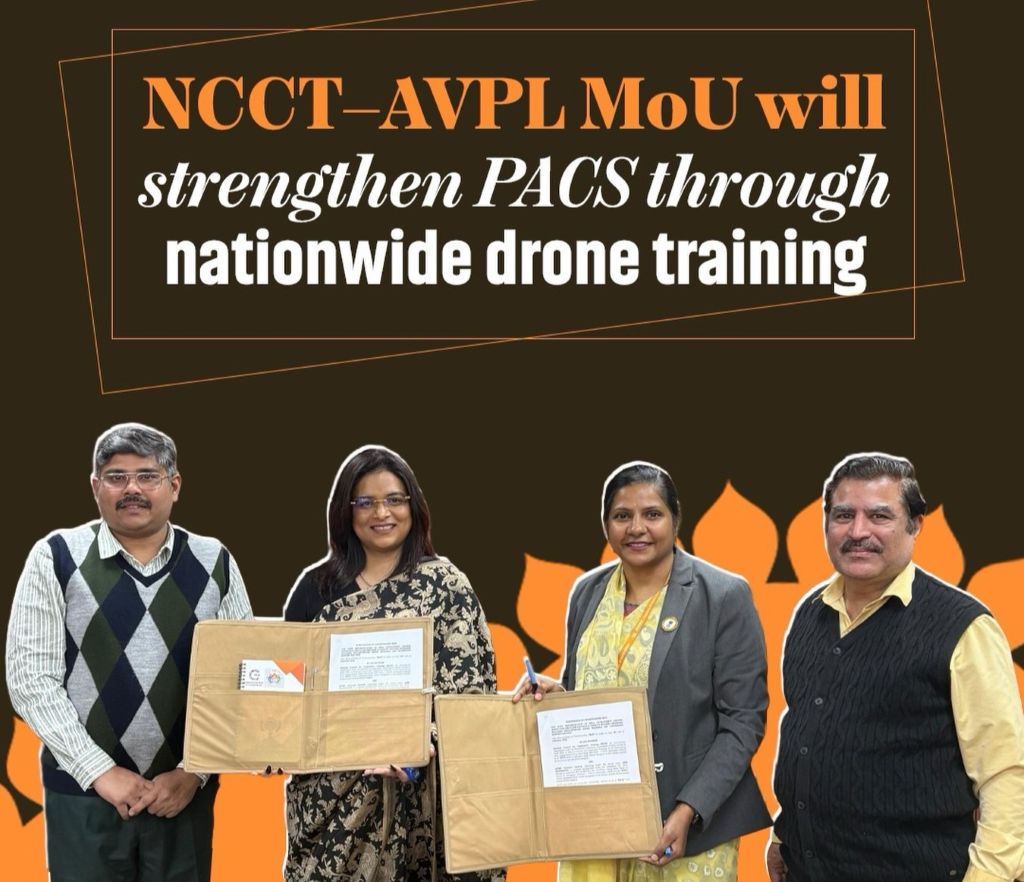
The National Council for Cooperative Training (NCCT) and AVPL International have formalised a Memorandum of Understanding to operationalise drone based skilling and technology deployment across Primary Agricultural Credit Societies (PACS), with facilitation from the Ministry of Cooperation. The agreement establishes the framework for certified training, technical support and entrepreneurship pathways, positioning PACS to integrate modern tools into their operations and expand into technology driven, income generating rural services.
Aligned with the government’s “Sahkar Se Samriddhi” vision, the partnership is designed to accelerate the adoption of drone enabled services across Primary Agricultural Credit Societies (PACS), positioning them to move beyond traditional credit delivery into technology driven, income generating rural activities. The agreement establishes a complete drone entrepreneurship ecosystem within cooperatives, anchored in counselling, DGCA aligned certified skill training, drone allocation, continuous handholding, and the creation of sustainable Drone-as-a-Service opportunities.
From training to entrepreneurship: a structured pathway for PACS
Central to the MoU is a structured implementation model that goes beyond operational instruction. AVPL International will design and deliver certified Remote Pilot Training programmes aligned with norms of the Directorate General of Civil Aviation, alongside building operational and technical support systems that enable PACS to deploy drone services efficiently. The focus is not only on producing licensed pilots, but on cultivating entrepreneurship, equipping cooperative members to run service-led micro-enterprises anchored in local demand.
The courses will cover drone operations, safety compliance, aerial spraying techniques, crop monitoring, mapping and basic maintenance. With DGCA recognised certification, trainees become eligible for commercial operations, unlocking fee based service models at the village level. AVPL will also provide ongoing technical handholding to ensure continuity of service delivery and long-term viability.
The larger objective is to reposition PACS as technology enabled rural enterprises by integrating drones into everyday agricultural workflows, supporting precision agriculture, improving crop efficiency and service delivery, creating rural drone entrepreneurs, and strengthening institutional resilience. According to AVPL, the initiative reflects its mission to democratise drone technology across India and accelerate technology driven rural development through national partnerships, with an execution focused roadmap for tech enabled, entrepreneur driven villages.
PACS at an inflection point as new mandates take effect
The timing of the collaboration coincides with a major policy shift. With the Ministry of Cooperation assigning 54 new business activities to Primary Agricultural Credit Societies, spanning agri input distribution, storage, rural services and digital facilitation, the need for technology led capacity building at the grassroots has become more urgent. Drone based agricultural services are now emerging as a practical opportunity within this expanded mandate.
India’s network of over 63,000 PACS forms the backbone of the rural cooperative credit system. Traditionally focused on short term agricultural lending and input distribution, these societies are being repositioned as multipurpose rural service centres. The government’s reform agenda includes computerisation of PACS, diversification into storage and processing, and alignment with national initiatives such as natural farming and crop insurance. Within this evolving ecosystem, drone services are being viewed as a pathway for PACS to transition from credit providers to tech enabled agri service hubs.
Also read: Source.ag Launches Sensor-Free PAR Reconstruction Tool
Demand for agricultural drones has increased following policy support that permits their use for pesticide spraying, nutrient application and crop assessment. Precision spraying enables lower chemical usage, water savings and improved operational efficiency, especially across large or difficult terrains. For small and marginal farmers, accessing these services through local PACS can make advanced tools both affordable and accessible.
Institutional capacity meets field execution
NCCT, as the apex training body for the cooperative sector, brings established expertise in human resource development and cooperative education, operating through a nationwide network of regional and state level cooperative management institutes that conduct thousands of programmes annually. By integrating drone training into its curriculum, NCCT is extending its mandate from conventional cooperative management to advanced technological skill development.
AVPL International contributes its experience in agricultural unmanned aerial systems and its network of DGCA approved training centres. The company’s outreach model emphasises rural entrepreneurship, aiming to create village level drone service providers who can support farmers locally while generating sustainable livelihoods.
Officials associated with the initiative expect the collaboration to strengthen PACS operations while creating employment pathways for rural youth. Trained members will be able to offer spraying, surveying and crop analytics services within and beyond their villages, reinforcing cooperative revenues and expanding service portfolios. As PACS step into their 54 expanded responsibilities, technology integration is set to be a determining factor in operational success.
The NCCT and AVPL agreement signals a coordinated push to modernise India’s cooperative landscape, aligning policy intent with on-ground execution and ensuring that grassroots institutions remain economically relevant in an increasingly digitised agricultural economy.


