
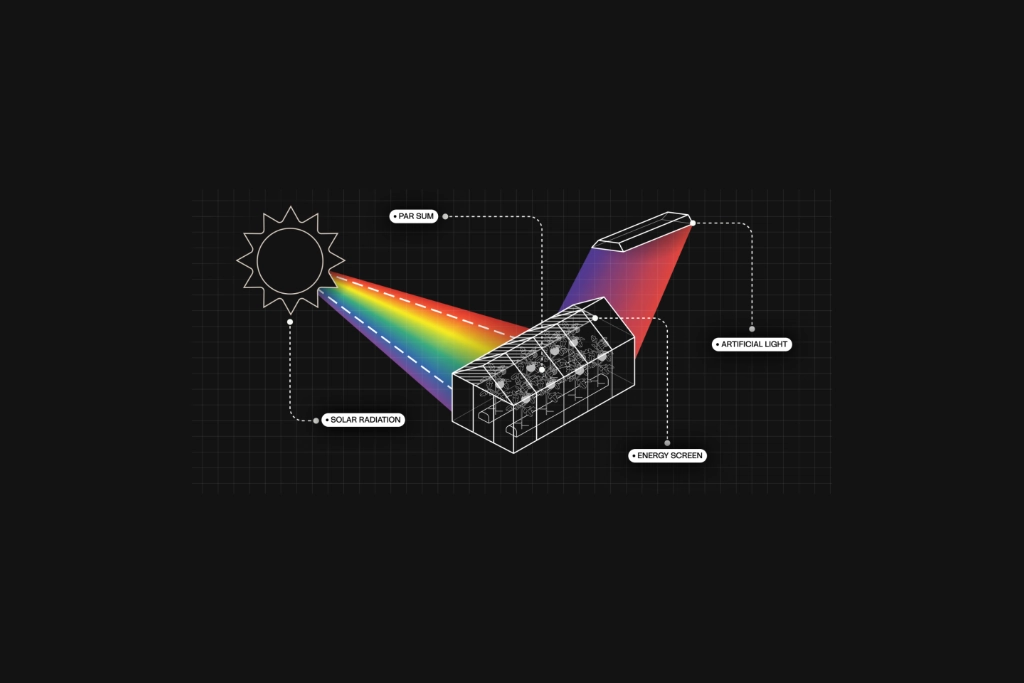
Dutch agritech company Source.ag has introduced Approximated PAR Sum, a data-reconstruction feature for high-tech greenhouses that estimates Photosynthetically Active Radiation (PAR) without the use of dedicated PAR sensors. The tool generates daily PAR totals using existing greenhouse data inputs such as solar radiation measurements, glazing transmission factors, screen positions, and artificial lighting output. Daily usable light is expressed in mol/m².
PAR refers to the 400-700 nanometer wavelength range used by plants for photosynthesis, the process responsible for growth and yield formation. Standard weather stations typically measure total solar radiation, which includes wavelengths not absorbed by crops.
Our goal was to turn existing greenhouse data into growing insight. With Approximated PAR Sum, we’ve minimized the dependency on physical sensors to reach a new level of modeling accuracy. We are essentially enhancing plant data, allowing growers to optimize for photosynthesis rather than just tracking the weather.
In controlled-environment agriculture (CEA), PAR measurement plays a role in crop cycle planning, supplemental lighting management, and energy optimization. By focusing specifically on radiation, growers can evaluate the share of light that plants are biologically able to use for photosynthesis rather than total radiation levels.
According to the company, the feature is intended to reduce dependence on specialized PAR hardware by reconstructing light data from available operational data streams. Daily usable light totals, expressed in mol/m², are calculated based on solar radiation data, structural transmission losses within the greenhouse, shade screen positions, and artificial lighting systems, including both HPS and LED fixtures.
Canopy-Level Light Intelligence
According to the company, the platform reconstructs canopy-level light conditions through calculations updated every five minutes. The system integrates real-time radiation data, adjustments for transmission losses through greenhouse structures, screen positions and types, and artificial lighting output measured in μmol/m²/s.
The tool also incorporates sensor health diagnostics to identify irregularities in data flows and is integrated with the company’s crop modeling platform. Approximated PAR Sum is available to existing users of Source.ag’s system.
Also read: Agriculture Counsellor Marion van Schaik Highlights AI Focus in Indo-Dutch Agritech Pact
For greenhouses that already operate PAR sensors, the feature can function as a reference point for validation. Physical sensors may be affected by dust accumulation, shading from structural components, or calibration drift over time. By comparing recorded sensor readings with reconstructed PAR values, discrepancies can be identified at an earlier stage, helping maintain consistency and reliability in light data.
According to Source.ag, the launch of Approximated PAR Sum reflects a shift away from hardware dependency toward software-driven plant science. The company states that by making reconstructed PAR metrics available across greenhouse configurations, it aims to broaden access to consistent light data and support greater biological accuracy in crop management.
Software-Led Light Modeling
The introduction of reconstructed PAR metrics by Source.ag reflects a broader evolution in controlled-environment agriculture, where software layers are increasingly supplementing or replacing standalone hardware. As greenhouse operations scale, Source.ag’s approach highlights how reducing dependency on physical sensors can lower maintenance complexity while helping standardize data streams across facilities.
Accurate tracking remains central to yield forecasting, energy optimization, and crop steering. By aligning daylight and artificial lighting inputs within a unified metric, greenhouse managers gain a clearer view of usable light rather than total radiation. In this context, Source.ag’s reconstruction model positions light data as a more consistent input for biological and operational decision-making.
The move also highlights the expanding role of predictive analytics in horticulture, where cultivation decisions are increasingly shaped by integrated data models rather than isolated measurements. As crop steering, yield forecasting, and energy optimization become more data-intensive, tools that standardize critical inputs such as light can strengthen model reliability.
In this context, developments such as those introduced by Source.ag may influence how growers evaluate capital investments, refine climate control strategies, and structure long-term production planning within high-tech greenhouse systems.


