
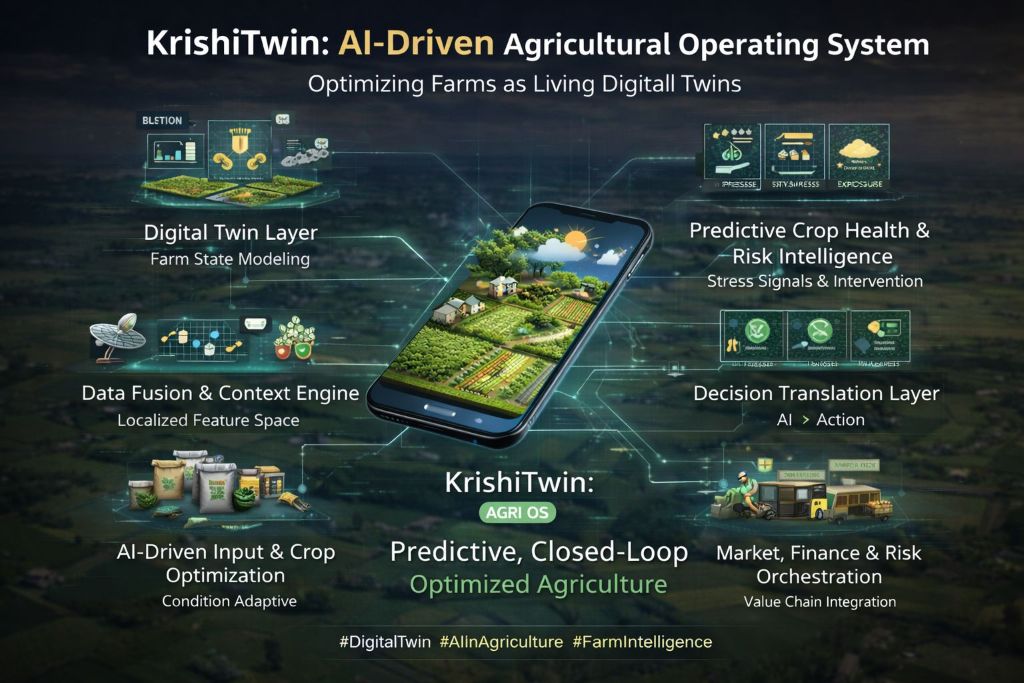
Across India’s agricultural landscape, where farmers continue to rely on a patchwork of digital tools that address isolated needs, KrishiTwin is being introduced as an artificial intelligence, driven agricultural operating system. Soil analysis applications, market price alerts, and irrigation calculators operate independently, offering little integration with on-ground production realities or downstream requirements linked to markets and finance. As a result, decisions on irrigation, crop protection, fertilization, and harvest timing are often shaped by intuition or incomplete datasets rather than continuous, contextual intelligence, leaving farmers exposed to risks ranging from pest outbreaks to market volatility.
Positioned within this environment, KrishiTwin is described by its developers as an artificial intelligence driven system designed to compute agriculture as a complete cyber physical production framework rather than merely digitizing farm inputs. Unlike standalone advisory or marketplace applications, the platform is built to span the full lifecycle of crop production while linking it with markets, finance, and risk management systems.
A Virtual Replica of the Farm in Real Time
At the heart of KrishiTwin is a digital twin layer that builds a living virtual model for every individual farm. This model draws on soil chemistry, crop phenology, historical yield records, weather trajectories, satellite imagery and farmer practice data, creating a continuously updated view of on-ground conditions. Where most agritech tools provide point in time reports, KrishiTwin’s approach maintains a stateful representation of the farm throughout the crop cycle.
Fusing Diverse Data with Context
To make this digital twin meaningful for real farming decisions, KrishiTwin integrates a range of data sources through its data fusion and context engine. Inputs from remote sensing, IoT proxies, weather forecasts and agronomic knowledge systems are merged into a context-aware environment that supports localized inference rather than broad, generic recommendations. This capability aims to ensure that insights are tailored to each farm’s unique conditions.
AI Assisted Decisions, Not Static Rules
Once data is contextualized for an individual farm, KrishiTwin applies machine learning models and rule-based agronomy systems to guide decisions about crop inputs such as seed varieties, nutrients and protection measures, including the timing and dosage of each. These decisions are designed to be adaptive to changing conditions rather than fixed prescriptions, enabling responsive management throughout the season.
Watching for Early Stress Signals
Part of the system’s analytic capability is dedicated to predictive crop health and risk intelligence. By employing temporal models and anomaly detection techniques, KrishiTwin seeks to flag early indicators of biotic and abiotic stress, such as pest pressure, water deficits, nutrient imbalance and climate shock exposure. The intention is to enable interventions before small signals escalate into yield reducing events.
Turning Analytics into Field Action
Computational recommendations hold value only if they can be translated into operational decisions. KrishiTwin’s decision translation layer maps complex model outputs into actionable guidance that specifies what should be done, when it should be executed, and the expected impact along with its risk profile. This layer is intended to bridge the gap between advanced analytics and practical on-field decisions.
Linking Farm Data to Markets, Finance and Risk Systems
In a departure from tools that stop at agronomy, KrishiTwin extends into harvest forecasting and aggregation, institutional buyer matching, and readiness for embedded finance and insurance. Verified performance data flows into these downstream systems with the goal of reducing information asymmetry across the agricultural value chain and enabling more seamless engagement with markets and capital.
Digital Traceability and Post Harvest Insight
KrishiTwin also builds traceability into the system by using blockchain hashing to record every seed, spray, harvest and shipment event. Post harvest modules incorporate grading, moisture monitoring, digital warehousing and packaging analytics, aiming to curtail post harvest losses and enhance quality-linked value capture.
Also read: Fyllo Partners with HyFarm to Advance Data Driven Potato Cultivation
Adding to its operational scope, the platform includes direct-to-consumer storefronts, buyer dashboards, pricing control and delivery integration. These features are intended to allow farmers to interact directly with buyers and manage sales logistics without intermediaries.
Finance, Insurance and Logistics as Part of the System
On the finance front, KrishiTwin combines AI based risk scoring with verified digital farm records to support faster access to credit products such as Kisan Credit Cards, alternative investment funds and subsidies, while also seeking to streamline claim validation for crop insurance through satellite, sensor and weather data analytics. Logistics capabilities emphasize cold chain routing, load optimization and real time shipment visibility, aligning agricultural movement with reliable logistics standards.
Framing an Agri Operating System for India
KrishiTwin’s core premise is that farmers are the CEOs of their soil and should be equipped with a system that connects production realities with market access, finance, risk management and logistics. By integrating these facets into a continuous, data driven framework, the platform aims to redefine how agricultural activity is coordinated and executed in India. In this framing, agriculture is not simply digitized; it is computed as a system where decisions flow from integrated data and insights across the farm-to-shelf continuum.


