
In a country where sunlight is abundant and sun drying papads and pickles remains a household ritual, the idea of solar drying is far from new. Yet, in the context of India’s agricultural economy, the stakes around drying have shifted dramatically. According to a Government of India report, farmers lose over INR 1.5 lakh crore worth of produce every year due to post harvest losses. At a time when the country is working towards becoming ‘Atmanirbhar’ and positioning itself as the world’s third largest economy, such losses represent a structural economic gap.
Compounding the issue is the rigid demand pattern of modern retail and quick commerce platforms. Uniform size, shape, and colour increasingly dictate procurement decisions. Nature, however, does not produce in templates. As a result, nearly 20 to 30 percent of a farmer’s best tasting produce is rejected for cosmetic reasons alone, leading to large scale wastage at the farm level. It was this disconnect that prompted Indore based engineer Varun Raheja to intervene.
The Origin of an Idea
Varun Raheja, founder and director of Raheja Solar Food Processing completed his B.Tech in Mechanical Engineering from Medicaps University, Indore, in 2018. During his college years, while many peers focused on placements, he began experimenting with composting and solar drying.
What he observed altered his trajectory. Compost made from ruined fruit could fetch around INR 40 per kg. Solar dried products made from the same raw material could command prices up to INR 5,000 per kg. The value differential revealed a clear opportunity.
I used to feel disheartened to see farmers who invested their money and months of effort into producing fruits and vegetables throwing them away. I realised that this was my calling.
In 2017-18, while still in college, Varun built his first solar dryer on his home terrace using INR 25,000-30,000 from his personal savings. The unit had a capacity of 20 to 25 kg. He registered his firm in 2018 and formally incorporated it as Raheja Solar Food Processing in 2019.
Throughout this period, his mother and co-founder, Babita Raheja, played an integral role. While Varun focused on engineering design, she worked on refining drying processes to preserve taste, colour, and nutritional value. A formative phase came during his internship under Padma Shri Dr Janak Palta McGilligan, where he gained hands-on exposure to solar dehydration and understood how sustainable technology could directly improve farm incomes.
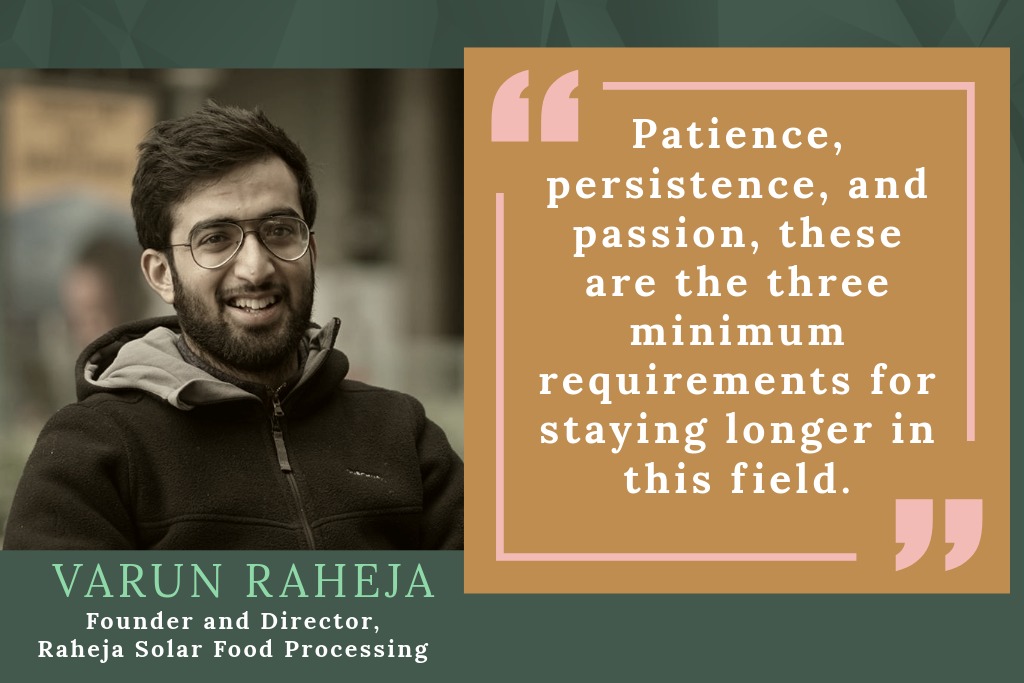
“Patience, persistence, and passion, these are the three minimum requirements for staying longer in this field,” Varun says.
Confronting Mindset Barriers
The early challenge was not technological but behavioural. Many farmers did not view post harvest losses as abnormal or as a macroeconomic issue. This created a trust deficit. As a young entrepreneur introducing new technology, Varun encountered hesitation and lack of transparency.
It’s always a challenge when you go to a new location as a young entrepreneur. It was hard to convince them directly because they were not transparent and lacked trust in new technology.
Recognising this, he shifted strategy. Instead of approaching farmers individually, he began collaborating with NGOs and Farmer Producer Organisations that already had deep local relationships. Social entrepreneurship proved demanding, and Varun set himself a 4-5 year window to validate whether the model could sustain itself.
“You are not just selling a product; you are trying to change a lifestyle and a mindset,” he noted.
Building the Infrastructure Backbone
Today, Raheja Solar operates from a 43,000 sq. ft. facility in Indore that functions as its central manufacturing and operations hub. The rented and customised space houses manufacturing and product development units, a research and development section for testing new designs and refining drying techniques, a quality control lab to monitor moisture levels and hygiene standards, raw material and finished goods storage areas, a processing and packaging unit for value-added products, a Farmer Central training centre, and administrative offices overseeing operations, partnerships, supply chains, and market linkages.
The company has installed over 8,000 solar dryers across 26 Indian states, including Kashmir, Arunachal Pradesh, Odisha, Rajasthan, Bihar, and Chhattisgarh. International expansion has reached Kenya, Malawi, Indonesia, and Bhutan. Its network now supports more than one lakh farmers across India and parts of Africa.
Each unit replaces fuel based drying methods, reducing carbon emissions while helping farmers increase income by 40 to 50 percent by enabling storage and sale at more favourable prices.
The Technology and Product Range
Raheja Solar manufactures foldable, modular solar dryers that operate without electricity or chemicals. Using the greenhouse effect, these systems remove moisture while preserving up to 80 percent of nutrients. The portfolio includes three models. Sahaj is designed for small farmers or home use, with a 20 to 25 kg capacity and pricing of INR 25,000-30,000. It can be installed on terraces or small land parcels and is suitable for herbs, flowers, and sliced fruits.
Samagra caters to farmer groups and self-help groups, drying 40-100 kg per batch. Priced between INR 48,000 and INR 96,000, it is suited for vegetables such as tomatoes and onions and semi commercial operations. Agraj is built for industrial-scale use, handling 500-1,000 kg per batch. Depending on customisation, it can cost up to INR 3.5 lakh.
A key feature is that even our largest 40-foot commercial dryers can be folded into a five foot box. This portability means we can reach remote farmers in Kashmir or the North East, where heavy machinery simply cannot go.
In 2025-26, IoT sensors were integrated into larger models, enabling remote monitoring of drying quality through a mobile application.

Science Behind the Process
According to Varun, solar drying in enclosed systems addresses the limitations of traditional open-sun drying. Direct exposure to harsh sunlight can cause discolouration and bleaching. Modern dryers use UV stabilised sheets that trap heat while blocking harmful rays, preserving natural colour.
The technology also prevents “case hardening,” where the outer layer dries too quickly and traps internal moisture. Controlled airflow and temperature ensure even drying. Enclosed systems protect produce from dust and insects while preserving sugars, aroma, and nutrients.
“If I convert 10 kg of tomatoes into sun dried tomatoes, the value jumps from INR 40 to INR 5,000. There is a massive business hidden in what we call waste,” he said.
The Hub-and-Spoke Model
Raheja Solar operates on a hub-and-spoke model, selling patented dryers to farmers, SHGs, and NGOs while providing specialised training in dehydration science, temperature management, and hygiene standards aligned with export quality. To address the recurring question of market access, the company offers guaranteed buy back agreements, purchasing dried produce at fair, fixed prices. This shields farmers from volatility in fresh markets.
The company supplies dried ingredients such as sun dried tomatoes, herbs, and fruit chunks to over 250 brands, including Chayos, Happilo, and Farmley. Through its D2C brand, Bare Fruit, it retails fruit bars, sun-dried tomatoes, dried flowers, and pancake premixes with 67 percent real fruit via its website and platforms like Amazon, BigBasket, and Jio Mart.
Supported by Tata Trusts, Reliance Foundation, IDFC First Bank, Villgro, ICAR, CEEW, and UNEP, the company also facilitates dryer clusters in villages and provides PMFME scheme guidance, training, and awareness programmes.
Aslo read: INTERVIEW | Adil Jamal on How SK Natural Farm Aligns Technology With Farmers’ Ground Realities
Revenue, Funding, and Scale
In FY24, Raheja Solar reported revenue of INR 7.07 crore. In FY25, revenue rose to INR 12 crore. For FY26, projections indicate INR 25-28 crore. In early 2025, the company raised angel funding of approximately $144,000-$200,000 (INR 1.2-1.67 crore), including investment from Upaya Social Ventures, to scale operations and expand its farmer network.
The Indore facility processes over 115 metric tonnes of fresh produce each month. A small 20 kg dryer can generate up to INR 60,000 in monthly revenue for a farmer, while mid-sized units can enable annual earnings of up to INR 10 lakh, depending on demand.
National Spotlight
Varun Raheja and Babita Raheja appeared on Shark Tank India Season 4, Episode 22, seeking INR 50 lakh for 1 percent equity at a INR 50 crore valuation. After negotiations, they secured INR 1.75 crore for 7 percent equity from Kunal Bahl, Peyush Bansal, and Vineeta Singh, valuing the company at around INR 40 crore.

Following the show, the farmer network expanded to over 65,000 and IoT enabled dryers were further strengthened. Revenue in FY 2025-26 is projected to cross INR 25 crore.
The Road Ahead
Raheja Solar now operates across 28 Indian states and countries including Kenya, Nepal, and Bhutan, with expansion plans targeting South America, Southeast Asia, and wider Africa. The stated goal is to empower five million farmers by 2030.
“My aim is to reduce wasted produce and, by doing so, stop farmer suicides in India and all over the world.”
From a terrace built prototype to a 43,000 sq. ft. operational hub, the journey of Raheja Solar Food Processin reflects an effort to ensure that no farmer’s produce is wasted due to inadequate drying infrastructure or lack of market access, while advancing solar powered entrepreneurship as a response to one of India’s largest agricultural challenges.


