
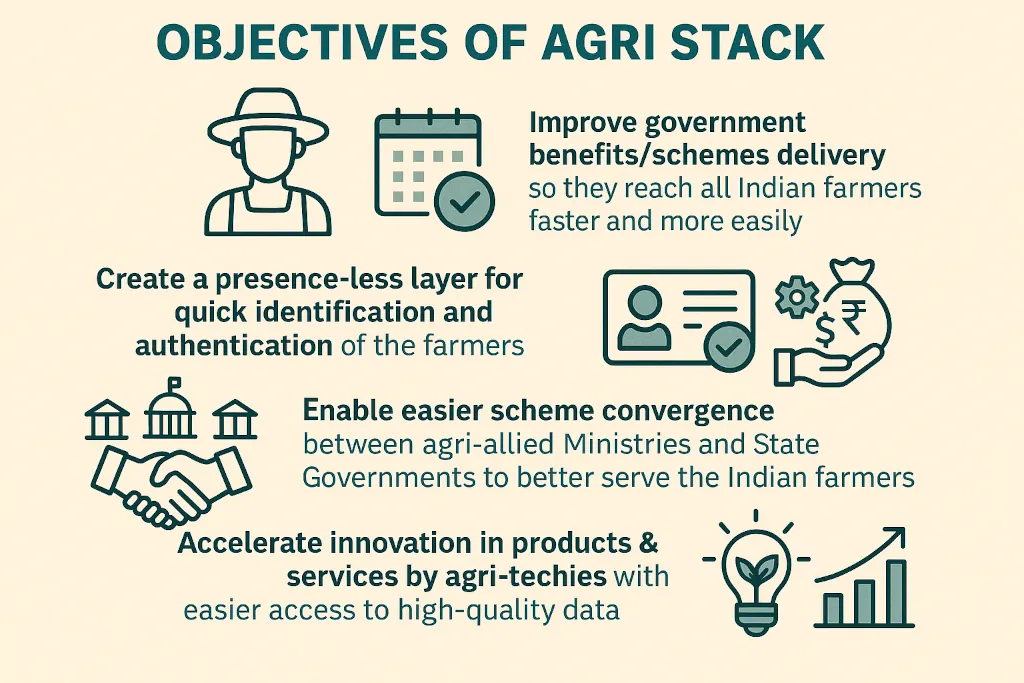
India’s push toward a fully digital agriculture ecosystem is accelerating — with over 7.2 crore (72 million) farmers already assigned digital IDs and five more states preparing to come on board. As reported by The Financial Express, Punjab, Haryana, Himachal Pradesh, Uttarakhand, and Jammu & Kashmir are now set to join the Centre’s flagship Agri-Stack initiative, which aims to create a unified database of farmers by integrating identity records, crop data, and land information across the country.
At present, 29 states, barring West Bengal and a few Union Territories, have signed Memorandums of Understanding (MoUs) for Agri-Stack implementation. The digital framework of Agri-Stack is designed to consolidate farmer-level data, enabling states and policymakers to frame more targeted and efficient agricultural schemes.
According to official estimates cited by The Financial Express, 14 states have issued over 7.2 crore (72 million) farmer IDs, known as Kisan Pehchaan Patra. The government plans to reach 9 crore (90 million) IDs by next year and 11 crore (110 million) by 2027, with the overarching goal of capturing India’s farmer demographics, landholdings, and cropping patterns more accurately.
Digital Crop Survey for Data-Driven Agriculture
As noted by PIB, earlier this year, a total allocation of ₹6,000 crore (₹60 billion) was announced to support States—₹4,000 crore (₹40 billion) earmarked for Farmer Registry (including legal heir systems), and ₹2,000 crore (₹20 billion) for Digital Crop Survey (DCS), on a first-come-first-served basis.
The DCS is currently being implemented across 18 states and Union Territories during the 2025–26 kharif season, providing the government with more accurate crop output estimates.
Also read: Agroz and Harvest Today Collaborate to Launch Groz Wall for Indoor Farming
As reported by The Financial Express, progress in farmer digital ID generation and DCS rollout is already being leveraged to deliver multiple government services , including direct benefit transfers under PM-Kisan, digital agricultural credit, issuance of soil health cards, and targeted subsidy delivery.While the data remains under ownership of the respective states, the farmer registry platform allows the inclusion of tenant and lessee farmers, subject to state policy. According to the agriculture ministry, about 30-40% of India’s gross cropped area is cultivated by farmers who do not hold formal land ownership.
Issuance of Digital ID’s, UP, Maharashtra lead the way
Among states that have already adopted Agri-Stack, Uttar Pradesh leads with 1.47 crore (14.7 million) farmer IDs, followed by Maharashtra with 1.18 crore (11.8 million), Madhya Pradesh with 91 lakh (9.1 million), Rajasthan with 78 lakh (7.8 million), Gujarat with 57 lakh (5.7 million), and Andhra Pradesh with 45 lakh (4.5 million). Tamil Nadu and Telangana have each issued about 31 lakh (3.1 million) IDs, The Financial Express reported.
Under Agri-Stack, databases of geo-referenced village maps, crop-sown registries, and farmer ID registries are being created. According to the agriculture ministry, 30 states have, in principle, agreed to build these digital systems.
Scaling India’s Digital Agriculture with Agri-Stack
The Agri-Stack project could represent a cornerstone of India’s digital agriculture vision, which aligns with the broader goals of precision farming, direct income support, and data-led policy making. Approval form remaining states and the completion of the digital crop survey could define the pace at which the initiative translates into tangible benefits for farmers.
As the Agri-Stack initiative expands, India could see the emergence of a unified Farmer Data Platform, improving transparency, reducing duplication across schemes, and helping tailor interventions to local needs, a transformation that could re-calibrate how agricultural services are designed and delivered across rural India.

