
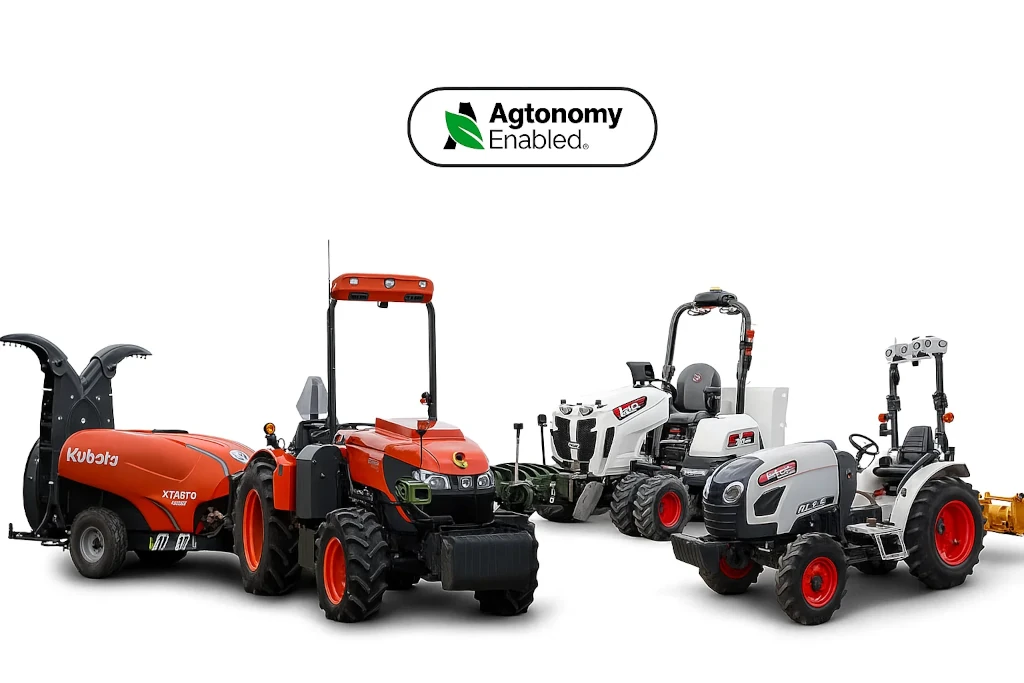
Agtonomy, a software based services comapny that leverages AI to deliver solutions for agricultural and land maintenance equipment, has announced a strategic expansion within the US, unveiling new deployments in the US Southeast and has also launched its inaugural international commercial initiative in Australia.
Agtonomy aims to speed up the use of autonomous, AI-powered vehicles among farmers, aiming to bring advanced agricultural tools to more regions. Their goal is to help specialty crop growers and land managers boost efficiency and productivity across the globe.
Agtonomy Expands Operations
Agtonomy’s commercial debut in Australia could mark a potential turning point for the company’s global operations. This initiative brings a physical AI platform to Australian producers, empowering them to address growing labor and productivity challenges with scalable, autonomous solutions purpose-built for both specialty and permanent crops.
Agtonomy is building something truly transformative bringing physical AI to industrial markets that are desperate for more automation to make ends meet
If successful, Agtonomy’s expansion into the southeastern US could broaden farmers’ access to Agtonomy-enabled equipment across key specialty crop and green space sectors, potentially providing producers and land managers in southeastern US with greater exposure to automation solutions.
With its new expansion, Agtonomy seeks to increase industry reliance on intelligent automation to address persistent agricultural challenges such as labor shortages, rising operational costs, and the urgent need for sustainable practices. By transforming traditional agricultural machinery into smart, self-driving units, the company aims to redefine the operational paradigm for specialty crop producers and land managers worldwide
Scaling Intelligent Farming Solutions
Agtonomy has established strategic partnerships with original equipment manufacturers (OEMs) such as Bobcat and Kubota. The company is working to embed its software and services platform into widely used machinery, with the goal of making advanced automation more accessible to a broader range of farmers through existing dealer networks.
This approach aims to address critical needs in the agricultural industry, specifically, increasing efficiency, reducing labor dependency, and enhancing precision in high-value crop cultivation, by enabling a single operator to manage multiple tasks with unprecedented accuracy and impact.
Also read: Italian Funding Firm Launches Novagria Ventures to Scale AgriFood Supply Chain
Agtonomy’s third-generation platform, ‘Physical AI’ was released in April 2025. According to Agtonomy, this system works without needing special infrastructure like pre-mapped fields or local base stations. It uses embedded cellular and Starlink connectivity along with camera-based navigation to operate in diverse and challenging agricultural environments. This means tractors can move accurately through tight rows of crops like fruit trees and vineyards without relying on existing digital maps, adjusting to what’s happening around them in real time.
Additionally, its ‘TrunkVision’ technology uses computer vision to maintain safe and precise operation, even where GPS signals are weak—a common challenge for many autonomous systems. This vision-based method achieves centimeter-level precison, helping to reduce crop damage during tasks like mowing, spraying, and weeding. Additionally, its multi-fleet management lets one operator remotely control over ten tractors at once, with the system continually learning and improving from real-world use.
Experienced Executives to Scale Growth
The new leadership team combines deep experience across technology and agriculture. Tim Bucher, co-founder and CEO, brings decades of experience from Silicon Valley and hands-on farming. CFO Karen Carte has a background in scaling startups and managing finances for tech companies.
We’ve thoughtfully built an executive team with the experience and focus to take us from innovation to real-world impact. Our team brings field-proven know-how from Silicon Valley, global ag OEMs, and specialty crop production. The result isn’t another flashy demo—it’s automation that growers can trust, use, and depend on, right now
CTO Nic Fischer leads development in autonomous systems with prior roles at robotics and AI firms. VP of Sales Matt Hesse has over 20 years in agronomy and precision agriculture. VP of Engineering Steve Holmes has extensive experience building hardware for companies like Google and Rivian. Brooke Brown oversees marketing with experience in agriculture, while Joe Wieciek manages engineering operations.
AI in Agriculture
Agtonomy’s global expansion could help shift AI in agriculture from theory to real-world use. This development may pave the way for AI-based automation to become essential across key agriculture sector worldwide. The impact on food security, rural economies, and environmental sustainability could be considerable, as autonomous fleets can boost productivity, cut waste, and reduce agriculture’s environmental footprint.
However, the growing dependence on automation could also bring concerns around data privacy and security, especially when it involves sensitive farm information. The digital divide may deepen if smallholders or farms in less developed regions are unable to afford or access these advanced technologies, potentially accelerating consolidation within the agricultural sector. Moreover, the ethical challenges surrounding AI’s impact on labor, particularly the displacement of human workers, underscore the need for thoughtful policies and frameworks to ensure a fair and inclusive transition.

