
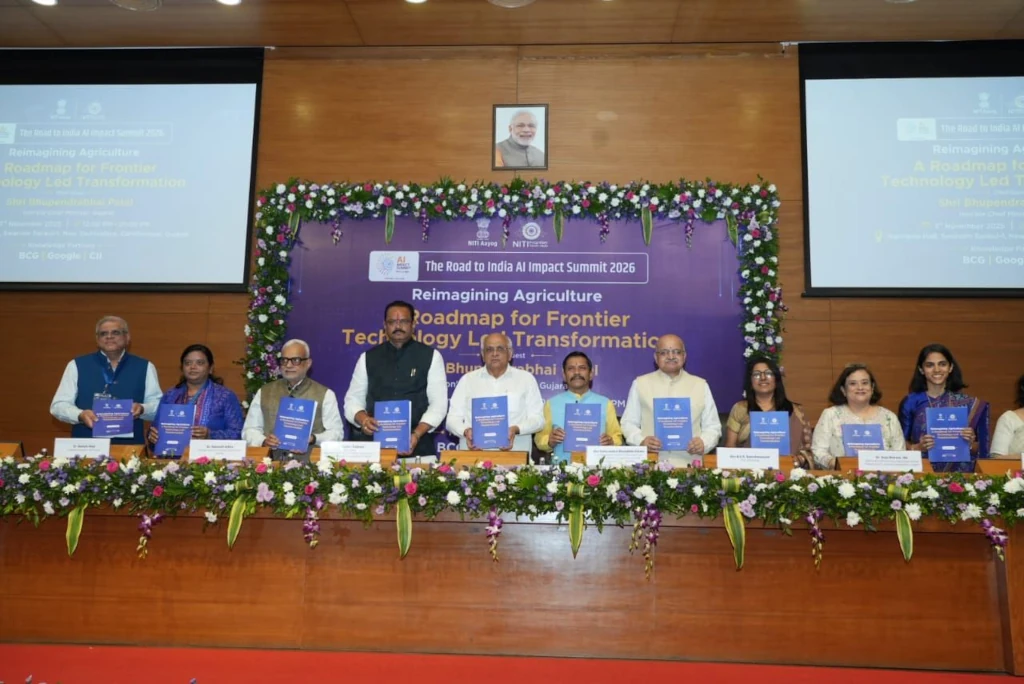
NITI Aayog’s Frontier Tech Hub has released a new roadmap, ‘Reimagining Agriculture: A Roadmap for Frontier Technology Led Transformation,’ in Gandhinagar, outlining how emerging technologies can reshape farming practices in India. The roadmap presents a strategic vision to leverage frontier technologies, including climate resilient seeds, digital twins, precision agriculture, agentic AI, and advanced mechanisation to drive productivity, sustainability, and income growth across India’s diverse farming systems.
By categorising farmers as Aspiring, Transitioning, and Advanced, it proposes context-specific, actionable pathways that address the distinct challenges faced by smallholders and commercial cultivators alike.
Agriculture stands on the brink of a profound technological renaissance. For decades, progress was measured in hectares and yields; the next revolution will be measured in data, intelligence, and design. The question is no longer whether we transform, but how fast we can make every farmer a co-creator of this new future.
The NITI Aayog strategy contends that with well-designed interventions, India can achieve stronger agricultural resilience, foster inclusive rural growth, and position itself as a global leader in agritech innovation, advancing the broader vision of Viksit Bharat 2047.
The roadmap was launched in the presence of Gujarat Chief Minister Bhupendrabhai Patel, alongside senior officials from NITI Aayog and the state government, with participation from industry leaders, researchers, and innovation partners working at the intersection of technology and agriculture.
Tailoring Technology for Every Farmer
Developed with support from the Boston Consulting Group (BCG), Google, and the Confederation of Indian Industry (CII), the roadmap reflects a joint effort by government, industry, and academia.
Also read: Satyukt Analytics Secures Patent for Satellite Based Method to Estimate Soil Nitrogen
It aligns with NITI Aayog’s broader goal of advancing frontier technology adoption through its Frontier Tech Hub, an ‘action tank’ focused on shaping a resilient, inclusive, and tech-driven India by 2047.
No two farmers in India are the same, and technology must reflect that diversity. The roadmap’s focus on designing solutions with empathy and deploying them with precision is key to ensuring that frontier technologies truly transform lives—making agriculture more resilient, inclusive, and future-ready.
The framework of classifying farmers as Aspiring, Transitioning, and Advanced aims to offer a clear way to design interventions suited to different levels of capacity, resources, and technology use. It recognises that small farmers often face challenges such as limited access to credit, machinery, and information, while more advanced cultivators need better market connections and efficiency tools.
This flexible approach can potentially move beyond uniform schemes and support need-based solutions. Its success, however, will depend on accurate farmer data, responsive institutions, and coordination among government and private partners to ensure that support reaches the right groups effectively.
Gujarat’s Evolving Digital Agriculture
Gujarat Chief Minister Bhupendrabhai Patel stated that the state is well positioned to drive India’s agricultural transformation, highlighting initiatives such as the Digital Crop Survey, Digital Agri Farm Registry, and the i-Khedut portal.
“By harnessing AI, data, and precision technologies, we can ensure that every acre becomes more productive, every drop of water more valuable, and every farmer more prosperous,” said Bhupendrabhai Patel, Chief Minister of Gujarat.
He said these efforts are creating an integrated digital ecosystem that helps farmers tackle crop diseases, boost productivity, and adopt advanced seeds and tools to reduce cultivation costs. Patel added that digital integration goes beyond efficiency, it strengthens farmer empowerment (sashaktikaran), which he described as vital to achieving the vision of Viksit Bharat 2047.
NITI Aayog’s Vision for Inclusive Agritech Transition
The NITI Aayog roadmap aims to present a forward looking approach that blends policy, technology, and farmer welfare. It highlights the government’s intent to make farming more efficient and resilient. By integrating frontier technologies such as agentic AI, digital twins, and advanced mechanisation within a single strategic vision for agriculture, it seeks to mark a shift from pilot-based approaches to a system-wide adoption plan.
The success of this vision will require strong execution and inclusive support systems to ensure the benefits reach every farmer, not just the technologically equipped ones. The roadmap’s strength lies in how it brings together farmer segmentation, emerging technologies, and institutional collaboration within one practical framework.
It focuses on linking technology adoption with resilience, inclusivity, and competitiveness, positioning agritech not merely as a tool for higher productivity but as a catalyst for broader rural transformation.

