
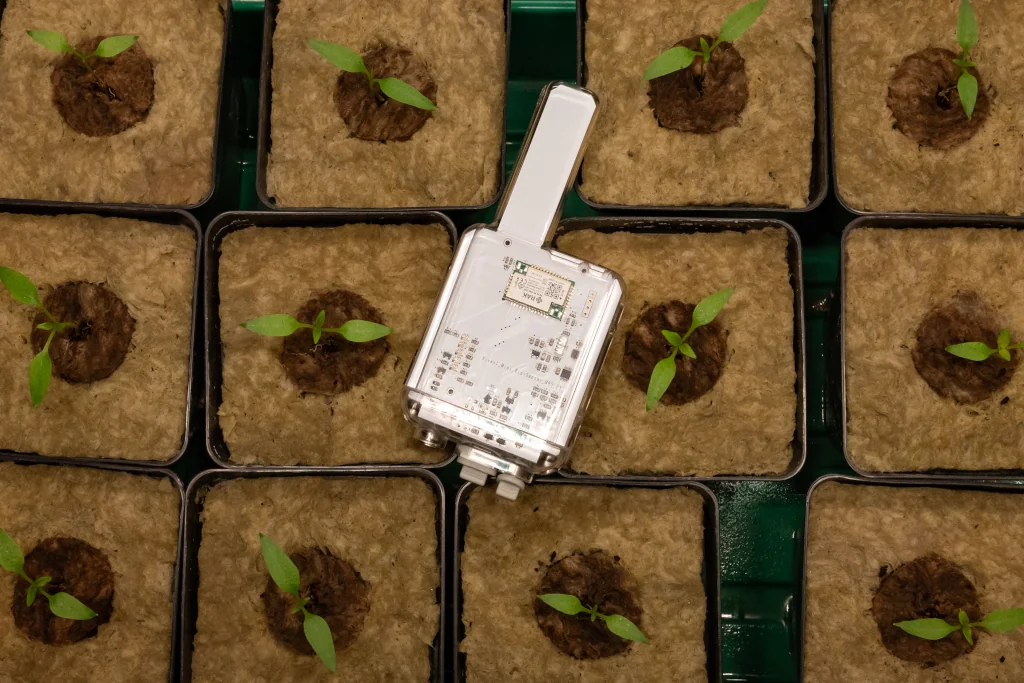
Vivent Biosignals, a Swiss plant-monitoring technology firm, has raised €7.5 million ($8.64 million) in new funding, including €2.7 million ($3.11 million) led by the Agri Investment Fund, to scale its plant-stress detection technology that identifies crop issues long before visible symptoms appear. The round also saw participation from Horticoop, Pymwymic, and several other Swiss private investors. Vivent plans to use the new capital to expand its biosignal-based crop monitoring system across more than 1,000 hectares in Europe.
By tapping into plant’s own signalling network, their biosensors and AI algorithms decode how crops respond to their environment in real time and often well before visual symptoms. Its system uses artificial intelligence to interpret electric signals naturally emitted by plants, enabling growers to identify stress caused by pests, disease, nutrient imbalance, or drought. The technology allows timely interventions and optimisation of inputs such as water, fertilizer, and crop protection products.
We are thrilled to welcome Agri Investment Fund as a new investor, joining Pymwymic and Horticoop. With Agri Investment Fund, we gain a partner deeply embedded in European agriculture and food value chains – exactly the kind of strategic alignment we need to accelerate our growth and deliver value at scale
The process starts with biosensors capturing high-resolution electrophysiology signals from plants, forming the raw input for Vivent’s models. Each recording is then enriched with metadata including crop type, substrate, irrigation regime, growth stage, and environmental conditions to improve model accuracy and adaptability. Using its proprietary dataset, Vivent trains machine learning models to identify stress signatures and predict plant health outcomes.
The company says its dataset is the world’s largest and most diverse of its kind, covering more than 1.2 million plant days and extracting 25 different crop health metrics from a single electrophysiological signal, which allows for highly specific and actionable insights. Once deployed, the models run on the sensor or in the cloud, issuing real-time stress alerts and feeding data into Vivent’s dashboard. According to the company, the platform provides clear crop health metrics designed for both farmers and plant scientists, accessible from any connected device.
Investors See Strong Potential
Investors have cited strong potential of Vivent’s system to improve farmer profitability and sustainability. According to Vivent Biosignal, early adopters of its technology have reported improved fruit quality, reduced waste, and better decision-making.
Also read: BioFiltro Secures $35M to Advance Wastewater Treatment
Tom Vlaemynck, CEO of TomatoMasters, said Vivent’s technology has helped the company boost fruit quality and cut waste, noting that early model insights immediately showed them they needed to adjust different growing parameters than originally anticipated.
We see enormous potential for Vivent’s technology to improve both farmer profitability and environmental sustainability. By giving crops a voice, Vivent is enabling a new era of precise, plant-led decision-making in agriculture – and we are excited to support the company’s growth.
Nigel Wallbridge, Vivent Biosignals’ co-founder and executive chairman, added that recent AI breakthroughs now enable the company to decode plants’ internal signal networks with unprecedented precision. With the support of new investors, he said, Vivent is accelerating the global transition toward plant-driven, resource-efficient agriculture while also addressing major blights that threaten global food production.
Transforming Crop Care with Vivent
Vivent’s technology was initially envisioned for deployment in greenhouses, but it is now being adopted for outdoor crops including potatoes, berries, apples, and grapes. According to Vivent Biosignals, the system provides continuous, real-time plant health insights across varied production environments.
Vivent’s capabilities in plant electrophysiology and AI-driven stress detection could potentially mark a major shift toward proactive crop management, offering meaningful value for diverse and climate vulnerable agriculture systems. Real-time insights on plant stress, irrigation needs, and nutrient imbalance considerably reduce losses across various agricultural domains by enabling proactive and data-driven crop management.
With India’s rapid expansion of protected cultivation, rising input costs, and erratic weather patterns, such systems can help farmers improve precision, reduce waste, and maintain consistent quality. The technology also holds promise for seed companies, research institutions, and agritech platforms working on crop modelling and climate-smart solutions. If made affordable and localized, it could strengthen India’s move toward data-driven, resource-efficient farming.


