
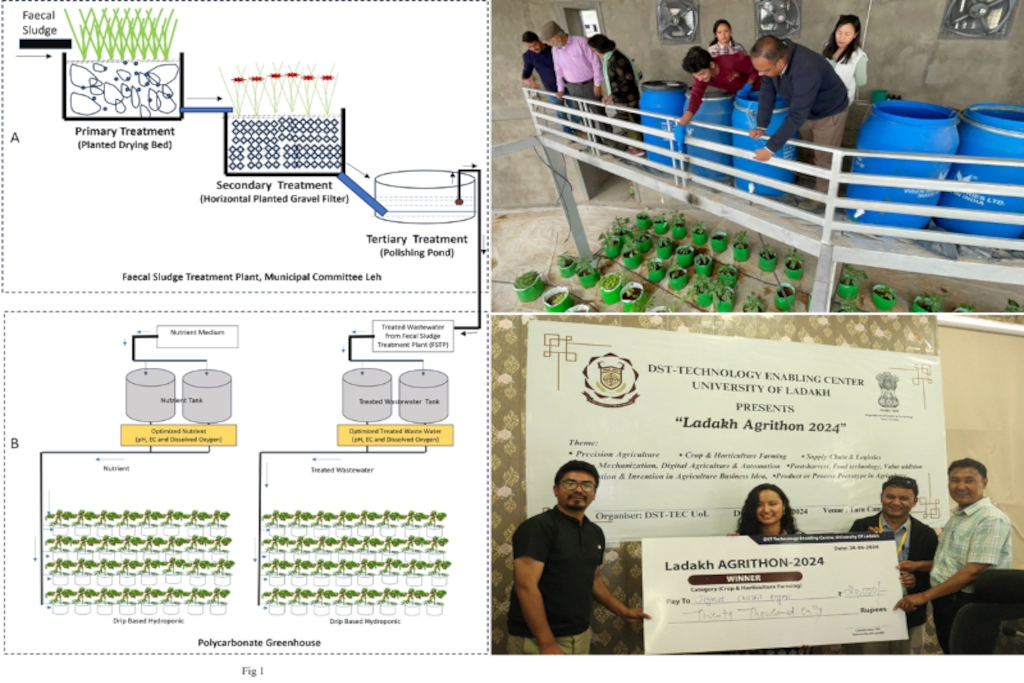
The Ladakh Regional Centre of the Govind Ballabh Pant National Institute of Himalayan Environment (NIHE) has received a national patent for a wastewater-fed hydroponic vegetable cultivation system developed using treated water from Leh’s faecal sludge treatment plant.
The system repurposes wastewater treated at Leh’s Bombgarh faecal sludge treatment plant, where it undergoes primary, secondary and tertiary treatment, including filtration and UV disinfection, before being transferred to storage tanks inside a polycarbonate greenhouse. Crop production is carried out through a drip-based hydroponic setup using cocopeat grow bags, aerated micro-tube feeder lines and regulated water delivery, designed to suit cold-arid conditions.
The project received support from the Ladakh Ecological Development Group (LEDeG) and the Leh Municipal Committee, with funding provided by the National Mission on Himalayan Studies (NMHS) under the Union Ministry of Environment, Forest and Climate Change.
By integrating wastewater reuse with hydroponic technology, the institute has set a new benchmark in climate-smart agriculture, opening new avenues for research, commercialisation and large-scale regional implementation. (via Times of India)
The field trials of wastewater treatment project focused on developing protocols for drip-based soilless farming tailored to Ladakh’s cold-arid environment. As part of the study, cucumber, tomato, capsicum, mangol, lettuce and spinach were assessed across three cultivation approaches, including hydroponics using treated wastewater, hydroponics with a conventional nutrient solution, and traditional soil-based farming.
The study observed improvements in plant growth, fruit yield, and nutritional and phytochemical traits. Results showed stronger vegetative performance and higher yields under hydroponic systems, with treated wastewater delivering outcomes comparable to commercial nutrient solutions. Crops grown using treated wastewater also recorded higher chlorophyll content and heavy metal levels within safe limits, indicating both agronomic effectiveness and food safety.
Advancing Cold-Arid Hydroponics
Developed by a multidisciplinary research team comprising Dr Lalit Giri, Mohammad Hussain, Jigmet Chushkit Angmo, Dr Sandipan Mukherjee, Dr Indra Dutt Bhatt and Dr Sunil Nautiyal, the patented system combines treated wastewater reuse with soilless cultivation to support food production in regions facing low rainfall, sub-zero winters and limited cultivable land.
Also read: AgreenCulture Raises €6M to Scale Autonomous Farm Machinery Systems
Laboratory assessments also showed higher concentrations of lycopene, β-carotene and antioxidants, while safety tests detected no heavy metals or toxic contaminants in either the treated water or the harvested crops, supporting both the agronomic performance and food safety of the system.
A series of targeted training programmes were also carried out in collaboration with the LEDeG, engaging farmers, youth and other stakeholders through structured sessions and hands-on demonstrations at RTC-Bomgarh. The initiative focused on hydroponic techniques using treated wastewater, with a participatory approach that facilitated knowledge sharing, skill building and practical exposure to soilless cultivation systems adapted to Ladakh’s cold-arid conditions.
Linking Sanitation Infrastructure with Food Production
The development indicates a shift in how agriculture is being shaped for ecologically constrained regions. Rather than adapting generic hydroponic models, the project responds directly to Ladakh’s structural challenges, limited freshwater availability, sub-zero winters and restricted arable land by integrating treated wastewater reuse with climate-appropriate soilless cultivation.
The technology links urban sanitation infrastructure with food production, demonstrating how faecal sludge treatment plants can become productive assets rather than isolated utilities. Laboratory results showing comparable yields to commercial nutrient solutions, alongside confirmed food safety, strengthen the case for wastewater reuse as a credible agricultural input rather than an experimental novelty.
By involving farmers, youth and local stakeholders through structured training and on-site demonstrations, the initiative moves beyond laboratory validation toward real-world adoption. This collective engagement helps bridge the gap between scientific research and on-ground practice, a common bottleneck in hill and cold-desert agriculture.
In policy terms, the patented system aligns with national priorities around water reuse, climate resilience and sustainable livelihoods. If scaled carefully, it offers a replicable model for other water-stressed and cold-arid regions seeking to strengthen food security while reducing pressure on scarce natural resources.


