
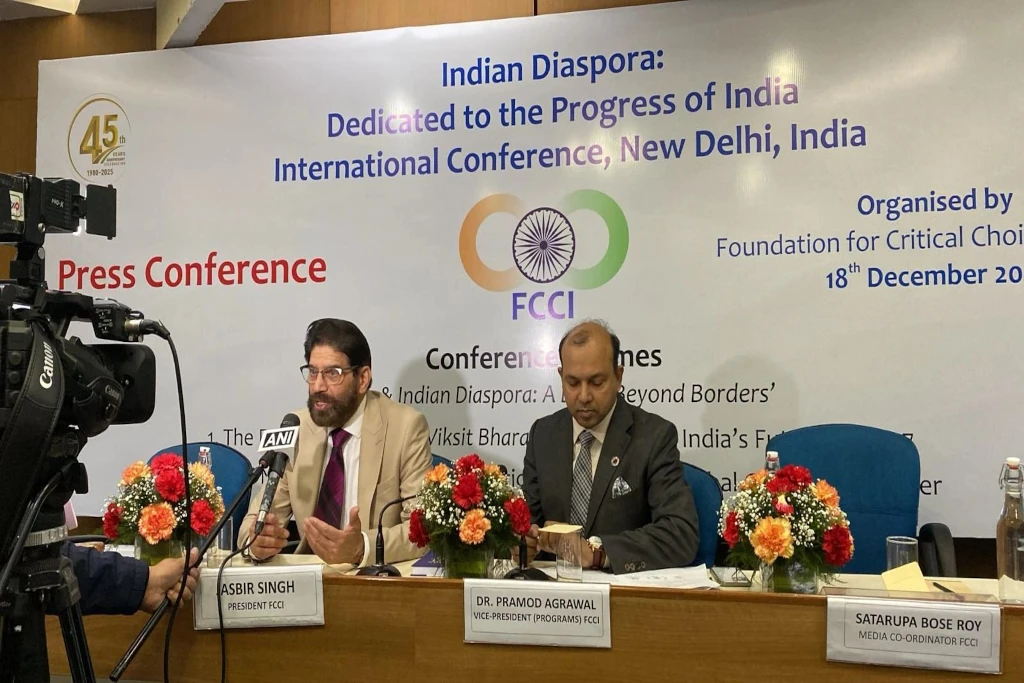
Indian farmer organisations, including All India Kisan Coordination Committee (AIKCC) and Bharatiya Kisan Coordination Committee (BKCC), are engaging with Indian diaspora-led thinktank Foundation for Critical Choices for India (FCCI) to gain exposure in advanced agricultural technologies in the Netherlands. The discussions focus on facilitating a visit aimed at exploring agritech practices, particularly in modern mechanisation, with farm organisations and institutions.
Established in 1980, the FCCI is a Netherlands-based thinktank that provides a platform for members of the Indian diaspora to engage with India’s strategic, social, and economic priorities.The proposed initiative is expected to focus on exposure to modern mechanisation, observation of Dutch approaches to smart farming and sustainable agricultural infrastructure, and assessment of how such systems could be adapted to Indian conditions.
It will examine developments in seed technology, particularly access to higher-quality and modern seed varieties, as well as crop enhancement practices aimed at improving productivity in staple crops such as cotton, rice, and wheat.
Jasbir Singh, President of FCCI, said discussions are underway to facilitate technology-focused visits to the Netherlands for farmer associations from Punjab, Haryana, and other agricultural regions, with an emphasis on exposure to modern farming systems and innovation ecosystems.
Knowledge exchange and technological cooperation are essential for the future of Indian agriculture. We are fully committed to enabling collaborations that genuinely benefit Indian farmers.
The remarks were made during a two day International Diaspora Conference organised by the Foundation for Critical Choices for India (FCCI) at the India Habitat Centre in New Delhi. During the event, FCCI framed agriculture as an area where structured global knowledge exchange could translate into near-term, practical outcomes on the ground.
Evolving Priorities in Farmer-Led Discourse
The event convened members of the Indian diaspora alongside policymakers, senior government officials, academics, and other stakeholders to examine India’s long-term development pathway toward 2047, with agriculture framed as a central component of sustainable and inclusive growth.
Also read: Bartronics Begins Nationwide Agritech Deployment with Maharashtra
In the conference discussions, representatives of farmer associations pointed to persistent technology gaps in Indian agriculture, particularly in major staple crops such as cotton, rice, and wheat.
Guni Prakash, a member of the BKCC, said the organisation would be meeting FCCI President Jasbir Singh to discuss potential opportunities for farmer associations, particularly from Punjab and Haryana, to visit the Netherlands. He noted that the objective of the proposed engagement would be to gain exposure to new agritech and learn about advanced approaches to improving crop quality and productivity.
Indian farmers urgently need technological innovation to accelerate development. We require quality seeds to enhance agricultural production. In many regions, farmers are still dependent on older seed varieties, which need significant improvement
The move by AIKCC and BKCC reflects a broader shift in how farmer organisations are positioning themselves within India’s agricultural transition. Beyond advocacy on prices and subsidies, there is growing recognition that productivity, resilience, and sustainability will increasingly depend on access to knowledge and technology.
From Production to Value Creation
Pramod Agarwal, Vice President of FCCI, brought an industry and sustainability perspective to the discussion, highlighting that India’s development challenge has shifted from increasing raw material production to creating greater value across agricultural and industrial supply chains.
He used the textile sector to illustrate this gap, noting that despite having one of the world’s few fully integrated textile value chains, India continues to export large volumes of raw cotton and low-value products, even as climate pressures, land constraints, and farmer distress affect productivity per hectare.
Agarwal also drew attention to the underutilised potential of agricultural by-products and waste, particularly from cotton, which could be repurposed as inputs for sustainability initiatives and circular-economy applications.
Waste is not waste if you know how to use it. By-products from cotton can be converted into materials for energy, insulation, composites and other applications. This is where sustainability and industry meet.
He further stressed that FCCI’s engagement extends beyond dialogue and policy discussions, arguing for the need to move toward implementable, cross-sector projects. Such initiatives, he said, should be capable of aligning multiple ministries including agriculture, textiles, commerce, and environment and translating ideas into on-ground execution rather than remaining at the level of concepts or consultations.

