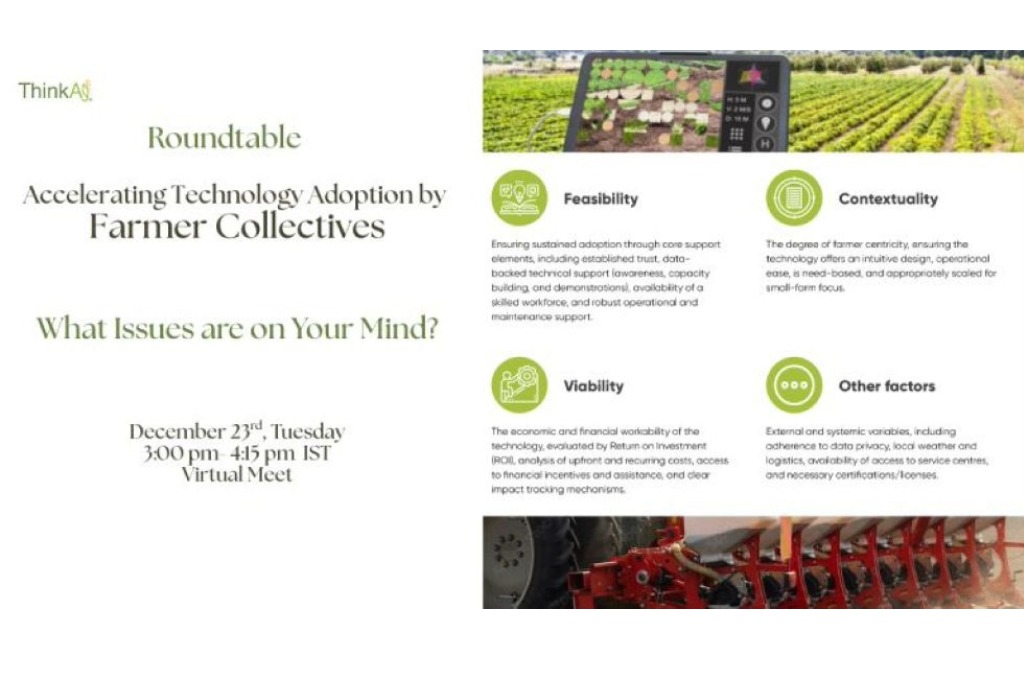
A closed door roundtable on “Accelerating Technology Adoption by Farmer Collectives,” organised by ThinkAg, convened agritech innovators alongside representatives from Farmer Producer Organizations and Cluster Based Business Organizations to examine the practical realities of deploying technology at the last mile. The discussion was designed as a learning exchange focused on experience based insights into what enables adoption beyond pilots, with emphasis on trust, governance, financing, and partnerships. The interaction took place on Farmers’ Day, situating the dialogue within the everyday operational and economic context of farmers and collectives.
The ThinkAg roundtable opened with agenda-setting remarks that framed the discussion as an informal but focused exchange. Participants addressed the prevailing assumption that farmers and FPOs are slow to adopt technology, noting that field practitioners often observe higher levels of uptake than commonly perceived, even when such adoption is not systematically recorded. The role of startups and grassroots entrepreneurs in taking solutions to farmers was highlighted, particularly their contribution to building last mile access.
The discussion also referenced the increasing shift of agritech startups toward micro entrepreneur models and pointed to the relevance of digital public goods and open agricultural technology stacks as mechanisms that can enable broader participation. Open commerce networks were discussed as a way for farmers to access multiple services through simplified digital interfaces, while artificial intelligence was described as a capability whose potential lies in making systems more usable and absorbable for farmers rather than adding complexity.
Structural Gaps Across the Agricultural Ecosystem
Participants examined structural gaps that continue to shape adoption outcomes across the agricultural ecosystem. These included fragmented supply chains, disconnected stakeholders, and unreliable last mile networks affected by trust deficits, connectivity constraints, and multilingual challenges. The absence of aggregated platforms was cited as a factor limiting farmers’ collective bargaining power, while limited transparency in pricing and payments was linked to weaker income realization.
Credit access emerged as a persistent constraint, with smallholders and FPOs remaining underserved by organized channels, contributing to a widening agri credit gap. These issues were discussed in the context of the absence of a unified digital framework capable of linking government bodies, research institutions, financial institutions, agribusinesses, and agritech startups, resulting in fragmented data exchange and slower ecosystem coordination.
From Tools to Systems: Rethinking Tech Adoption Pathways
A consistent theme across the discussion was that the challenge lies not in the availability of technology, but in the ecosystem’s capacity to absorb and sustain it. Speakers emphasized the need to move away from isolated tools toward end-to-end systems that fit into existing workflows, allowing farmers and collectives to continue operating as they do today. Capabilities such as voice, video, payments, and finance were discussed as elements that should operate in the background rather than require explicit decision making.
Opportunities in platformization, traceability, and data driven intelligence were highlighted when integrated into digital public infrastructure rather than remaining siloed. A layered approach combining channel access, commerce, and intelligence was discussed as a way to transition users from narrow, closed networks to interconnected and open agri networks that support scale through shared participation.
Platform Experiences with FPOs and Enterprises
The discussion included references to horizontal platforms integrating markets, finance, and data for FPOs and agri enterprises. Databases covering large numbers of FPOs, with subsets vetted for active engagement, were discussed as enabling collectives to manage communities, campaigns, operations, and digital presence through microsites and marketplace access. Similar capabilities for agri enterprises included end-to-end trade execution, digital trails for reconciliation, and creation of market linkages. Increases in traffic, partnerships, and credit marketplace usage over recent months were cited as indicators of adoption driven by operational relevance rather than outreach activity.
Perspectives from FPOs and Agtech Founders
FPO representatives shared experiences related to value addition, renewable energy based processing, and post harvest interventions. These included discussions on solar tunnel dryers, university supported efforts to reduce harvest losses, and the financial and asset related challenges farmers face when adopting such technologies. Questions were raised around blockchain based export systems for fruits and vegetables, while other exchanges focused on digital applications in government procurement, seed production, cold storage, smart storage, and sorting solutions to reduce wastage and improve market linkage. Practical insights were also shared on onion cultivation, including machine based transplanting, quality management practices, reduced pesticide usage, and monitoring of water content to manage weight loss and fungal risks across large acreages using connected devices.
The agritech discussion segment featured ScaNxt, Marut Drones, and Promethean Power Systems. Prem Kumar V, Founder and CEO of Marut Drones, explained that the company focuses exclusively on agricultural drones for activities such as spraying, fertilizer spreading, hybrid pollination, and direct seeding, with deployment carried out through rural entrepreneurs who provide on-ground services. He shared cost considerations for farmers, including per acre spraying expenses, and emphasized that trust is critical for adoption, as farmers are required to make high value decisions based on service reliability.
Jofi Joseph, representing Promethean Power Systems, outlined the company’s work in farm side cold storage using proprietary technology that eliminates the need for diesel generators, particularly for dairy where immediate chilling is required, while also supporting horticulture. He explained that after initially supplying equipment to dairies, the company has worked over the last five years with FPOs to install systems that enable milk collection, chilling, and sale, currently engaging thousands of farmers across multiple villages. Jofi Joseph emphasized that market linkage, cost viability, and guaranteed margins are essential for adoption, and described derisking strategies that include reducing machine size or cost, providing ongoing training and maintenance, and ensuring assured offtake.
Rajat Vardhan, Founder & CEO, ScaNxt spoke about the role of scientific technologies such as artificial intelligence and machine learning, combined with village level entrepreneurs and FPO led models, in enabling data driven decision making. He highlighted the importance of affordability across the entire technology cycle, the role of research institutions, and the need for incentives aligned with farmer needs. When asked about challenges, he pointed to resource constraints and perception gaps as barriers to scale.
Markets, Incentives, and Trust as Recurring Themes
Across the agritech segment, market linkage was repeatedly identified as the starting point for adoption, with incentives and trust closely following. Participants noted that assured offtake and margin visibility reduce risk for farmers, while availability of trained on-ground resources remains a constraint to faster expansion. The discussion reinforced the view that adoption improves when technology is embedded within viable business models anchored in farmer collectives rather than introduced as standalone interventions.
The ThinkAg roundtable concluded with a shared understanding that adoption is driven by outcomes rather than tools, that finance works best when contextual and embedded into operations, and that institutions such as FPOs provide a dependable pathway for scale. Participants reflected on the role of trust building, handholding, and alignment between technology providers and farmer collectives. The session closed with acknowledgments to participants and a reiteration that coordinated movement across markets, finance, data, and institutions enables technology adoption to progress from isolated efforts to sustained, farmer centered practice.