
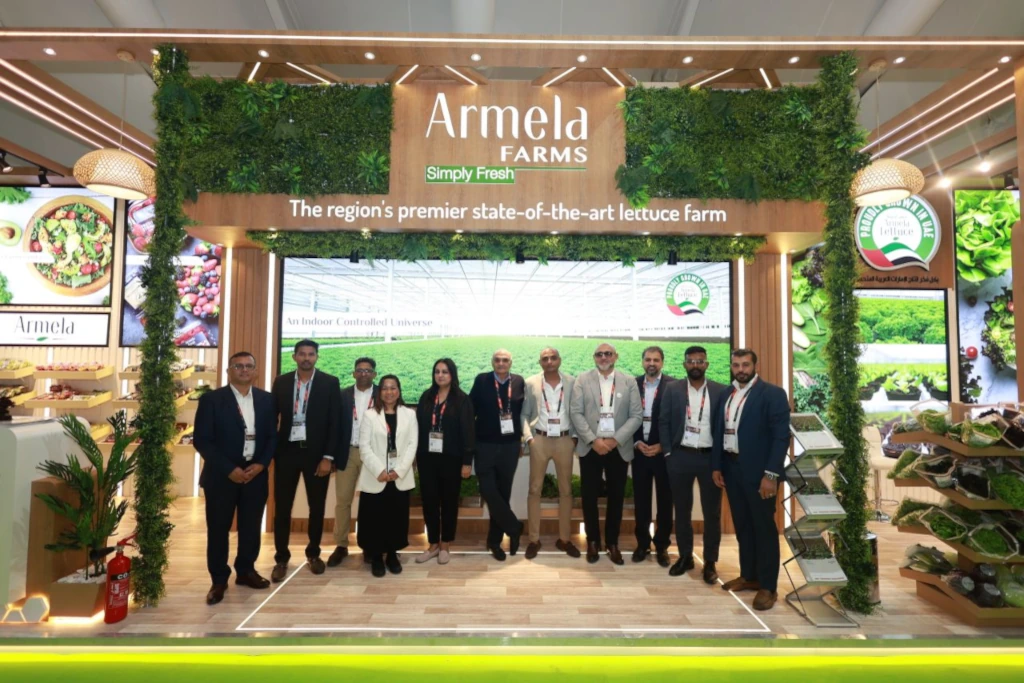
UAE agritech firm Armela Farms has announced plans to develop a horizontal high-tech strawberry production facility, alongside early evaluations of additional crops such as baby spinach and blueberries, as it looks to expand local fresh produce cultivation in the country.
The announcement was made during the Gulf Food event in Dubai, where the company outlined its ongoing efforts to scale controlled-environment agriculture (CEA) and reduce reliance on imported produce. Avir Shah, founder and CEO of Armela Farms, told Zawaya Projects that the planned facility is intended to enable year-round production and distribution. The company also plans to test local broccoli production, which the UAE currently imports in large volumes from Kenya.
We are among the largest importers of broccoli in the UAE. Now we’re exploring whether mid tech greenhouses can produce it locally year round
According to Armela, if the trials are successful, local broccoli production could help reduce transport costs and improve year-round availability for consumers. Armela added that its operations are backed by UAE-based investor AW Rostamani Group, which supports its agricultural expansion activities.
Armela currently produces leafy greens using hydroponic systems across facilities in Dubai and Abu Dhabi. Industry estimates place its share of the UAE lettuce market between 80-85% . In recent years, it has also expanded into crops such as kale and cucumber through a combination of farm acquisitions and incremental upgrades to existing infrastructure. The company also operates a temperature-controlled logistics fleet of more than 30 vehicles, which it says is monitored continuously.
Operating Model and Expansion
Armela’s recent expansion takes place against a broader regional backdrop in which Gulf countries are strengthening food security strategies and increasing investment in climate-resilient farming. Governments across the region continue to support modern agricultural systems designed to operate under extreme temperatures and constrained water availability.
Armela was founded in 2016 and initially operated a small research facility focused on herbs, lettuce, and tomatoes. Following two years of research and development, the company shifted the facility entirely to lettuce cultivation. Early production reportedly sold out within six to eight months, prompting an expansion strategy built around high-tech horizontal hydroponic systems.
Also read: GrubMarket Secures $50M Series H Funding to Accelerate AI Integration and eCommerce Expansion
Avir Shah said the company was the only operator at the time able to scale high-tech hydroponic lettuce production while maintaining consistent yields throughout the year. Armela said it owns and operates all of its farms and supplies a range of Tier 1 and Tier 2 retailers across the UAE, in addition to wholesale markets and online channels. Its produce is currently available through platforms such as Talabat and Noon, with additional online marketplaces including Amazon and Careem expected to be added.
Over the past six months, Armela has also expanded into trading activities, sourcing fruits and agricultural commodities from international markets and selling premium produce under its main brand. In parallel, it has launched a secondary brand, Origins by Armela, which focuses on origin-based sourcing, grading, and repackaging of produce from overseas suppliers.
The company stated that its market positioning has shifted toward the premium segment, with locally grown lettuce now priced above imported alternatives. This change, it said, reflects increasing consumer recognition of the brand and demand for locally produced crops.
Broadening the Local Crop Base
Armela’s expansion strategy reflects a broader recalibration underway in the UAE’s agritech sector, where companies are moving beyond leafy greens toward crops with higher import exposure and greater supply chain sensitivity. By testing strawberries and broccoli alongside established hydroponic production, Armela is targeting categories where local cultivation could meaningfully reduce reliance on overseas suppliers.
The focus on horizontal high-tech and mid-tech systems also points to a more pragmatic approach to CEA, balancing cost, scalability, and crop suitability rather than relying on a single technology model. If commercially viable, these trials could signal a shift from pilot-driven agritech growth to operationally grounded expansion, aligning food security objectives with economic sustainability in arid markets. For the UAE, such developments may play a growing role in strengthening local food systems without overextending capital or resources.


