
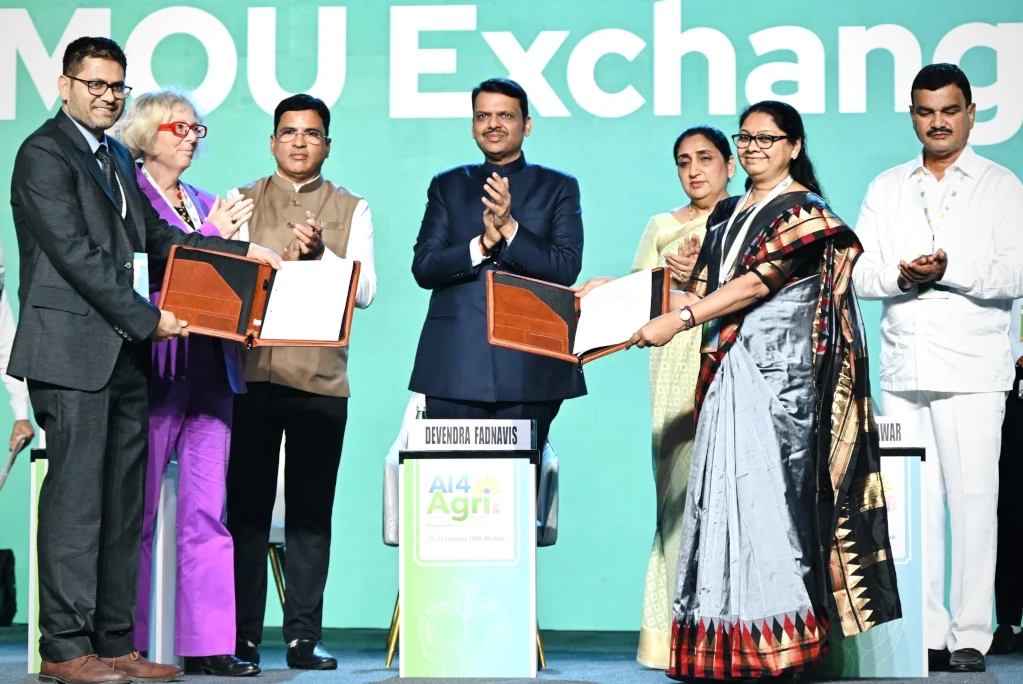
The Government of Maharashtra has signed a Memorandum of Understanding (MoU) with Wageningen University & Research (WUR), a Netherlands-based public research institution focused on agriculture, and food systems, to collaborate on the application of artificial intelligence and digital technologies within the state’s agriculture sector.
The agreement outlines cooperation in areas such as AI-enabled plant breeding and seed development, strengthening digital capabilities within Maharashtra’s agricultural institutions, and supporting data-driven pilot initiatives. It also includes provisions for skill development and expanded research collaboration with national and international partners.
The agreement was signed at the AI 4 Agri 2026 summit held at the Bandra Kurla Complex (BKC) in the presence of Maharashtra Chief Minister Devendra Fadnavis. The MoU establishes a framework for collaboration between the Maharashtra government and WUR to assess state-specific agricultural needs. Initial areas of focus include the use of sensor-based systems to monitor crop growth and the development of AI models tailored to Maharashtra’s agro-climatic conditions.
The proposed AI for Agriculture Research Network is intended to link participating institutions, facilitate knowledge exchange, and support coordinated research efforts aimed at advancing innovation and improving access to technology-based solutions in the agriculture sector.
The AI 4 Agri 2026 Global Conference and Investor Summit is a satellite event of the India AI Impact Summit 2026. Last year, the state introduced the MahaAgri-AI Policy (2025-2029), outlining a structured roadmap for integrating data-driven technologies into the agriculture sector. With an initial outlay of ₹500 crore, the policy commits dedicated funding toward digital infrastructure, AI-based applications, and institutional capacity building aimed at addressing farm-level challenges across regions including Vidarbha, Marathwada, and Western Maharashtra.
Five Pillars of Collaboration
In an interview with ANI Arun Kumar Pratihast, Senior Researcher at WUR, outlined the five pillars of the collaboration, AI and digital phenotyping, digital breeding, crop-specific pilot projects, knowledge exchange, and international learning. He noted that while these five pillars form the starting framework of the partnership, specific projects will be developed to further define and implement each of these focus areas in detail.
Also read: Agriculture Counsellor Marion van Schaik Highlights AI Focus in Indo-Dutch Agritech Pact
He further added that additional meetings and consultations will be held with the state government to better understand local priorities before moving into implementation. Based on those discussions, specific programmes will be identified and rolled out. Citing AI and digital phenotyping as an example, he explained that selected crops would be monitored using sensor-based systems to track parameters such as leaf development and overall crop growth. The collected data would then be used to build and refine AI models tailored to Maharashtra’s agricultural conditions.
He noted that state agricultural universities would play a critical role in this process by providing the contextual knowledge and field-level data required to adapt existing European models to Indian conditions. He stated that while Wageningen already operates AI models at a European scale, their successful application in Maharashtra would depend on access to reliable local datasets. Once such local data and expertise are integrated, the existing models can be tested, recalibrated, and adapted accordingly. He emphasised that the involvement of local institutions will therefore be central to the initiative’s effectiveness.
Aligning Research and Policy
Maharashtra’s collaboration with Wageningen University & Research, when viewed alongside the MahaAgri-AI Policy (2025-2029), signals a structured attempt to move beyond pilot-driven digitisation toward institutionally embedded AI deployment in agriculture. Rather than positioning AI as a standalone technology intervention, the framework appears to link research capacity, field data systems, and policy-backed financing. Whether this alignment translates into scalable outcomes will depend on execution depth at the university and district levels.
The emphasis on AI-driven phenotyping, digital breeding, and crop-specific pilots suggests a shift toward data-intensive agriculture. If implemented effectively, such models could enable region-specific decision support in a state marked by agro-climatic diversity. However, adapting European-scale AI systems to Maharashtra’s fragmented landholdings and variable data quality may require significant recalibration, particularly in data standardisation and sensor deployment.
State agricultural universities are likely to become critical intermediaries in this transition. Their role in generating reliable datasets and contextual insights could determine whether imported models are merely replicated or meaningfully localised. The availability, interoperability, and governance of agricultural data will be central to this process.


