
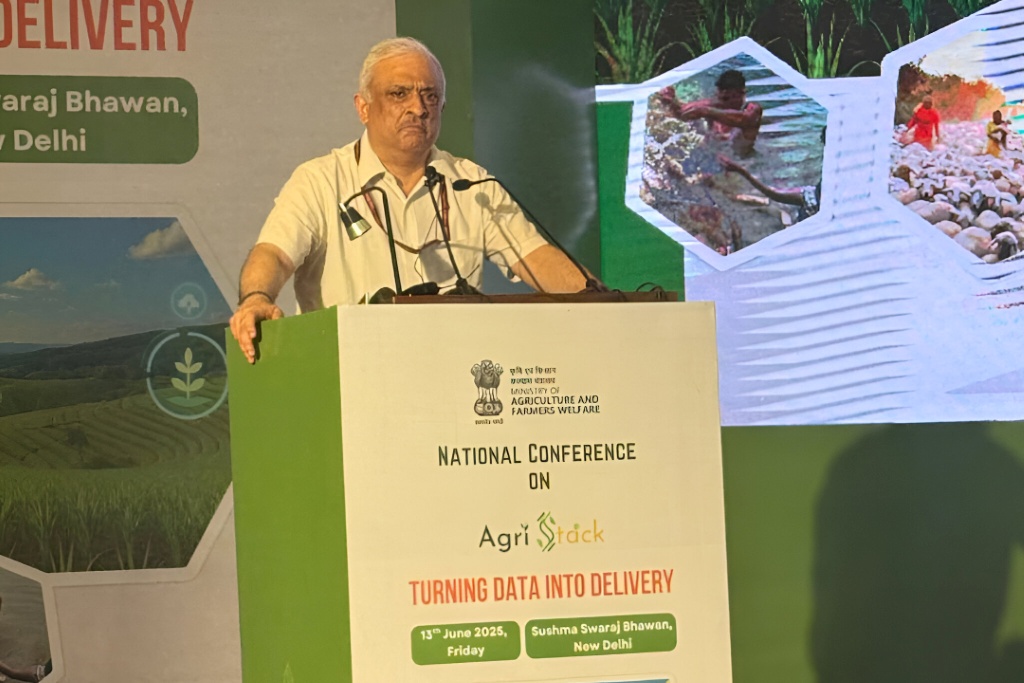
In a move aimed at deepening digital infrastructure in agriculture, the Ministry of Agriculture & Farmers’ Welfare (MoA&FW) announced a INR 60,000 million (approximately US$ 697.67 million) Special Central Assistance (SCA) package during the National Conference on Agri Stack: Turning Data into Delivery, held at Sushma Swaraj Bhawan. The conference convened senior government officials, state representatives and technical experts to assess the status of the Agri Stack initiative under the Digital Agriculture Mission (DAM) and finalize a coordinated roadmap for data based agricultural governance.
The INR 60,000 million (US$ 697.67 million) assistance package is divided into two major components, INR 40,000 million earmarked for the development and maintenance of comprehensive Farmer Registries, including legal heir systems, and INR 20,000 million for the execution of the Digital Crop Survey (DCS). The funds will be disbursed to States on a first come first served basis. This financial provisioning is aimed at building core digital infrastructure across land records, farmer authentication, crop verification and service linkage systems.
The allocation was announced during a joint launch of the SCA Guidelines by the Secretaries of Agriculture and Land Resources, the Chief Knowledge Officer and Advisor (CKO&A), and the Additional Secretary of the Ministry, in the presence of other dignitaries. The funding is designed to incentivize rapid adoption by the States and to scale delivery mechanisms that can support authentication based schemes.
MoUs with Four States and PSB Alliance to Streamline Credit Access
A key outcome of the conference was the signing of Memoranda of Understanding (MoUs) between the National Farmers’ Welfare Program Implementation Society (NFWPIS), MoA&FW, and the States of Maharashtra, Kerala, Bihar and Odisha, along with the PSB Alliance. This collaboration aims to facilitate digital access to credit services by using Farmer Registry linked authentication, significantly reducing documentation requirements for small and marginal farmers. The integration is expected to ease the flow of institutional credit and promote more equitable access to agricultural finance.
Policy Priorities: Linking Farmer Registries with Records of Rights
Delivering the welcome address at the Agri Stack Conference, Devesh Chaturvedi, Secretary (Agriculture), emphasized the need for States to dynamically link their Farmer Registries with updated Records of Rights (RoR). He called for the structured use of digital datasets to enable personalized service delivery and targeted scheme implementation. He reiterated the government’s objective of enabling transparent, farmer centric governance through digital platforms.
The Secretary of the Department of Land Resources (DoLR) underlined the foundational importance of digitized land records and Aadhaar seeding in ensuring correct farmer identification. He flagged structural challenges including declining land value and stagnant rural incomes, advocating for digital accuracy as a prerequisite for effective interventions.
Integration of Flagship Schemes Through Agri Stack
Pramod Kumar Meherda, Additional Secretary (Digital), MoA&FW, outlined the integration of Farmer IDs with national schemes such as PM-KISAN, PMFBY and Kisan Credit Card (KCC). He stressed the importance of geo referencing and data standardization in line with Unified Farmer Service Interface (UFSI) norms. The Ministry also introduced new services, including a farmer authorization system and Digitally Verifiable Certificates (DVCs), to enable secure and selective sharing of land and crop information.
State Level Presentations Highlight Progress and Requests
In the dedicated session Insights from States on Agri Stack Usage, Maharashtra detailed the enrolment of farmers in the State’s Farmer Registry and progress on achieving SCA milestones. The State requested central support for establishing a Data Provisioning Engine (DPE), enrolling farmers into MahaDBT through Farmer ID and launching Mahavistaar AI, a proposed sandbox for data driven advisories.
Also read: Seeds from the Sky: How LVNS Drone Project is Redefining Reforestation
Uttar Pradesh presented its integration of Agri Stack with its Minimum Support Price (MSP) e-procurement system for 2024 and outlined on ground issues in the rollout of the Digital Crop Survey. Karnataka showcased the use of Agri Stack in disaster response, linking of the FRUITS platform with banking systems and deployment of soil health cards for customized advisories.
Technical Deliberations and Digital Service Expansion
Led by the Chief Knowledge Officer and Advisor (CKO&A), technical sessions at the Agri Stack Conference addressed quality concerns in data capture, gaps in tribal land records, photographic inconsistencies in crop surveys and non compliance with DCS standards. The sessions stressed the use of AI/ML tools, remote sensing and automated validation to improve data fidelity and reduce human error.
The CKO&A introduced the Digitally Verifiable Credential (DVC), also known as the Kisan Pehchan Patra, allowing farmers to generate authenticated digital credentials linked to land parcels and crops. These are integrated with DigiLocker and are automatically invalidated upon land mutation. A unified grievance redressal platform was also launched, offering OTP based login, multilingual support and options for audio uploads, allowing farmers to lodge land related complaints or authorize others to act on their behalf.
AI Driven Interfaces and System Support Tools
The Ministry showcased an AI chatbot trained on Agri Stack data, developed using Google Gemini, capable of multilingual interaction. Other AI based pilots were also introduced, including tools to assist supervisors in identifying crops, facial recognition for field surveyor verification and backend code optimization with system integrators. Anindya Banerjee, Deputy Advisor acknowledged the importance of inter agency coordination and reaffirming the Centre’s role in supporting State governments to realize the potential of inclusive, data led agriculture.
The National Conference on Agri Stack concluded with a strong emphasis on cooperative federalism, digital transparency, and structured financing as foundational pillars for the next phase of agricultural governance in India. With the INR 60,000 million Special Central Assistance package now in motion, States have been positioned to operationalize data driven service delivery systems that are both scalable and inclusive. As the implementation unfolds, the coordinated efforts between the Centre, States and financial institutions are expected to reshape the backend infrastructure of agricultural schemes, ensuring timely access, targeted benefits and authenticated service delivery for millions of farmers across the country.


