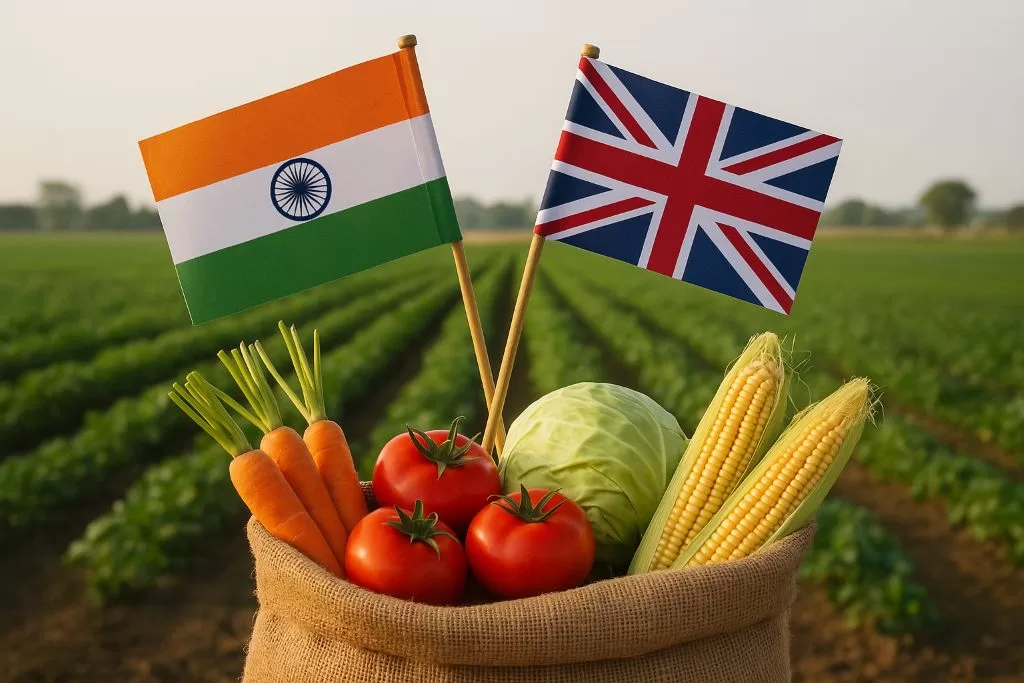
The India-UK Comprehensive Economic and Trade Agreement (CETA), signed between the Governments of India and the United Kingdom, is set to reshape the agricultural and allied sectors by providing duty free market access to nearly 100% of Indian agri exports to the UK. A key provision of the CETA includes tariff elimination on 99% of India’s exports to the UK, with substantial benefits accruing to Indian farmers, agro processors, fisherfolk and allied industries.
Signed in the presence of Prime Minister of India, Narendra Modi, and UK Prime Minister Keir Starmer, the agreement builds on a trade relationship currently valued at US$ 56 billion and aims to double this figure by 2030.
Enhanced Agri Market Access: Opportunities for Farmers and Food Processors
CETA brings Indian agricultural products into closer competition with global suppliers in the UK market by eliminating tariffs on 1,437 tariff lines, accounting for 14.8% of India’s trade structure in the sector. Processed foods, covered by 985 tariff lines or 10.1% of India’s total, also gain from this liberalisation. In 2022-23, India exported US$ 45.05 billion in agricultural products, with a notable gap in UK imports, which stood at US$ 37.52 billion, of which only US$ 811 million were sourced from India.
For processed food, Indian exports globally stand at USD 14.07 billion, while the UK’s imports exceed US$ 50 billion, with Indian products comprising just over US$ 309 million. CETA seeks to address this disparity, with expectations of over 50% growth in Indian agri and processed food exports to the UK over the next three years.
High value Indian products like tea, mangoes, grapes, spices, and marine products, sought by the UK market, especially among the Indian diaspora, will now be more competitively priced. The agreement is designed to elevate Indian exporters to a level playing field with competitors such as the EU, South Africa, Vietnam and Canada. It gives India a sharper competitive edge in specific segments such as grapes, processed food preparations, bakery items, preserved fruits and vegetables, and sauces.
Specific state economies are positioned to benefit. Maharashtra, Gujarat, Kerala, and the Northeast states, owing to their agri export capacity in horticulture and spices, stand to gain from increased market demand and premium price realization. State specific agri export plans led by APEDA already align with CETA’s targets, enabling a smoother integration into the enhanced trade framework.
Marine Sector Gains: Broader Market Reach and Job Creation in Coastal Economies
CETA removes tariffs on Indian seafood exports to the UK, which previously ranged between 4.2% and 8.5%, making Indian shrimp and white fish more competitive. India’s marine exports were valued at US$ 8.09 billion in 2022-23, with UK’s marine imports pegged at US$ 5.4 billion. However, India’s share remains low at 2.25%. The agreement offers substantial headroom for growth, particularly in value added products, which already recorded a 3.5% rise in FY 2024-25.
This tariff elimination is expected to improve procurement prices for fisherfolk and expand capacity utilisation in seafood processing plants, many of which employ women workers. States such as Kerala, Andhra Pradesh, Tamil Nadu, Gujarat and Odisha are expected to see job creation and greater income opportunities, further strengthening coastal economies.
Plantation Sector Access: Boosting Niche Indian Exports
With the UK already accounting for 1.7% of Indian coffee, 5.6% of tea, and 2.9% of spice exports, the duty free access under CETA is expected to accelerate exports of Indian plantation products. Indian instant coffee, in particular, will now compete more effectively with European exporters such as Germany and the Netherlands. The agreement also supports value added production, positioning Indian exporters to tap into high margin markets through product differentiation.
Safeguards for Domestic Sensitivities
While the agreement opens 89.5% of India’s tariff lines, sensitive agricultural sectors such as dairy, cereals, millets, pulses, fruits, vegetables, edible oils and oilseeds remain protected through strategic exclusions. Products like milk, butter, cheese, tomatoes, garlic, peas, radish, groundnut oil and mustard remain under India’s sensitive list. This ensures that farmers engaged in these segments are not adversely impacted by import surges or market distortions.
Additionally, bilateral safeguard measures have been included in CETA to manage import fluctuations and ensure domestic industries are shielded from any sudden market disruptions. Products crucial to India’s food security and rural employment are granted phased tariff reductions over 5, 7, or 10 years, reinforcing India’s long-term agricultural self reliance goals.
Professional Mobility and Services: Upscaling Agricultural Knowledge and Skills
CETA also enhances mobility for agricultural scientists, food technologists, agri business professionals, and educators, enabling short term professional movement under a clearly defined and predictable framework. With provisions such as the Double Contribution Convention, Indian professionals posted temporarily in the UK are exempted from UK social security payments, resulting in savings estimated at over INR 4,000 crore for approximately 75,000 workers.
The agreement facilitates skill exchange and investment in sectors like agri education, food safety, and agricultural engineering services. Mutual recognition agreements planned within a year of CETA’s enactment are expected to smoothen credential recognition in disciplines such as veterinary sciences, food processing and agri consultancy.
Support for Forest Communities and Environmentally Sustainable Agriculture
CETA underscores the importance of forest economies by acknowledging the livelihoods of forest dwellers and the need for sustainable forest management. The agreement encourages environmentally responsible trade in forest based products and promotes conservation practices, especially in tribal and forest dependent economies. Furthermore, CETA encourages recognition of traditional knowledge in patent filings related to agricultural biodiversity and genetic resources, creating a bridge between indigenous knowledge systems and formal intellectual property frameworks.
Also read: Old School’s JalSaathi Offers a Modular, Low Cost Approach to Smart Irrigation for Farmers
Rural Women and Youth: Broadening Participation and Equity
Women farmers, workers in food processing, and self help groups engaged in agro based enterprises will benefit from increased access to global markets. CETA includes gender responsive provisions, supports women led micro enterprises, and promotes non discriminatory labour rights. Dedicated working groups are established to address gender disparities and enable wider access to resources, procurement opportunities, and financial inclusion.
India’s youth, over a quarter of the population, are poised to benefit from job creation in agriculture linked MSMEs, export logistics, food certification, and quality testing. Lower tariffs on inputs and advanced farm equipment will enhance productivity and attract skilled youth into agribusiness operations, beyond traditional farming.
MSMEs and SMEs in the Agricultural Value Chain
Small and medium enterprises, which contributed 45.8% to India’s total exports in 2024-25, gain from reduced compliance costs, digital customs processes and dedicated institutional mechanisms under the CETA. A contact point is being established to support SME participation in government procurement and innovation exchanges. Businesses in food processing, agri logistics, and cold chain services will benefit from simplified procedures, lower duties, and access to UK’s public procurement opportunities.
State Level Gains: Regional Specialisation in Agri and Allied Sectors
The agreement is expected to deliver state specific advantages. Maharashtra is expected to benefit through grape and onion exports, Gujarat through groundnut and seafood, Tamil Nadu through processed food and leather, and Kerala through spices and marine products. Andhra Pradesh, Odisha and West Bengal are poised for gains in shrimp exports and fisheries, while Punjab, Rajasthan and Delhi NCR stand to benefit from enhanced access in textiles, food processing, and handicrafts.
Inclusive Trade for Farmers, Fisherfolk and Rural Communities
CETA is structured to promote inclusive growth across all tiers of the agri value chain. Farmers will gain direct access to the UK’s US$ 63.4 billion agricultural import market for products such as meats, dairy, fruits, vegetables, juices and processed foods. The removal of UK tariffs is expected to secure better returns and higher price realization for primary producers. Safeguard duties will not be imposed on Indian agri exports, ensuring price stability and uninterrupted market access.
In fisheries, nearly 28 million individuals engaged in the sector are expected to benefit through enhanced export opportunities, particularly from coastal states. Value-added exports such as processed shrimp and fishmeal are expected to grow in response to rising UK demand. Coastal economic development is expected to follow, supported by job creation in fishing, processing, and logistics.
The India-UK Comprehensive Economic and Trade Agreement (CETA) positions India’s agricultural and allied sectors for accelerated export led growth. By removing barriers, easing market access, and preserving domestic sensitivities, CETA provides a calibrated and inclusive approach to global integration. It empowers farmers, strengthens the competitiveness of agro industries, supports fisheries and plantations, and fosters rural development. As tariff free access materializes and supply chains expand, CETA is poised to anchor India’s position as a major supplier in global agri markets, while delivering economic opportunities to rural and semi urban communities across the country.