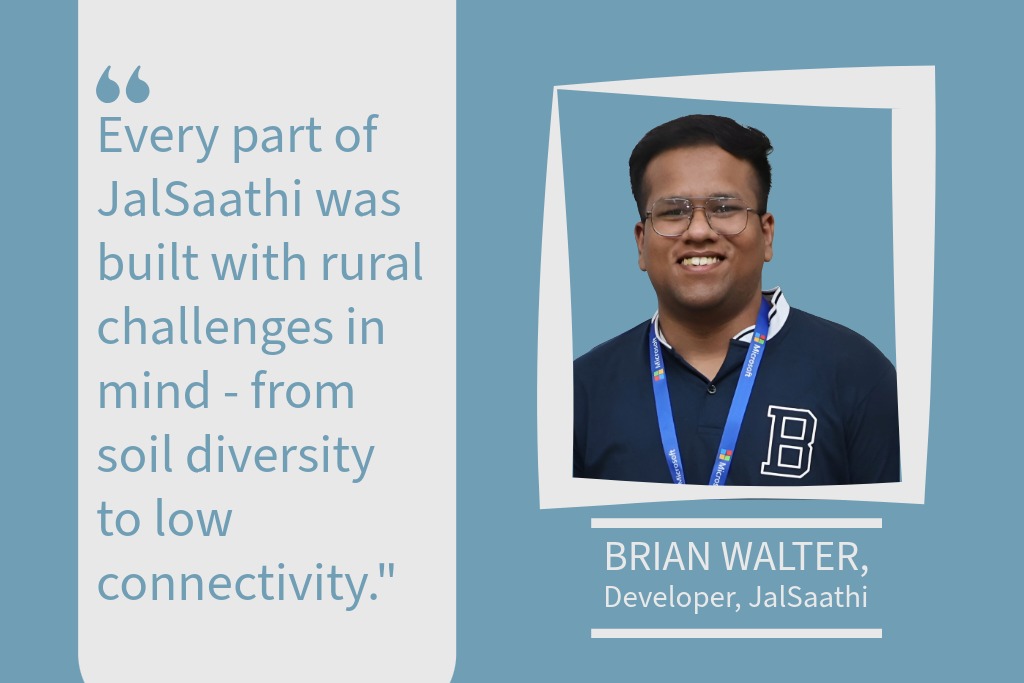
JalSaathi is a low cost, offline compatible irrigation solution developed to address the on ground challenges faced by smallholder farmers ranging from water mismanagement to unreliable connectivity. Designed with simplicity, affordability, and adaptability in mind, the system helps reduce water waste, cut labour dependence, and deliver real time functionality even in low infrastructure rural settings.
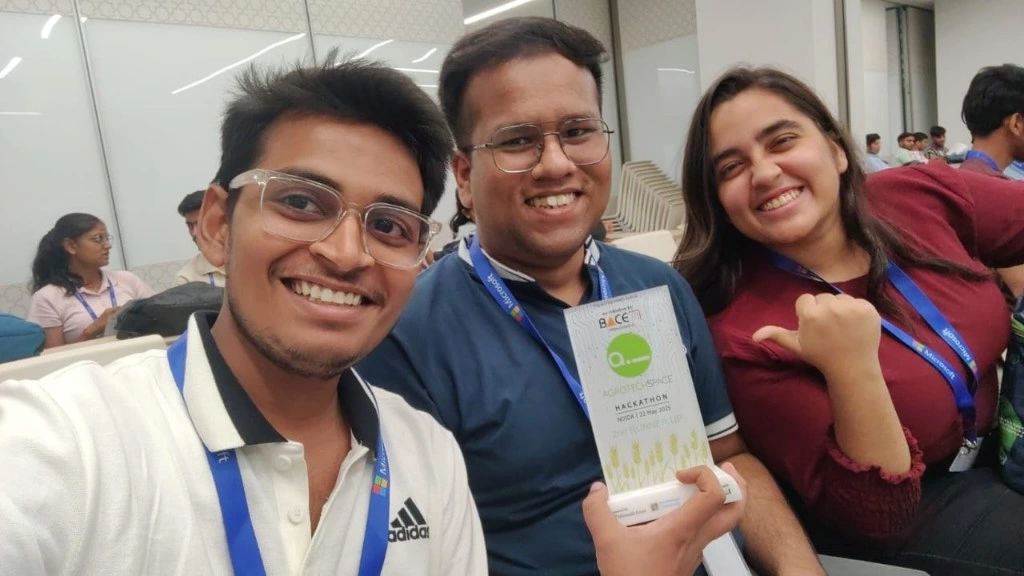
In a conversation with Agrotech Space, Brian Walter, currently in his third semester at GTBIT (IP University), reflects on the development journey, strategic decisions, and future roadmap for scaling impact. He co-developed JalSaathi alongside Aaron Rao and Ananya Arora, both of whom will soon begin their fifth semester at ABES Engineering College. The trio, former schoolmates, named their team Old School, and were recognised as second runners-up at the second edition of the Agrotech Space Hackathon. Following are edited excerpts from the interview:
Agrotech Space: What motivated your team to develop JalSaathi, and how did you arrive at the idea of addressing water inefficiencies in smallholder farming through smart irrigation?
Brian Walter: We were given the problem statement, “Renewable Energy Driven Smart Irrigation System for Water Efficiency” at the second edition of the Agrotech Space Hackathon. The first thought that came to my mind was, “If so much water is wasted at home despite conscious efforts, how much more must be wasted in agriculture, especially by small scale farmers?” We did some digging and discovered that only 35 to 50% of the water used actually reaches the crops, meaning around 50 to 65% of it is wasted.
Agrotech Space: How did your team approach designing a smart irrigation system that is both affordable and easy to adopt for small scale farmers who may not be familiar with digital technology?
Brian Walter: Most existing irrigation systems are either too costly or too complex, which makes small scale farmers hesitant to try them. They can’t really go for something they don’t fully understand, it’s hard to build trust in a system that feels unfamiliar. So they often go back to what’s always worked for them, like traditional flood irrigation, even if it’s inefficient. With JalSaathi, we focused on keeping things simple, functional, and affordable so that it feels approachable right from the start. No complicated setup, no dependence on constant internet, and all at an affordable price. The idea was to make something farmers could understand and feel confident using. Once they try it and see the results, trust builds naturally.
Agrotech Space: Could you walk us through how JalSaathi functions on a technical level, specifically how the hardware components and interface work together to automate irrigation in the field?
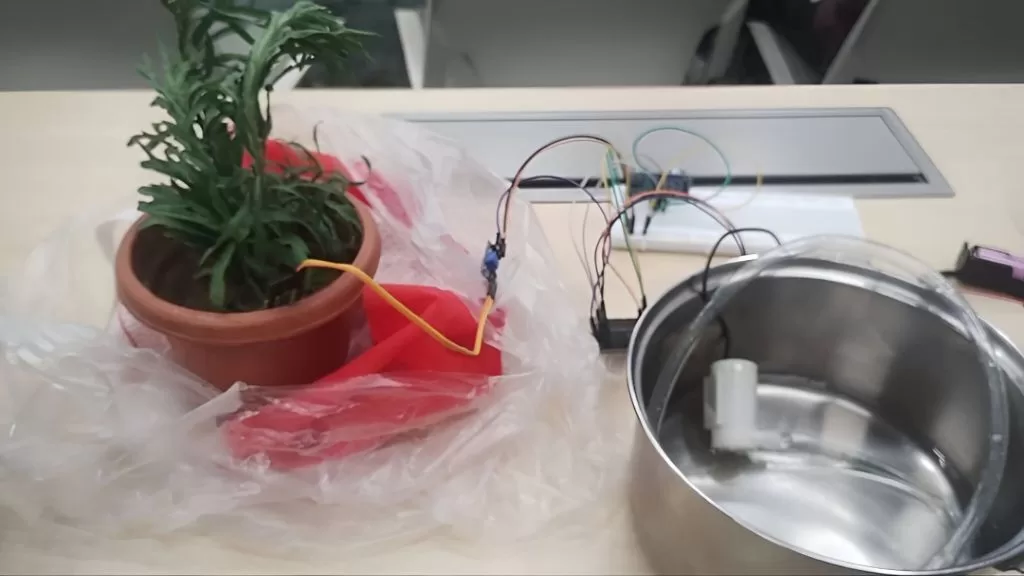
Brian Walter: Absolutely! At the core of JalSaathi is the Arduino ESP32 microcontroller, which acts as the central unit connecting all sensors and actuators. We’ve used a soil moisture sensor to detect the current moisture level in the soil. Based on this reading, the ESP32 decides whether to activate the water pump, which is controlled through a 5V relay module, essentially functioning as a switch. The relay is powered by a battery, allowing the system to operate even in field conditions (also making it solar ready).
To prevent water wastage, we included a fail-safe mechanism using an ultrasonic sensor that measures the water level in the storage tank. If the tank is empty, the system automatically disables the pump, even if the soil is dry, and the ESP32 sends an alert to the farmer to refill the tank.
For user interaction, the ESP32’s built-in Wi-Fi module hosts a local web interface that requires no internet. The dashboard is bilingual (Hindi and English), making it farmer friendly and easy to navigate.
Agrotech Space: What were some of the key challenges you faced while integrating real time hardware with a bilingual web dashboard, and how did you overcome them?
Brian Walter: Technically, the ESP32 made things smoother since it’s a powerful and fairly user friendly microcontroller. It allowed us to host the web dashboard locally using a mobile hotspot, which meant we didn’t need constant internet access, a huge plus for rural areas.
The real challenge wasn’t technical, it was putting ourselves in the mindset of the farmers. We kept asking, “How can this webpage actually be useful and usable for someone who may not be comfortable with digital tools?” That’s when the idea of making the dashboard bilingual (Hindi and English) really clicked.
And we’re not stopping there, the framework we’ve built can be easily extended to support other regional languages, which will make it even more accessible. We also realized that trust plays a big role. Farmers know their land better than any sensor. So, we added emergency stop and resume buttons on the dashboard, giving them full control when needed. The dashboard displays soil moisture, tank level, pump status, and provides manual control over the system, all in a clear, readable format.
Agrotech Space: Given the cost constraint of INR 900, how did you prioritize hardware and software components to ensure both effectiveness and scalability?
Brian Walter: There wasn’t a strict INR 900 cap placed on us, but from the beginning, we knew that if we’re building for farmers, it has to be truly affordable. So we made that our personal benchmark. We went into local markets, did our research, bargained where we had to, and somehow managed to build the whole prototype under INR 900.
Now, when you compare that with existing kits that often cost INR 20,000 or more, we had to ask ourselves, “What if JalSaathi was built as a full product?” After doing the math, we found that even with industrial grade components, a fully deployable JalSaathi kit could still come in under INR 5,000.
We’re not claiming to replace large scale systems just yet, but what this shows is, low cost, farmer first alternatives are absolutely possible. And when given the right support, they can have real impact where it’s needed the most.
Agrotech Space: How did you approach the decision to make JalSaathi function in both offline and online environments, and what role did this dual mode capability play in your broader design strategy?
Brian Walter: Our initial plan was to keep it completely offline, since that aligns better with many rural scenarios. But as we thought more about the direction India is heading, this vision of a “Smart India”, it felt right to include a web interface as an added layer of usability.
At its core, JalSaathi still works offline because all the irrigation logic is embedded into the ESP32 itself. The web interface just acts as a bonus, it lets users monitor everything in real time, in both Hindi and English. In areas without Wi-Fi, we also explored Bluetooth as a fallback to keep users updated.
Personally, I specialize more in hardware, but my teammates Aaron Rao and Ananya Arora brought their software expertise to the table and helped bring the web interface to life.
Agrotech Space: Did you engage with farmers or gather informal user insights during development, and how did those inputs influence JalSaathi’s design?
Brian Walter: While we didn’t formally conduct field interviews, the roots of our idea come from something very close to home. Our grandparents live in villages, and we’ve all grown up visiting them, eating vegetables straight from the farm, seeing how things are done firsthand.
We didn’t directly tell them about the project, but we did ask questions like, “If you had a system that could water your crops automatically, what would you want it to do?” Those casual conversations gave us insights we might have missed otherwise. They helped us understand what actually matters to farmers, simplicity, trust, and control. Those little chats became a big part of our brainstorming sessions and were honestly a major inspiration for how we shaped JalSaathi.
Agrotech Space: From a strategic standpoint, how do you envision scaling JalSaathi, whether through public sector channels, NGO partnerships, or market based models?
Brian Walter: We see multiple paths for scaling JalSaathi. On one hand, it can be developed into industrial grade kits for rural farmers. On the other, we could build a smaller, more compact version for urban users, say, for home gardens, possibly with a subscription model for maintenance and monitoring. I’m most excited about the idea of partnering with NGOs or integrating it into government led schemes.
JalSaathi is essentially a DIY kit, which makes it ideal for grassroots deployment.
Imagine if, for a year, we could install it on farms for free, and simultaneously train local village youth on how it works. Not only would this create awareness, but it would also introduce young people to the possibilities of IoT and digital tools whether it’s setting up Wi-Fi, building dashboards, or troubleshooting hardware.
In the long term, this could even lead to job creation: these trained youth could become JalSaathi support technicians within their own communities. It’s a sustainable, community-first approach, and one I’d love to see realized if JalSaathi gets the right kind of support.
Agrotech Space: How do you envision integrating predictive analytics or AI into JalSaathi, and what long term value could this unlock for irrigation efficiency and beyond?
Brian Walter: I think that’s the natural next step for JalSaathi. One of the great things about using the ESP32 is that it can handle lightweight machine learning operations through TinyML. With this, we can train the system based on the type of soil it’s deployed in. Over time, it could start recognizing patterns, like when the soil typically dries out, how long irrigation usually lasts, and even seasonal changes in moisture retention. This could be a game changer.
With properly trained models, JalSaathi wouldn’t have to rely solely on real time sensor input, which can degrade over time or require frequent maintenance. Instead, it could begin predicting irrigation needs proactively. That means smarter water use, reduced wear on components, and greater efficiency in the long run.
Also read: Old School’s JalSaathi Offers a Modular, Low Cost Approach to Smart Irrigation for Farmers
And it doesn’t have to stop at irrigation. With the right data inputs, we could eventually track soil health indicators over time. So integrating AI doesn’t just improve performance, it expands JalSaathi’s potential to become a more holistic tool for farmers.
Agrotech Space: Looking at regional diversity in agriculture, how adaptable is JalSaathi to different crops, climatic zones, or irrigation patterns?
Brian Walter: JalSaathi was built with flexibility as a core design principle. Since the soil moisture sensor provides variable readings depending on the soil type, we can calibrate the system by flashing crop or region specific moisture thresholds directly into the ESP32 microcontroller. So whether it’s sandy soil in Rajasthan or black cotton soil in Maharashtra, the system can be tuned to reflect local agronomic needs.
In farms where multiple crops are cultivated across different zones, we can deploy additional sensor nodes, each equipped with its own soil moisture sensor, distributed strategically across the field. These nodes then communicate with a central ESP32 hub, which processes the inputs and makes irrigation decisions tailored to the unique requirements of each section.
This modular configuration ensures that JalSaathi remains scalable and context aware, making it well suited for India’s diverse agricultural practices without disrupting the simplicity or reliability of the system.
Agrotech Space: Beyond technical innovation, what has JalSaathi taught you about designing for inclusion, resilience, and real world impact, particularly in rural settings?
Brian Walter: One of the most profound takeaways from working on JalSaathi has been the realization that meaningful innovation starts with empathy. At every stage of development, we asked ourselves, “Will this genuinely make a farmer’s life easier?” and “How can we make this solution even more intuitive or useful?” That mindset shaped everything, from the bilingual interface to manual override features.
Designing for rural India requires looking beyond just the hardware or code. It’s about building trust, ensuring accessibility, and creating solutions that are not only technically sound but also practically usable. JalSaathi showed us that even with limited resources, a user first approach can yield impactful, scalable outcomes. For us, this is not just a technical project, it’s a platform rooted in the belief that inclusive innovation, if supported and scaled responsibly, can make a tangible difference in the lives of real people. That belief continues to drive our efforts forward.
Agrotech Space: As a young innovator working at the intersection of technology and agriculture, what advice would you offer to peers trying to develop purpose driven solutions?
Brian Walter: The most important thing is to begin with the right mindset. If you’re solving a real world problem, the end user must be at the core of every decision. Continuously ask yourself, “Will this actually help someone?” Purpose driven innovation isn’t about demonstrating technical complexity, it’s about creating something functional and impactful.
Focus on getting the fundamentals right. Keep it simple, because simplicity is often more difficult to achieve than complexity. Once the core solution works, iterate. Refine it, test it, and keep improving. You’ll inevitably run into obstacles, and not everything will work as planned, and that’s part of the journey. The key is persistence. Keep pushing forward. If your purpose is rooted in real impact, and you stay committed to it, the results will come.