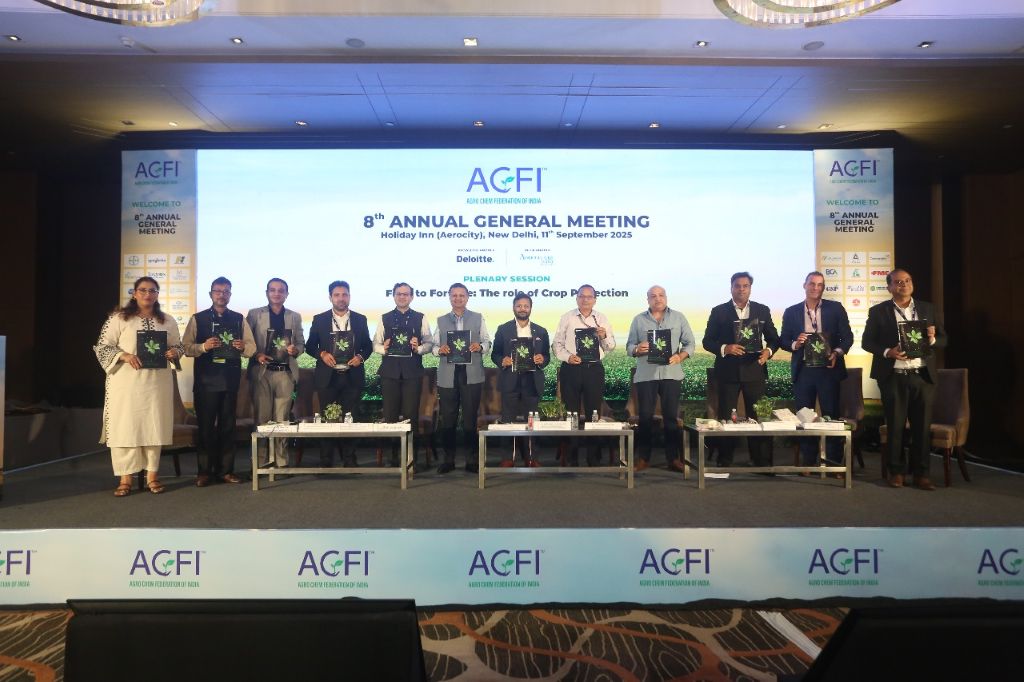
The Agro Chem Federation of India (ACFI) has called on the government to introduce targeted incentives, including a production linked incentive (PLI) scheme and tax holidays, to reduce India’s dependence on imported technical ingredients and foster the establishment of domestic manufacturing hubs. The demand was made at ACFI’s 8th Annual General Meeting in New Delhi, where a knowledge paper developed with Deloitte was released, outlining the current state of the agrochemical sector and strategies to build resilience in the supply chain.
Export Growth and Import Reliance
The knowledge paper, titled “Ensuring the availability of quality agrochemical products to farmers in India and globally,” highlighted that India’s agrochemical exports have surged from US$ 1.3 billion in 2014-15 to US$ 3.3 billion in 2024-25, making the country the third largest exporter after China and the United States. Agrochemicals from India are shipped to more than 140 countries, with the US, Brazil and Japan among the leading markets.
Despite these achievements, the sector continues to import a large share of critical technical grade inputs. Imports rose 54 percent over five years, climbing from INR 9,267 crore in FY2018-19 to INR 14,315 crore in FY2022-23. China remains the largest supplier, contributing nearly half of India’s technical imports. Industry participants cautioned that this dependence exposes India to serious risks of supply disruptions, price spikes and shortages caused by geopolitical tensions or production halts in Chinese factories.
Concerns from Industry Stakeholders
Speaking at the AGM, Parikshit Mundhra, Managing Director of Willowood, emphasised that heavy reliance on China could create strategic vulnerabilities for India’s agrochemical industry. The report noted that certain high value molecules are not manufactured domestically in sufficient quantities because of high production costs, environmental constraints and lack of technology. These gaps, it argued, can only be addressed through greater investment and policy support for domestic production.
Recommendations for Policy Support
The ACFI-Deloitte paper called for the introduction of a PLI scheme targeted at critical active ingredients and intermediates. It also suggested that tax holidays and fiscal incentives could attract larger investments in manufacturing. Another key recommendation was the creation of agrochemical manufacturing parks, equipped with common facilities such as effluent treatment plants and advanced laboratories, to lower costs and improve competitiveness.
The report further recommended increased public-private collaboration in research and development, particularly to promote innovation in new agrochemical molecules. It highlighted the importance of strengthening micro, small and medium enterprises (MSMEs), which are vital to the industry’s ecosystem, through capacity building programmes, financial access and technical training.
Industry Perspectives on Growth
Industry leaders supported these recommendations during the AGM. Burjis Godrej, Managing Director of Godrej Agrovet, called for setting up agrochemical parks across regions and encouraged collaborative R&D to accelerate the discovery of new molecules. Simon Wiebusch, Chairman and Managing Director of Bayer CropScience, observed that relaxed regulatory requirements for exports and incentives under Make in India were already encouraging multinationals to transfer technology to Indian players. This, he added, is turning India into an attractive destination for global manufacturing.
Also read: From SEMICON to Soil: Agrotech Honchos Decode India’s Chip Dreams
Newly elected ACFI Chairman Rahul Dhanuka stressed that improving the ease of doing business would not only enhance agricultural productivity but also help achieve the national goal of doubling farmers’ income.
Focus on Sustainability and Farmer Health
Agriculture Commissioner and Registration Committee Chairman Dr Praveen Kumar Singh drew attention to the need for an “output–outcome” approach in evaluating new agrochemical products, focusing on measurable field results. He emphasised the dual responsibility of protecting both crop health and farmer well being. Stressing the importance of sustainability, he pointed to the necessity of developing climate and insect resistant seed varieties and advancing integrated pest management practices that reduce environmental harm while ensuring productivity.
Road Ahead for the Sector
The ACFI-Deloitte paper concluded that while India has established itself as a net exporter of agrochemicals, its reliance on imports remains a critical vulnerability. Drawing parallels with China’s journey to self sufficiency, India’s fertiliser reforms and the pharmaceutical sector’s PLI driven success, the report argued that agrochemicals require a similar policy framework to expand domestic capacity and reduce external risks.
Scaling up manufacturing, encouraging backward integration, investing in research and streamlining regulatory processes, the report observed, will be key to making India self-reliant and globally competitive. By addressing these challenges, India can ensure farmers have reliable access to quality crop protection products while strengthening its position in the global food supply chain.