
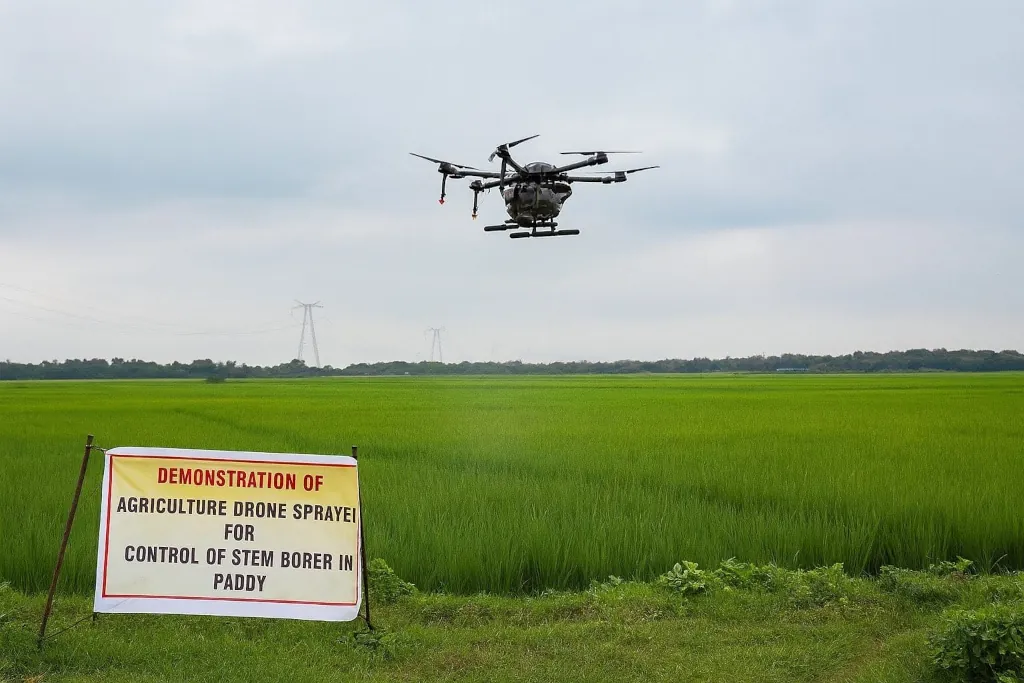
The Odisha Department of Agriculture and Farmers’ Empowerment is testing drone technology to make pesticide spraying faster and safer for farmers. As part of the initiative, Krishi Vigyan Kendra conducted a field demonstration in Sajjanpada village of Nayagarh district, covering six hectares of paddy farmland.
During the trial, drones sprayed pesticides over standing crops to show how the technology can cut chemical overuse, limit farmers’ exposure to hazardous substances, and enable timely, environment-friendly pest control. Officials said the success of such demonstrations could pave the way for wider adoption of drones across Odisha.
Optimizing Drone Spraying for Precision Agriculture
Drone spraying provides precise spraying that can be completed in a fraction of the time compared to traditional methods. These initiatives can potentially maximise benefits for small and marginal farmers who often struggle with labour shortages and rising input costs. The department has noted that success of the Nayagarh demonstration could pave the way for scaling up drone usage across other districts in Odisha. Plans are also underway to train local farmers and agricultural workers to operate drones.
Pest control is a major issue for farmers, affecting crop yields and increasing the need for efficient and sustainable solutions. It is necessary to manage pests at the right time to obtain a suitable yield. To address this challenge, pesticides are being sprayed using drones, applying modern technology to improve efficiency and precision. The agriculture department emphasised its commitment to empowering farmers by leveraging such technological solutions across the agricultural sector. The demonstration signifies a major step towards integrating advanced technologies in farming, aiming to improve productivity and sustainability in the region.
Also read: Assam Gets $56.8M Bioethanol Plant
Drones offer a range of benefits, including water management, plant health analysis, soil health assessment, and field mapping. They help increase production, prevent environmental degradation, and enable enhanced crop monitoring. Currently, the primary use of drones in Odisha is limited to pesticide spraying, though their application could be expanded to broader precision agriculture practices.
The use of drones can also help reduce dependency on manual labour. It is crucial for small and marginal farmers, who often face labour shortages, to be able to operate drones on their farmlands without much investment in human resources. Farmers engaged in large-scale operations can also use drones for spraying pesticides, reducing operational costs of farming and improving efficiency across farmland.
Drone spraying helps reduce the excessive use of chemicals, as the advanced GPS sensors target only the infested crops. By applying pesticides in the right amounts without wastage, farmers can optimise pesticide costs by 30 to 40%.
Drone Spraying Gaining Momentum in Odisha
Last year, Krishi Vigyan Kendra conducted similar demonstrations in Jagatsinghpur region of Odisha, where farmers were trained to use drones for spraying Bispyribac Sodium, a widely used post-emergence, broad-spectrum herbicide on their land to control the growth of grassy and broadleaf weeds. The trials were held at Tirtol centre, where around 50 farmers participated in the training.
During the demonstration farmers made inquiries regarding the use of drones, including cost, weather support, operational complexity, regulatory compliance, impact on crops, data interpretation, and privacy. Experts emphasised that drone technology is an effective measure offering a range of benefits, such as improved efficiency, higher output, and reduced costs.
Earlier this year, Subhen Kumar Panigrahy of Bada Borsingi was honoured by Governor Hari Babu Kambhampati after becoming the first farmer in Ganjam district to adopt drone technology. After completing two-month drone training in Bengaluru and Haryana, he obtained a license from the Union Ministry of Civil Aviation to operate a medium-sized drone with a 15 kg capacity. Subhen used the drone to spray liquid fertilisers on his crops, replacing manual spraying of urea and other fertilisers.
With more farmers across Odisha gaining training and adopting drone technology, the state is steadily moving toward the wider use of drone spraying and precision practices in agriculture.

