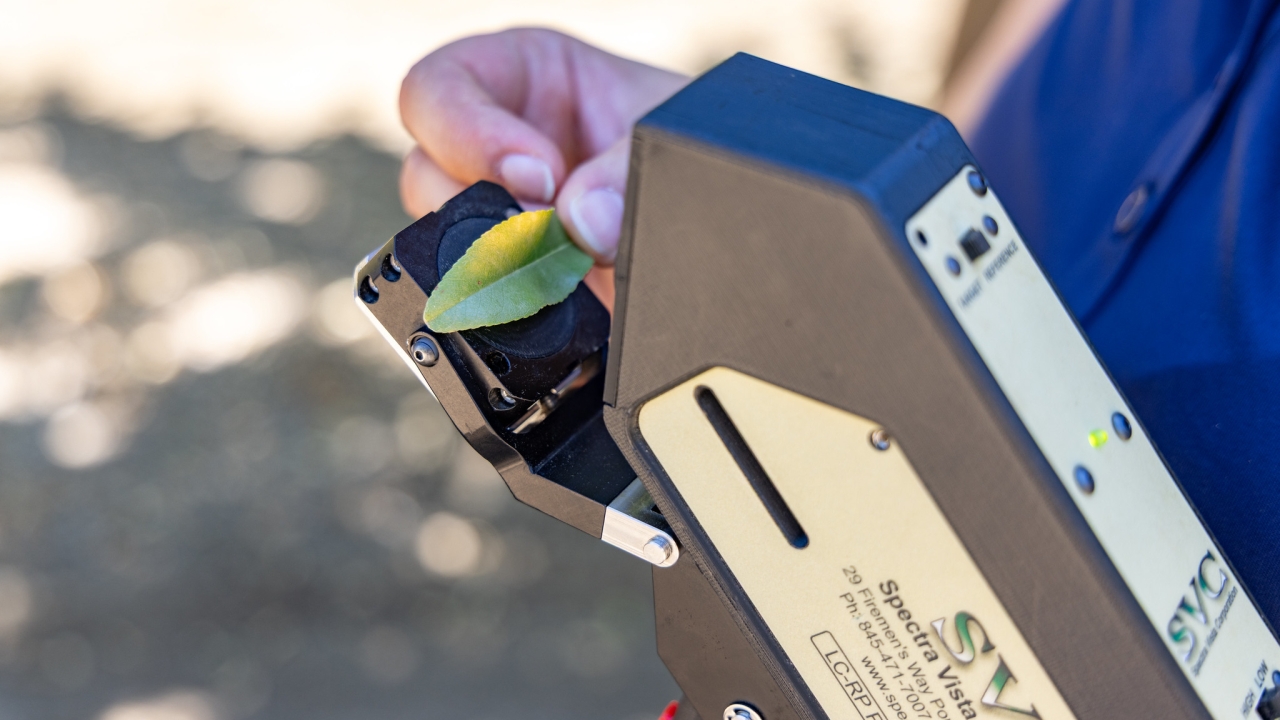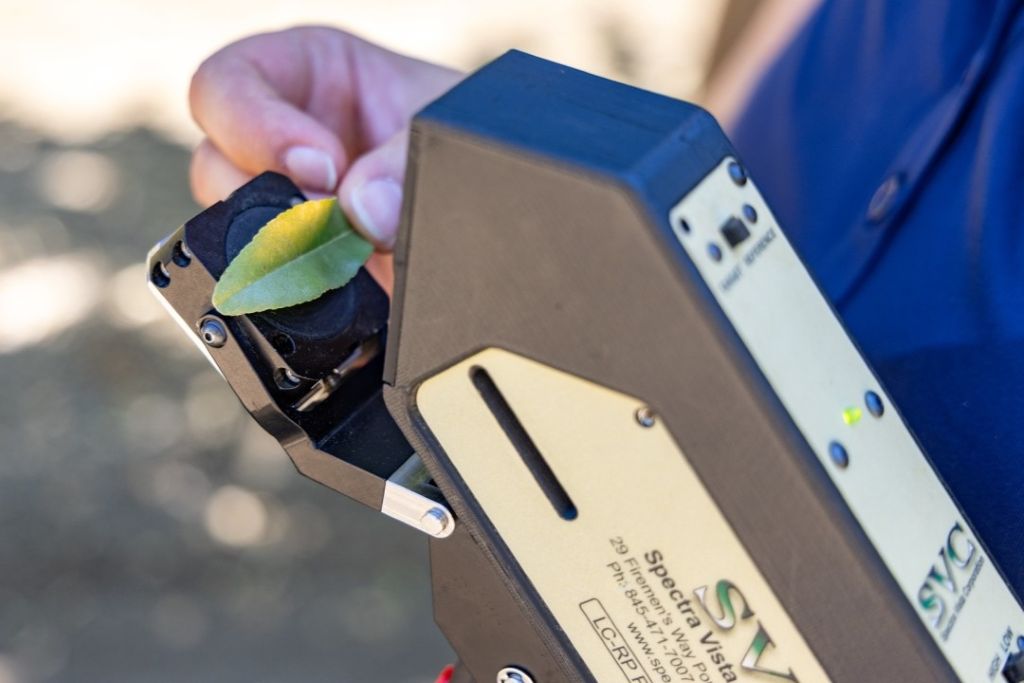
Researchers at the University of California, Davis, have developed Leaf Monitor, a mobile tool paired with a handheld spectrometer that uses artificial intelligence and predictive modeling to deliver real time crop health information. The app provides data on leaf nutrition and structural traits in just five seconds, enabling rapid assessment in the field.
The AI model was developed with funding from the US Department of Agriculture’s National Institute of Food and Agriculture’s HiRes Vineyard Nutrition multistate project, its Animal and Plant Health Inspection Service, and the California Table Grape Commission.
The California Table Grape Commission supported the development with the aim of enabling faster fertilizer related decision making. Proper fertilizer use results in vines that produce grapes with optimal size, weight and color. Evaluation of vine nutrient status has been a top priority, and exploring new digital tools is also considered central to the future of the industry.
How the Tool Works
Leaf Monitor measures leaf reflectance across a broad spectrum, covering wavelengths between 400 and 2500 nanometers, beyond the visible range of 400 to 700 nanometers detectable by the human eye. Each part of this spectrum is sensitive to different plant attributes.
When a leaf is scanned, the spectral data is uploaded to a cloud based machine learning system that predicts nutrient content and structural traits. The algorithm was trained over five years using thousands of chemically analyzed leaf samples from California’s specialty crops, particularly grapevines and almonds. This dataset established a reliable foundation for predictive modeling.
Early Detection of Deficiencies
The Leaf Monitor provides early detection of nutrient deficiencies that usually remain unnoticed until late in the season, when damage can no longer be reversed. Spectrometry allows rapid and reliable identification of deficiencies before visible symptoms appear.
“Nutrient deficiencies in plants often go unnoticed until late in the season, by which point the damage is already irreversible. This is why early detection is essential. Spectrometry provides a rapid and reliable way to identify these deficiencies before visible symptoms appear.”
In demonstrations, the Leaf Monitor tool has provided results on 10 nutrient indicators such as nitrogen, potassium and phosphorus, as well as six biochemical and structural traits including chlorophyll, water content, and leaf density.
Reducing Time and Cost
Traditional nutrient testing involves collecting leaf samples, drying, grinding, and shipping them to a lab, with results taking up to two weeks. Farms usually conduct such testing only a few times a year due to cost constraints. Leaf Monitor provides results instantly in the field, reducing reliance on laboratory processes and allowing more frequent checks.
“Having this information is very valuable for the farmers. Right now, in five seconds, they can have a sense of how much nutrition they have in a leaf. We incorporated a wide range of diversity so the model can see many different scenarios that could happen in California for these crops. We need to produce more food while using less resources, so it’s essential to have a monitoring system that provides precise and accurate feedback on our management practices.”
Precision Fertilizer Management
The Leaf Monitor tool enables farmers to tailor crop management decisions to specific areas of a field rather than treating entire fields uniformly. Fertilizer use can be aligned with real time conditions, reducing the likelihood of overuse and preventing nitrogen runoff, a concern both economically and environmentally.
Also read: Project InnerSpace Launches GeoFund with First Cold Storage Initiative in Himachal Pradesh
The Leaf Monitor tool can also aggregate scan data to map spatial patterns across larger areas, capturing field variability that is not visible to the human eye.
Accuracy and Availability
The prototype Leaf Monitor is available free of charge as part of a suite of tools on the Digital Agriculture Laboratory website. A web based version will follow, with continued improvements as more data is incorporated into the algorithm.
The system currently achieves an average accuracy rate of about 65% across traits, with stronger performance for key nutrients such as nitrogen and phosphorus. Users are required to pair the app with a spectrometer to operate it effectively.
The project emphasizes the need for food production systems that can deliver higher yields while using fewer resources, supported by monitoring systems that provide precise and accurate feedback for agricultural management.