
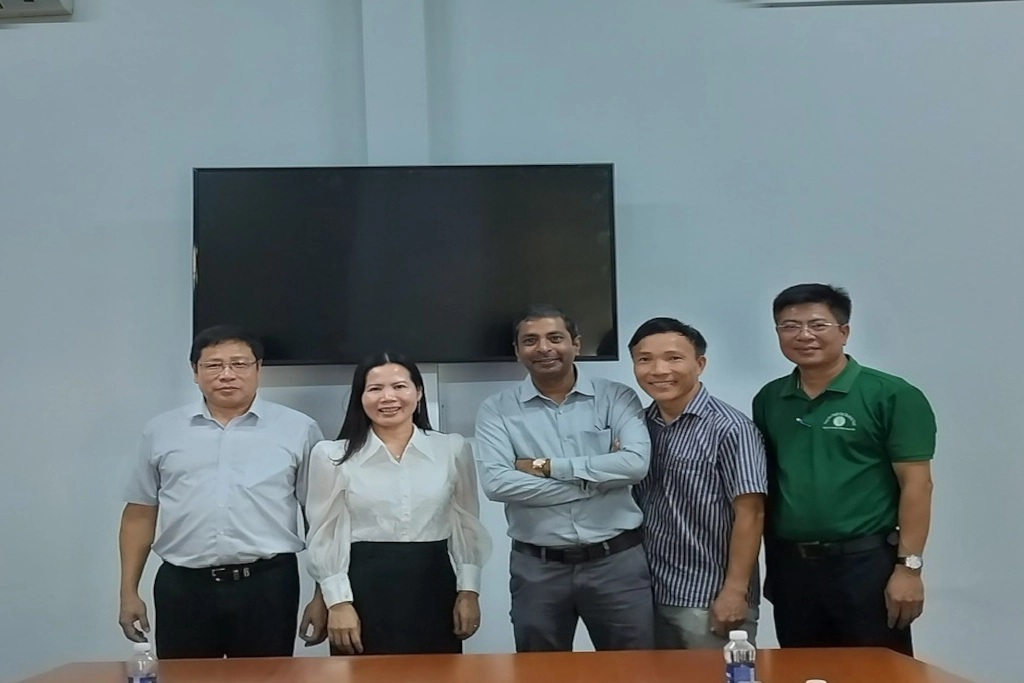
String Bio, a biotechnology firm developing low-carbon agricultural solutions, has completed its first field trials in Vietnam in partnership with the Cuu Long Delta Rice Research Institute (CLRRI), a public research institution based in the Mekong Delta. The trial focused on CleanRise, String Bio’s patented microbial biostimulant, which is designed to improve nutrient-use efficiency and support plant responses that increase productive tillering and reduce grain sterility.
String Bio has stated that data from the study indicates improvements in grain yield, nitrogen-use efficiency and greenhouse-gas reduction, marking an early milestone as CleanRise begins to be evaluated outside India in other major rice-growing regions.
According to the company, earlier trials in India showed that CleanRise can lower methane and nitrous oxide emissions by up to 50 % and can be used across a range of rice-growing systems, including Alternate Wetting and Drying (AWD), Transplanted Rice (TPR), Direct-Seeded Rice (DSR) and Single Drainage.
The validation data from CLRRI extends the consistent performance, scaling and benefits of
CleanRise witnessed with rice farmers across India. To have studies completed with Dr.Cuong’s
lab at CLRRI in the Mekong delta provides a high level of confidence for us to bring CleanRise,
a first-of-a-kind solution, to the rice farmers of Vietnam.
For the Summer-Autumn 2025 season, the CLRRI team applied CleanRise in paddy fields under four treatment conditions using two nitrogen levels, 100 % and 75 % of the standard dose, each tested with and without CleanRise.
According to the company, the trial results indicated a 12% increase in grain yield compared with farmers’ standard practices. CleanRise used with a 25% reduction in nitrogen fertilizer delivered yields similar to full nitrogen application, suggesting improved nitrogen-use efficiency. The field measurements also recorded a 30 to 40% decrease in greenhouse gas emissions, along with better grain quality, including reduced sterility and improved grain fullness.
Dr Tran Ngoc Thach, Director General of CLRRI, noted that additional multi-season and multi-location trials would be useful to further validate and strengthen the evidence base for the product’s performance.
Expanding Research Efforts in Vietnam
String Bio is expanding its research collaborations to further evaluate and deploy CleanRise in Vietnam, with the aim of contributing to national climate-resilience objectives and supporting improvements in smallholder farming systems.
String Bio is focused on developing sustainable solutions that can be applied across sectors such as food and nutrition, agriculture, animal nutrition and carbon management. The company reports that its manufacturing platform is designed to produce materials and inputs aimed at balancing performance considerations with cost and environmental impact. It also notes that it collaborates with investors and research partners to advance technologies intended for use at larger scales.
Also read: Centuria Acquires 43-ha Perfection Fresh Glasshouse Facility
Dr Thach and Dr Cuong of CLRRI said CleanRise is compatible with current cultivation practices and supports Vietnam’s national ‘One Million Hectare Low-Carbon Rice Program.’ They noted that its ease of application and lack of infrastructure requirements make it a practical option for wider adoption across varied rice-growing regions in Vietnam.
The Cuu Long Delta Rice Research Institute (CLRRI), part of the Vietnam Academy of Agricultural Sciences, is a centre for rice research in the Mekong Delta. Based in Can Tho, the institute conducts work on varietal improvement, crop management practices and climate adaptation across the region’s rice systems. Its programmes include collaborations with domestic and international partners aimed at improving productivity and resilience in rice production.
Evaluating CleanRise’s Low-Carbon Potential
String Bio’s field trial with CLRRI could mark a notable moment in the growing intersection of biotechnology and low-carbon rice production. The results suggest that CleanRise could offer measurable benefits for yield, nitrogen efficiency and emissions reduction.
While the findings from this single-season trial are promising, CLRRI’s call for multi-season, multi-location testing highlights the need for broader validation before large scale adoption. The study also reflects a wider shift in Asian rice systems toward microbial and biological inputs as countries seek alternatives that balance productivity with environmental pressures.
As String Bio expands partnerships, the key question will be how consistently these outcomes can be replicated across diverse farming conditions.

