
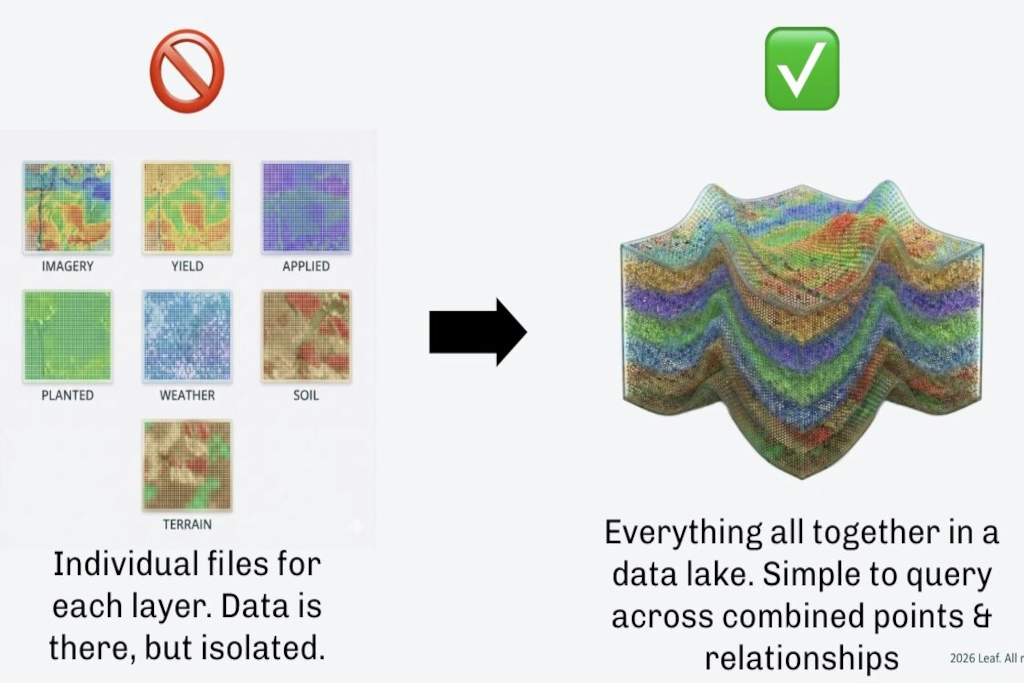
US-based agritech firm Leaf Agriculture, which develops data and API infrastructure for the food and agriculture sector, has announced the launch of LeafLake, a platform aimed at enabling advanced analysis of agronomic and environmental information. An application programming interface (API) allows different software systems to communicate and exchange data. LeafLake is designed to support analysis across planting, application, harvest, and environmental datasets.
The company said the platform will give users access to a wide range of farm and environmental data, including weather, soil, terrain, and imagery, through a unified, custom-built data lake. Such architectures are typically used to centrally store and manage large volumes of diverse and rapidly generated data in agriculture.
LeafLake enables Leaf customers to run sophisticated analysis across planted, applied, and harvested operations, combined with environmental layers such as weather, soil, terrain, and imagery. Using straightforward SQL, teams can answer questions like which seed variety produced the best yields in a field (or across a region), which conditions improved biological product performance, and how to generate management zones from yield and environmental signals—in seconds.
The platform is designed to reduce data infrastructure complexity and improve time to insight, allowing users to run Structured Query Language (SQL)-based analysis across multiple fields and regions in seconds. This enables users to manage, manipulate, and extract actionable insights from large, structured datasets supporting analytics, machine learning, and business intelligence use cases.
Unified Data and Analytics
According to Leaf Agriculture, the platform includes built-in query and analytics tools that allow users to access and analyse data directly, without relying on external software or complex integrations. Infrastructure management, including scaling, maintenance, and security, is handled centrally, reducing the need for dedicated IT resources and manual capacity planning. The system automatically adjusts computing and storage capacity based on demand and operates on a usage-based model.
Also read: What Finance Minister Nirmala Sitharaman’s Budget Signals for Agritech
It also incorporates access controls and compliance measures aligned with regulatory requirements such as GDPR and CCPA. By combining structured farm records with environmental data such as soil, weather, and satellite information, the platform aims to support faster analysis and help users examine how management decisions and environmental conditions relate to outcomes in the field.
LeafLake allows you to get immediate answers to questions like “which variety had the highest yield last year, after controlling for soil type and fertilizer applications?” or “in which environmental conditions did this biological product perform best?”. These work at the field level, and across millions of fields all with the same simple queries.
The platform is designed to address the ‘data gravity’ challenge commonly faced in agriculture, where analytics are constrained by fragmented systems and complex infrastructure requirements. By administering storage, performance, security, and scaling within a unified platform, LeafLake aims to shift the focus from data engineering to agronomic and business applications. The product is aimed at providing customers with direct access to their data without the need for reliance on external tools or complex integrations, facilitating faster analysis and reduced operational overhead.
Evolving Farm Data Architecture
According to Leaf Agriculture, LeafLake is already being used by businesses across the food and agriculture sector to run real-time analytics, train machine learning models, and generate business intelligence reports, bypassing the structural constraints of traditional agronomic data infrastructure. With the launch of LeafLake, the organisation aims to simplify agronomic data management while accelerating the transition from raw data to actionable insights across agricultural supply chains.
Leaf’s launch of LeafLake could reflect a broader shift in how agricultural data is being organized and accessed across the industry. Farm and environmental data has often been spread across multiple systems, making large-scale analysis slow, costly, and dependent on technical integration work. By placing data storage and analysis within a single environment, LeafLake could signal an effort to treat data access as a foundational capability rather than an added layer.
This approach may suggest that future adoption will be influenced less by standalone digital tools and more by scalable data infrastructure that can adapt to rising data volumes, compliance demands, and collaboration across organizations. As agricultural businesses increasingly need to connect field-level information with enterprise decision-making, platforms of this kind could shape how data is governed, shared, and applied across agricultural value chains.


