
India showcased its Artificial Intelligence (AI) based rice sorting system at the Bharat International Rice Conference (BIRC) 2025, marking a crucial advancement in its effort to modernize agricultural processing and strengthen its global rice export capabilities. Held at Bharat Mandapam, New Delhi, BIRC 2025 underscored the country’s strategic focus on technology driven efficiency, quality enhancement, and sustainability within the rice value chain.
The two day event, organised with the institutional support of the Department of Commerce under the Ministry of Commerce and Industry, Government of India, and led by the Indian Rice Exporters Federation (IREF), brought together delegates from more than 80 nations, including top global rice importers, exporters, scientists, and policymakers.
AI Based Rice Sorting System Launched
The BIRC 2025 featured the live launch of Artificial Intelligence (AI) based rice sorting system, marking an important step in advancing the nation’s agri processing infrastructure. The AI powered system, equipped with Big Data capabilities, simultaneously analyses the colour, size, shape, and structure of rice grains, offering higher precision while reducing costs, power usage, and manpower requirements. It allows for the integration of sorting and grading within a single space, replacing multiple machines and streamlining operations.
The AI system applies advanced image recognition and machine learning algorithms to evaluate rice quality in real time, ensuring uniformity and accuracy. By identifying imperfections and categorising grains effectively, the system enhances both quality and consistency across production lines. The consolidated design also reduces operational expenses, enhances throughput, and ensures improved alignment between production and export requirements.
Export Growth and Global Market Expansion
The adoption of AI in rice sorting is a central part of India’s broader plan to modernize agriculture and strengthen its role in global food exports. India, the world’s second-largest rice producer after China, recorded an estimated output of over 177 million metric tons in 2022, as reported by the Food and Agriculture Organization (FAO). The government aims to raise its export figures, targeting high-value markets in regions such as the European Union, the USA, Latin America, and the UK, in addition to its established presence in the Gulf and African markets.
Alignment of Technology with Sustainability
The AI based system contributes not only to operational efficiency but also to sustainability goals. By minimizing grain loss, optimizing energy use, and reducing reliance on manual labour, it supports environmentally responsible production practices. The integration of such technology reflects India’s commitment to sustainable agricultural modernization, particularly as global food supply challenges intensify.
The system’s adoption is expected to help farmers and exporters improve quality compliance and reduce rejection rates in international shipments. It further ensures that agricultural outputs correspond more closely with global demand, aligning production with quality expectations and enabling producers to secure higher realizations.
Institutional Collab and Tech Advancement at BIRC 2025
The BIRC 2025 provided a platform for showcasing technological progress across the rice value chain, supported by national institutions such as the Indian Council of Agricultural Research (ICAR) under the Ministry of Agriculture. ICAR is developing new drought-resistant and low-pesticide rice varieties designed to enhance yield, improve resilience, and support sustainability objectives.
The government’s broader strategy includes promoting the participation of Farmer Producer Organisations (FPOs) and exporters within the value chain to ensure equitable benefit distribution. Emphasis was placed on awareness regarding quality standards and export-oriented practices, ensuring that production aligns with global requirements.
Showcasing Diversity and Innovation
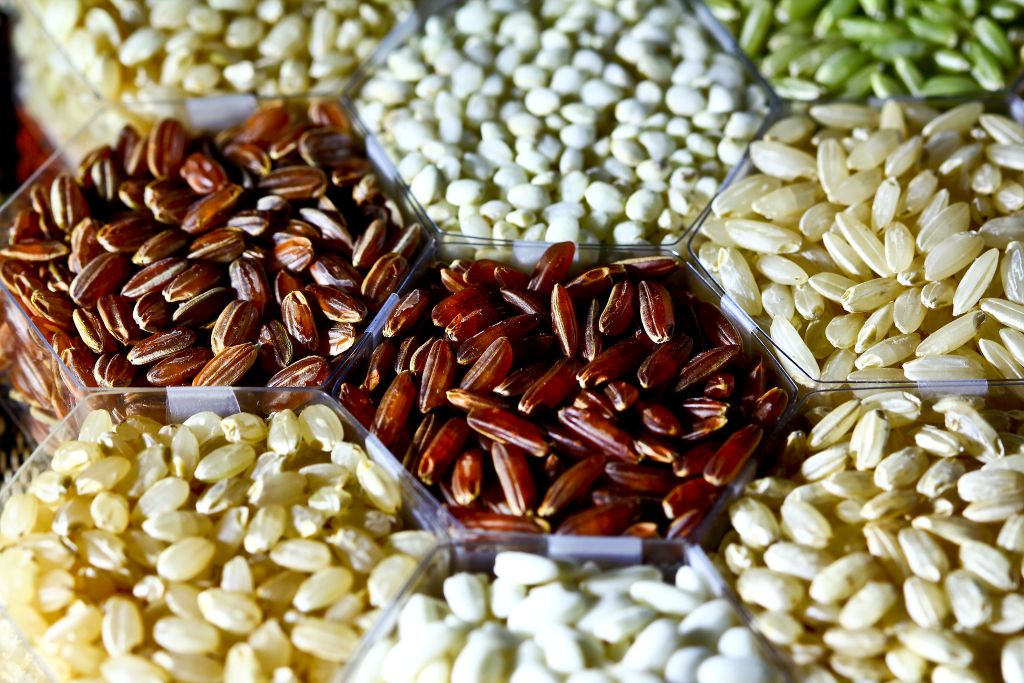
BIRC 2025 brought together participation from all Indian States and Union Territories, each displaying unique rice varieties and heritage grains that reflect the country’s agricultural diversity. More than 17 Geographical Indication (GI) rice varieties were showcased, representing origins such as Odisha, Chhattisgarh, Uttarakhand, and Manipur. These varieties embody distinct regional identities and production characteristics that contribute to India’s global agricultural reputation.
Also read: SBI Foundation and ICRISAT Launch SMART-CROP to Drive Data Led Farming Solutions
A dedicated pavilion for women entrepreneurs, startups, and MSMEs at the BIRC 2025 highlighted innovation across the agri-value chain, including advancements in seed development, post-harvest processing, digital trade, and blockchain-based traceability. Live demonstrations and mentorship initiatives were conducted to facilitate business onboarding, capacity building, and export readiness.
Bridging the Technology Gap
Despite the promise of AI integration, accessibility remains a challenge for smallholder farmers, who constitute about 80% of India’s agricultural population. Many of these farmers operate on less than two hectares of land and often lack capital for advanced technologies. Bridging this divide will require coordinated investment in training, infrastructure, and financing mechanisms to ensure inclusive adoption.
Government agencies and industry bodies are working to make such technologies accessible at scale, emphasizing training and resource-sharing frameworks to enable participation across various levels of the agricultural economy. This approach seeks to make digital and automation tools integral to India’s agricultural value chain without excluding smaller producers.
Toward a Technology-Driven Agricultural Ecosystem
BIRC 2025 projected a clear direction for India’s rice sector: modernization through integrated technology, sustainability-driven growth, and global export diversification. The conference reaffirmed India’s objective to strengthen its agricultural infrastructure, enhance competitiveness in the international market, and ensure equitable benefit distribution across stakeholders.
With AI based sorting systems now entering the operational landscape, the rice industry is poised for greater efficiency and global relevance. The initiative demonstrates India’s intention to position itself as a consistent and trusted source in the international rice trade, reinforcing a future-oriented agricultural ecosystem driven by innovation, quality, and sustainability.


